
Key takeaways: In 2025, Paraguay offers a strategic opportunity in real estate thanks to its growth (4.4%), low debt (35% of GDP), and investment-grade rating. An accessible market with net returns (6-10%), an advantageous tax regime (exemption from foreign income tax), and key areas such as Asunción and Ciudad del Este.
Are you hesitant to invest in real estate in Paraguay, perceived as an unpredictable emerging market? Think again: in 2025, the country will obtain an "Investment Grade" rating (Moody's), combining sustained growth (4.4%) and moderate debt (35% of GDP).
This guide reveals the keys to successful investment: areas such as Asunción and Ciudad del Este offer attractive returns, while a favorable tax regime (0% tax on foreign income) and simplified procedures for foreigners turn this opportunity into a winning strategy.
Anticipate appreciation through strategic projects such as the Bioceanic Corridor, a driver of future real estate value.
Paraguay is establishing itself in 2025 as a strategic opportunity, reinforced by Moody's "Investment Grade" rating in 2024, aligning its credibility with that of Uruguay, Chile, and Peru. With public debt at 35% of GDP and projected growth of 4.4%, the country combines economic stability with an attractive legal framework for foreigners. Its model is based on a dynamic agro-industrial sector, electricity exports via the Itaipu and Yacyretá dams (25% of total exports), and growing urban development, particularly in Asunción, the region's second-largest real estate hub.
In 2025, local rates remain high (8.50% for 10-year bonds in guaraníes), favoring foreign investors. In Asunción, average prices range from $1,200 to $1,500 per square meter in the city center, with potential for appreciation linked to projects such as the Bio-Oceanic Corridor (connecting the Atlantic and Pacific oceans) and the expansion of Paraguay-Paraná river traffic. Strategic areas such as Ciudad del Este and San Bernardino are attractive for their mix of commercial and tourist opportunities, with rental yields of up to 10-15%. The country combines low taxation (10% income tax) and unrestricted capital repatriation, offering a concrete opportunity for sustainable returns.
This guide clarifies the key elements for investing in 2025: monetary stability, transparent regulations, and market trends. Recent reforms (merger of ministries, 2013 PPP law) show an openness to foreign capital, stimulating infrastructure projects. For informed investors, 2025 marks a turning point, laying the foundations for sustainable growth that goes beyond risky speculation. International flows, attracted by stability and tax incentives, confirm this shift towards a mature and promising real estate market.
Paraguay has demonstrated solid economic growth, averaging 4% per year over two decades. In 2025, this momentum is expected to strengthen with a projected growth rate of 4.4%, driven by the service, manufacturing, and livestock sectors. Low public debt, estimated at 35% of GDP, contrasts with regional trends, consolidating the country's credibility.
Far from being a passing trend, Paraguay offers economic and monetary stability that is rare in Latin America, creating an environment of confidence for long-term investors.
International recognition is part of this trajectory. In 2025, Moody's assigned the country an "Investment Grade" rating, placing it on the same level as Uruguay and Chile. This reputation attracts foreign capital, strengthening confidence in the real estate market.
The Paraguayan tax system is based on a territorial approach: only locally generated income is taxable. Thus, foreign-source income is completely exempt. This rule benefits non-resident investors, who can repatriate their capital without restrictions.
Foreigners have the same property rights as local citizens. There is no requirement to set up a local company or partner with a resident in order to purchase property. Furthermore, although residency is not mandatory, it offers significant tax advantages. Learn more about Paraguay's attractive tax residency.
Local financing remains expensive, which is an advantage for foreign investors with their own capital. Real estate prices, which are still affordable, offer potential future appreciation linked to infrastructure projects such as the Bioceanic Corridor. This dynamic encourages acquisitions in anticipation of rising values.
In practice, the acquisition process takes 30 to 60 days, with simplified formalities. Non-residents must provide a valid passport, a RUC (tax number), and proof of solvency. However, consulting a local lawyer remains crucial to secure the transaction.
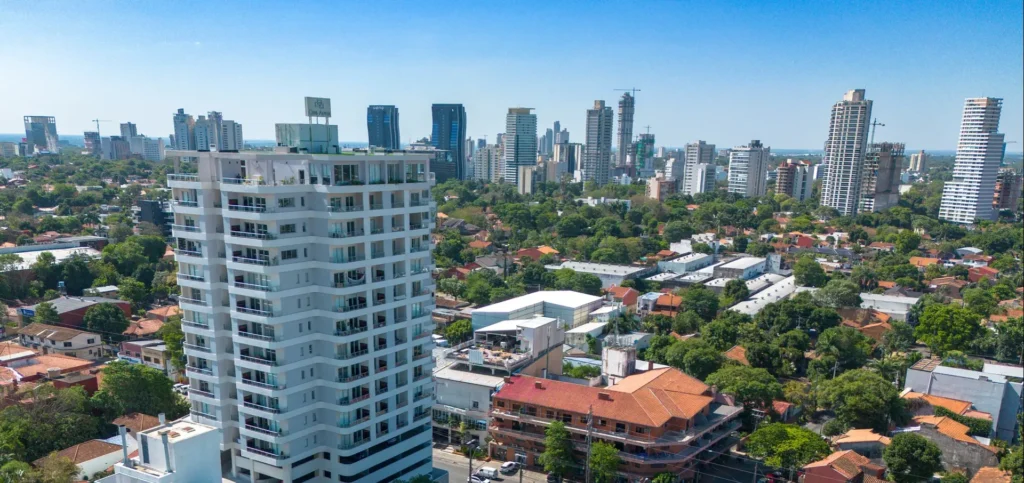
Asunción is the most attractive hub for residential and commercial real estate. The neighborhoods of Villa Morra, Recoleta, Manora, and Carmelitas offer a mix of modern infrastructure, security, and access to services. In Villa Morra, "en pozo" (under construction) studios start at $35,000, with an average down payment of 20%, while completed properties range from $70,000 to $85,000. The Paseo Galería neighborhood stands out for its high-end projects, with prices between $1,200 and $1,500/m² in the city center. Airbnb rentals generate up to 10% return, while an apartment in Carmelitas rents for between $500 and $700/month, with maintenance fees of less than $2/m².
Ciudad del Este, the country's second largest city, benefits from a strategic location on the border with Brazil. Its commercial market is thriving thanks to cross-border trade, with gross yields between 5% and 12%. Free trade zones attract logistics companies, stimulating demand for warehouses and commercial premises. Encarnación, nicknamed the "Pearl of the South," attracts visitors with its growing tourism industry. Villas with swimming pools generate high returns. A modern 1,080-square-foot apartment costs around $90,000, compared to $120,000 in Asunción. Lakefront villas in San Bernardino attract Argentinians and Brazilians, with summer rents reaching $2,500/month, particularly during Carnival or the 2025 World Rally.
The Paraguayan Chaco is ideal for large-scale investments (ecotourism, agriculture), with land prices 60% lower than in urban areas. 100-hectare farms can be purchased for $150,000, compared to $1 million in coastal areas. Areas close to the Bioceanic Corridor, such as Mariano Roque Alonso, are benefiting from growing demand linked to logistics projects. The construction of section 3 (Mariscal Estigarribia to Pozo Hondo) is stimulating industrial real estate, with land gaining 15% in value annually. Developers specializing in free trade zones offer returns of 8-10% on warehouses.
For foreigners, Paraguay simplifies the acquisition process with a passport and a RUC (tax number). Moody's "Investment Grade" rating in 2025 guarantees increased transparency. The "10-10-10" tax system (10% VAT, 10% income tax) enhances the market's attractiveness, with potential capital gains of 5 to 7% per year.
The traditional residential sector offers net returns of 6% to 9% per year. Foreigners benefit from a favorable environment: the laws allow unrestricted acquisition, without the need for local partners or permanent residence. For short-term rentals (Airbnb in Recoleta or Carmelitas in Asunción), net annual yields exceed 10%, driven by growing tourism and strong seasonal demand in July and August. Gross returns vary between 5% and 8%, reaching 10% to 12% in targeted segments. These opportunities are due to the absence of legal barriers for foreigners, low taxation (taxation only on local rental income), and the rise of furnished rentals for expatriate executives or digital nomads.
Prices are rising by an average of 5% to 7% per year, supported by a stable economy (growth forecast at 4.4% in 2025) and low public debt (35% of GDP). In Asunción, the price per square meter in the city center ranges from $1,200 to $1,500. A two-bedroom apartment costs between $80,000 and $150,000, with a modern 100 m² model costing around $120,000. This dynamic can be explained by the emergence of an active middle class, as highlighted in the study on social progress in Paraguay, and by the development of the Bioceanic Corridor, which is driving up property values in areas such as Mariano Roque Alonso and Luque. Investors anticipate accelerated appreciation thanks to infrastructure projects and the influx of foreign capital into free trade zones.
| Area/City | Type of property | Average price (USD) | Estimated annual net rental yield |
|---|---|---|---|
| Asunción (Recoleta/Villa Morra) | 2-bedroom apartment | 120,000 – 150,000 | 7% – 10 |
| Asunción (suburbs) | 2-bedroom apartment. | $80,000 – $110,000 | 6% – 8 |
| Encarnación | 2-bedroom apartment | $80,000 – $90,000 | 6% – 9% (high seasonal potential) |
| Ciudad del Este | 2-bedroom apartment. | $70,000 – $100,000 | 6% – 8 |
This table compares opportunities by area. Asunción offers the best returns thanks to its economic status and demand from expatriates. Prices remain affordable, reinforcing the strategic advantage of anticipating future appreciation, supported by the arrival of digital nomads and reduced acquisition costs (approximately 2.8% for the buyer). Free trade zones, such as Ciudad del Este, are attractive for commercial real estate, while San Bernardino and rural areas appeal for their spacious properties at competitive prices. For a successful investment, it is crucial to surround yourself with local professionals (lawyers, real estate agents) to navigate a fragmented market and optimize taxation (property tax at 10% for residents, 15% for non-residents).
Investing in Paraguay in 2025 remains accessible to foreigners. The law guarantees non-residents the same property rights as local citizens, with the exception of specific border areas such as those near Brazil or Argentina, which are subject to restrictive rules. Contrary to popular belief, residency is not mandatory to purchase property, but it does offer tax advantages. This detail is often a source of confusion.
To secure your investment, formalize your tax status via the RUC (Registro Único de Contribuyentes), an identification number issued by the SET. This document validates your taxpayer status, facilitates real estate transactions, and allows you to open bank accounts in guaranis or dollars. For a long-term move, consult the steps for expatriating to Paraguay, including temporary or permanent residency.
The acquisition process follows a structured six-step process:
A specialized lawyer secures the legal steps. The notary (Escribano Público) validates the authenticity of the deeds, an essential guarantee. In 2025, the Bioceanic Corridor will stimulate the economy: anticipating real estate appreciation through local experts is strategic. This infrastructure reduces logistics costs and attracts investment in areas such as Luque and Villa Elisa.
Local financing remains complex for non-residents, but some developers such as Paraguay Inmobiliario offer direct payment plans. An experienced advisor can guide you towards these solutions. Prioritize a real estate agent who is an expert in growth areas such as Paseo Galería in Asunción or San Bernardino, where tourist demand is growing by 5% per year. Developers often collaborate with banks such as Banco Nacional de Fomento for payment facilities.
The choice between long-term and short-term rentals depends on your goals. Long-term rentals offer stable income and simplified management, ideal for investors who want to focus on other projects.
Conversely, short-term rentals through platforms such as Airbnb, particularly in Asunción and Encarnación, offer higher potential returns of up to 10% to 12% per year. However, this approach requires active management, adaptation to tourist seasons, and constant attention to travelers' expectations.
Foreign tenants in Paraguay fall into three main groups: the Paraguayan middle class looking for affordable housing, expatriates working for multinational companies, and digital nomads attracted by the low cost of living. Residents of neighboring countries (Brazil, Argentina) also seek properties for stability reasons.
In Asunción, neighborhoods such as Carmelitas and Recoleta attract expatriates thanks to their safety and amenities. Digital nomads prefer accommodations with high-speed WiFi, air conditioning, and dedicated workspaces. In Encarnación, demand is seasonal, linked to tourism.
For non-resident investors, the solution is to use a local rental management agency. This agency manages rentals, contracts, and repairs. Here are the key steps:
Management fees vary between 8% and 12% of the monthly rent. For European investors, monitoring the euro-guarani exchange rate allows for optimized fund transfers.
In 2025, Paraguay is positioning itself as a unique opportunity for real estate investors. With projected economic growth of 4.4%, public debt limited to 35% of GDP, and an "Investment Grade" rating from Moody's, the country offers a particularly attractive legal and tax environment. Net rental yields range from 6% to 9%, while monetary stability and low acquisition costs (around $1,200/m² in Asunción) reinforce its potential.
To maximize your chances of success, there are three key pillars. First, conduct thorough research: target strategic areas such as Recoleta in Asunción (high demand for Airbnb rentals) or the free trade zones of Ciudad del Este (tax advantages). Second, a clear strategy: opt for furnished apartments in the city center (higher returns) or agricultural land in the Chaco (ecological development). Finally, the support of local professionals remains essential. A lawyer will verify the validity of property titles, while an expert real estate agent will identify undervalued properties.
Investing in Paraguay in 2025 means anticipating the future growth of a stable and promising market. The key is careful preparation and reliable professional support.
The investment process, although complex, is simplified with the right partnerships. Administrative procedures (obtaining a RUC, verifying legal documents) and tax subtleties (10% capital gains tax for residents) require local expertise. Recent legislative changes, such as the acceptance of cryptocurrency payments, add a layer of sophistication that should not be overlooked.
To secure your project, contact our team of French-speaking experts based in Asunción. Our knowledge of priority areas, regulations, and professional networks will guide you toward informed choices in line with 2025 trends in the Paraguayan market.
In 2025, Paraguayan real estate is a strategic opportunity, driven by sustained growth (4.4%), economic and monetary stability (Investment Grade rating), and an attractive tax environment. To succeed, prioritize thorough research, a clear strategy, and competent local partners. Anticipate future growth by relying on experts to secure your project.
Investing in real estate in Paraguay offers several strategic advantages. The country enjoys sustained economic growth (4.4% forecast for 2025), low public debt (35% of GDP), and an Investment Grade rating from Moody's, guaranteeing increased stability. The tax regime is advantageous with a simplified system (10% VAT, 10% income tax, and 10% corporate tax), with no taxation on foreign income. Foreigners have the same property rights as residents, with prices still affordable (USD 1,200 to 1,500/m² in Asunción) and net rental yields of 6% to 10% per annum. Finally, the possibility of repatriating capital without restrictions and the prospect of capital gains linked to infrastructure development (bioceanic highway, urban projects) reinforce the market's attractiveness.
Yes, Paraguay is positioned as a reliable opportunity for foreign investors. Its stable economy, investment grade rating, and tax appeal (non-residential territory) make it a relevant choice. Foreigners can purchase property without restrictions, except in border areas. Prices remain competitive compared to other Latin American capitals (e.g., $70,000 to $150,000 for an apartment in Asunción), with attractive rental yields (up to 15% depending on management). In addition, large-scale projects (such as the Distrito Perseverancia) and population growth highlight long-term appreciation potential, despite the need to surround yourself with local professionals to avoid legal or market risks.
Paraguay is emerging as a solid alternative to traditional Latin American countries. Unlike saturated or volatile markets, it combines economic growth (4% annually), monetary stability (fixed exchange rate of around 7,000 guaraníes/USD for 20 years), and a clear legal ecosystem for foreigners. Compared to Uruguay or Chile, its real estate prices remain more affordable (USD 1,200/m² in Asunción versus USD 3,560/m² in Santiago), while its returns (up to 25% on "en pozo" projects) often surpass those of mature markets. However, its attractiveness depends on the investor's objectives: it is particularly suitable for those seeking diversification in an emerging market with a long-term strategy.
Paraguay is not a tax haven in the strict sense, but its tax system is highly advantageous. It applies the principle of territoriality: only locally generated income is taxable (0% on foreign income). Tax rates are low (10-10-10) and incentives exist for investments over USD 5 million (exemptions under Law 60/90). On the other hand, its ranking as the fourth most crime-ridden country in 2023 and certain weaknesses (corruption, legal uncertainty) detract from its "haven" label. Nevertheless, it represents a serious alternative for investors wishing to optimize their tax situation without compromising the soundness of the legal framework, provided that they comply with the acquisition formalities (RUC, legal verification) and surround themselves with local partners.
Yes, but with precautions. Paraguay has undeniable advantages: a growing economy, a legal framework favorable to foreigners, and competitive returns (6-15% depending on management). The market remains accessible (studios starting at $35,000 in "en pozo" projects), with a potential capital gain of 25% upon completion. However, the risks are not insignificant: corruption, social inequalities, and energy dependence require in-depth study. To maximize gains, focus on strategic areas (Asunción, Ciudad del Este) and work with local professionals. In summary, Paraguay is worth it if you anticipate its future growth and opt for rigorous preparation.
In 2025, the average salary in Paraguay will be around €650 per month for full-time work, with variations depending on the sector (up to €900 for skilled trades). This modest level reflects an affordable cost of living (rents of $500 to $700 per month in Asunción), which supports rental demand. For investors, this means that long-term rentals mainly target the rising middle class, while Airbnb rentals in tourist areas (Encarnación, San Bernardino) offer high occupancy rates. However, this dynamic requires an analysis of rental profiles and rental prices to align supply with local debt capacity.
Moving to Paraguay offers tax and practical benefits for investors. Tax residency allows you to avoid withholding taxes on foreign income and makes it easier to open bank accounts. On a personal level, the cost of living is low (housing, healthcare, education), with a pleasant lifestyle in cities such as Encarnación and San Bernardino. On a professional level, the simplified legal landscape (same property rights as Paraguayan citizens) and the absence of mandatory local partners make investing a smooth process. However, there are challenges: the language barrier, energy infrastructure in need of improvement, and the need to integrate into an ecosystem where English is not widely spoken. For expatriates, Paraguay combines economic opportunities and quality of life, subject to cultural and logistical adaptation.
Paraguay stands out as a strategic destination for investing your money in 2025, particularly in real estate. With an "Investment Grade" rating, low public debt, and a simplified tax system (10-10-10), it offers a secure environment for long-term investments. Its real estate market, still undervalued compared to neighbors such as Argentina and Brazil, offers solid returns (7-10% annual net return) and capital gains supported by infrastructure (bioceanic highway). However, it is not the only choice: markets such as Portugal (via the Golden Visa) and Singapore remain relevant for diversification. Paraguay is particularly attractive to investors seeking a balance between emerging growth and institutional stability, provided they carefully analyze the risks (corruption, social inequality) and surround themselves with competent professionals.
Retiring in Paraguay offers financial benefits and a high quality of life. The cost of living is moderate: a couple can live comfortably on €1,500 to €2,000 per month, including quality housing, affordable healthcare, and a variety of cultural activities. Foreign retirees enjoy tax benefits (VAT exemption on the import of goods under certain conditions) and a temperate climate in cities such as Encarnación. On a social level, international communities (particularly Argentine and Brazilian retirees) facilitate integration. However, differences in service levels (health, security in certain areas) persist, making it advisable to research the local area before moving. For retirees, Paraguay offers a balance between a manageable budget and an attractive environment, provided they settle in secure areas with good transport links.