
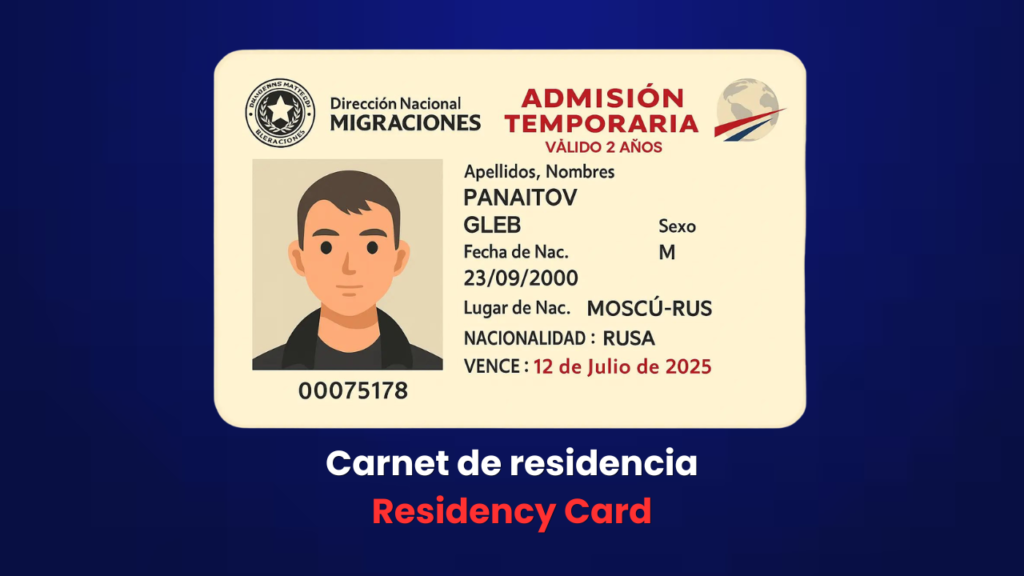
Temporary residency is the real gateway to settling in Paraguay. It is a 2-year right of residence that authorizes you to live on Paraguayan territory. At the end of these 2 years, it allows you to obtain permanent residency — that is, a lifelong right of residence.
A lot of information circulates on this topic, often imprecise or copied from one site to another. This guide is different: it is written from Asunción, based on real cases handled on the ground. The goal is simple — to clearly explain how to obtain your temporary residency, which documents to prepare, how much time and money to budget, and where the real pitfalls lie.
Temporary residency is a 2-year right of residence on Paraguayan territory: it allows you to live in Paraguay for two years. It should not be confused with tax residency or with permanent residency, which are two distinct concepts.
The main value of temporary residency is that it is the step leading to permanent residency: only at the end of its 2 years does it allow you to obtain permanent residency. And permanent residency does not expire: it constitutes a lifelong right of residence in Paraguay.
In concrete terms, the journey happens in two stages: you first obtain temporary residency, you settle in, then you move to permanent status. This is today the most natural path for anyone wishing to make Paraguay their lasting base.
Obtaining temporary residency relies on a complete file. Some documents are prepared in your country of origin, others can only be obtained once you are in Paraguay.
⚠️ Special case: residence abroad
If, over the last 3 years, you have resided more than one year — cumulatively — in a country other than your country of origin, you must provide the apostilled (or legalized) criminal record certificate of that country, as well as a document proving that you have resided there, or that you currently reside there.
The apostille is an official stamp that allows a document to be recognized internationally between countries that have signed the Hague Convention. France, Belgium, Switzerland and Paraguay are among them. If your document comes from one of these countries, a simple apostille is enough.
If your document comes from a country that has not signed the Hague Convention, the apostille does not exist: you must then go through legalization at the relevant Paraguayan consulate.
In your country of origin, you must gather and authenticate the following documents:
⚠️ Special case: residence abroad
If, over the last 3 years, you have resided more than one year — cumulatively — in a country other than your country of origin, you must provide the apostilled (or legalized) criminal record certificate of that country, as well as a document proving that you have resided there, or that you currently reside there.
Once you arrive, the following steps are carried out directly in the country:
Once all the documents listed above have been gathered, you go to the National Directorate of Migration (Migraciones) to submit your temporary residency application. You then receive a residencia precaria, a provisional permit covering the waiting period. The processing time for temporary residency is 45 to 90 days.
This is a very common confusion, and it is better to clear it up right away: obtaining temporary residency does not automatically make you a tax resident of Paraguay.
Temporary residency is an immigration status — simply a right of residence. Tax residency, on the other hand, is a distinct concept that determines where you are taxed. It is obtained at a later stage: once you have your cédula (the Paraguayan ID card), then your RUC (the Paraguayan tax identification number). You can therefore be a temporary resident of Paraguay without being a tax resident there, and vice versa.
If your project includes a tax dimension, handle these two processes separately: the residency card does not, on its own, settle your tax situation.
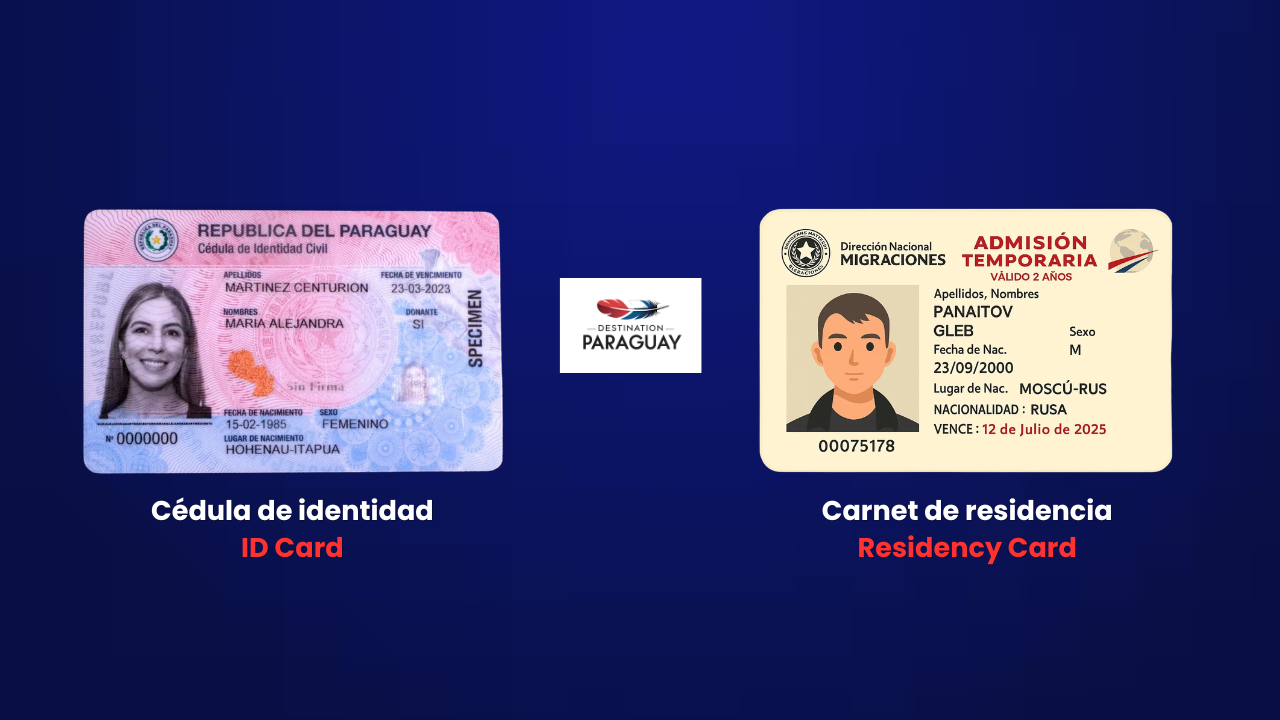
The temporary residency card is not enough on its own: it does not serve as everyday identification. For that, you need the cédula, the Paraguayan ID card — it is what allows you to act concretely in the country: work legally, open a bank account, obtain a driver’s license, sign contracts.
The cédula application is submitted to the Department of Identifications. Here are the documents to present:
The processing time for the cédula varies greatly: from 15 days to 8 months depending on the case.
This is the stage where, in practice, many files run into trouble: a misinterpreted record, a non-compliant document or a missing authentication can block issuance. This is precisely where the experience of serious guidance makes the difference — knowing in advance where things get stuck saves weeks.
The submission of the application for temporary residency can be done quickly, during a single trip to Paraguay, provided you arrive with a complete and well-prepared file. This is the whole point of anticipating the gathering and translation of documents.
Timelines vary greatly from one case to another. At Destination Paraguay, thanks to files prepared in advance and our knowledge of the ground, our clients obtain their temporary residency on average in 45 days and their cédula in 30 days. These documents can be collected by power of attorney, which saves you from having to stay in the country for the entire processing period.
When carrying out the process yourself, the budget is split among several items:
| Item | Approximate cost |
|---|---|
| Residency + cédula (official fees) | $500 |
| Sworn translation | $100 |
| Interpol certificate | $80 |
| Certificado de antecedentes para extranjeros | $45 |
| Certificado de vida y residencia | $60 |
| Carnet de extranjero | $50 |
| Notarized copies | $10 per page |
In total, carrying out the process yourself and without making any mistakes, expect a budget of between $1,000 and $1,500.
By going through professional guidance, all these fees and steps are bundled into a turnkey package.
The law does not require resorting to a lawyer or an agent: in theory, you can do everything yourself. In practice, it is another story. The procedure involves many offices, each with its own requirements, and a single detail mishandled can compromise the entire file — a non-compliant document, an apostille on the wrong document, an unrecognized translation.
Assistance has a cost, but above all it buys security and time. A word of caution before choosing a provider: be wary of promises that are too good. A serious provider will honestly explain the steps, realistic timelines and risks — not just the dream result. At Destination Paraguay, this is the field-based, verifiable approach we have defended from the start.
Yes. Temporary residency is a 2-year right of residence on Paraguayan territory; at the end of these 2 years, it allows you to obtain permanent residency. Permanent residency does not expire: it constitutes a lifelong right of residence in Paraguay.
A valid passport, as well as a criminal record certificate and a birth certificate, apostilled or legalized. Add a marriage or divorce certificate if applicable, and the criminal record certificate of any country where you have resided for more than one year.
Yes, into Spanish. The translation must be done in Paraguay by a sworn translator registered with the courts; no translation done abroad is accepted.
No. The residency application can be submitted during a single trip, and the cards can then be collected by power of attorney.
The residency card proves your resident status; the cédula is the Paraguayan ID card that allows you to act in daily life (work, banking, driver’s license, contracts).
At Destination Paraguay, our firm assists foreigners at every stage of their residency, their cédula and their RUC. Contact us for clear guidance with no false promises.