

Paraguay tax residency minimum days: this guide explains the practical steps, documents and points to check when preparing your plans. Paraguay tax residency is attracting more and more entrepreneurs, investors, retirees, digital nomads and expats looking for a simple, stable and international tax residency solution.
But one question comes up again and again:
How many days do you need to spend in Paraguay to become tax resident?
Online, the answers are often contradictory. Some people mention 183 days. Others talk about 120 days. Some mention 90 days. Others say there is no minimum number of days required.
As a result, many foreigners do not know what to believe.
The reality is more nuanced, but it becomes much clearer when you start from the right legal texts. To understand Paraguayan tax residency, two references are especially important:
- the General Resolution No. 65/2020, which regulates the procedure to obtain a Paraguayan tax residency certificate;
- the Law 125/1991, Article 152, which deals with the domicile of individuals.
The key point is this: General Resolution 65/2020 does not establish any mandatory number of days you must spend in Paraguay to request a tax residency certificate.
Instead, it focuses on a coherent tax file: RUC, tax compliance, identity documents and administrative documentation.
The famous 120 days refer to the concept of domicile, not to an automatic tax residency requirement.
Minimum stay: Quick answer: do you need to live 183 days in Paraguay?
General Resolution 65/2020 does not itself set a 183-day threshold for requesting the certificate. That does not mean that documents alone automatically establish tax residency.
Paraguay does not work like many European countries where the 183-day rule is often used as the main tax residency test.
If you carefully read General Resolution 65/2020, you will not find a clause saying that you must live 183 days in Paraguay to be tax resident.
You will also not find a clause saying that you must live 120 days in the country to obtain a Paraguayan tax residency certificate.
General Resolution 65/2020 establishes a documentary procedure. It requires, among other things, that the applicant has a RUC when they are a taxpayer, is up to date with tax obligations, presents a valid identity document, and provides a Constancia de Movimiento Migratorio when the applicant is an individual.
In other words, the real question is not only:
“How many days have I spent in Paraguay?”
The real question is:
“Is my Paraguayan tax file coherent, active and defensible?”
Minimum stay: How many days per year?
Does RG 65/2020 impose these annual thresholds for the certificate application?
183 days per year
No fixed 183-day threshold in this procedure.
120 days per year
Article 152 concerns a presumption of domicile.
90 days per year
No fixed 90-day threshold in this procedure.
This is not a guarantee of tax residency with 0 days per year. Applicable tax-residency criteria, immigration status and the rules of other countries still need to be assessed.
Minimum stay: Summary table: 0 days, 90 days, 120 days or 183 days?
| Number of days | What many people think | What the texts actually say |
|---|---|---|
| 183 days | You must live more than 183 days per year in Paraguay to become tax resident. | General Resolution 65/2020 does not mention a general 183-day requirement to request a tax residency certificate. |
| 120 days | You must spend 120 days in Paraguay to be tax resident. | The 120 days relate to the concept of domicile under Law 125/1991, Article 152, not to an automatic tax residency rule. |
| 90 days | A short 90-day stay may be enough or may be required. | This number is not the central criterion in General Resolution 65/2020 for the tax residency certificate. |
| No fixed threshold in RG 65/2020 | There is therefore nothing to do. | False. You still need a clean tax file: RUC, filings, compliance, identity documents, migration movements and overall consistency. |
Minimum stay: General Resolution 65/2020: the key text for Paraguay tax residency
General Resolution No. 65/2020 is the central text for understanding the procedure for obtaining a tax residency certificate in Paraguay.
It establishes the mechanism allowing an individual, a legal entity or a legal structure to request a document certifying their status as a resident in Paraguay for tax purposes.
This certificate can be used to prove Paraguayan tax residency before the tax authority of another country.
This is therefore the text you should read first if you want to understand what the Paraguayan tax administration actually requires.
And this is exactly where the confusion disappears.
General Resolution 65/2020 does not say:
- you must spend 183 days in Paraguay;
- you must spend 120 days in Paraguay;
- you must spend 90 days in Paraguay;
- you must reach an annual physical presence threshold.
It mainly says that the applicant must follow a procedure and provide specific documents.
Certificate procedure and tax residency criteria
Article 1 of RG 65/2020 refers to the legislation in force. The certificate procedure must therefore be read alongside the substantive rules. For example, for non-resident income tax (INR), the DNIT cites Article 2 of Decree 3181/2019, which refers to permanent immigration residency for individuals. A Temporary Residency card or an active RUC should not be treated as an automatic guarantee of tax-resident status. Your position also needs to be assessed under the rules of any other country concerned.
Source: DNIT frequently asked questions, INR residency criteria.
What General Resolution 65/2020 actually requires
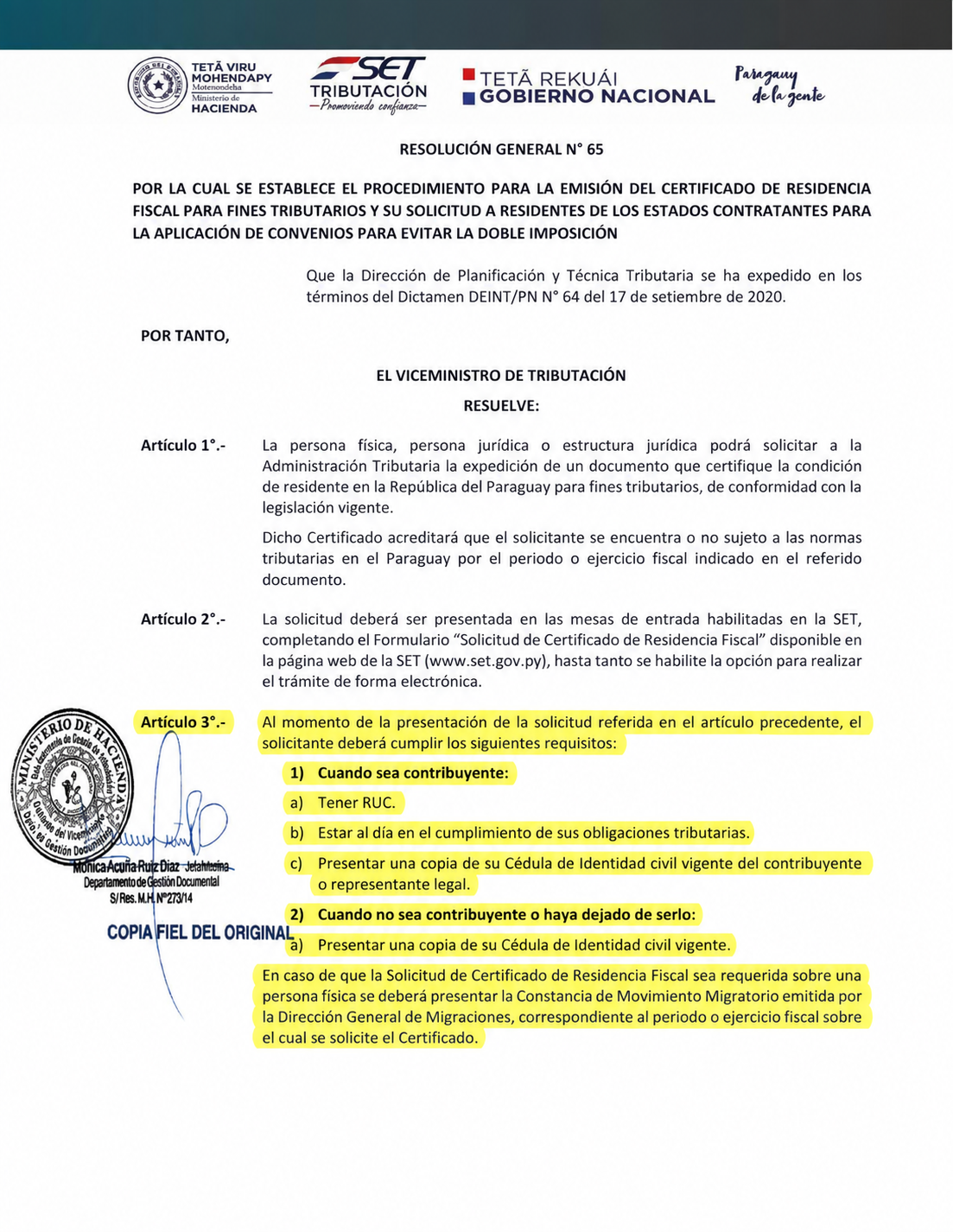
General Resolution 65/2020 requires several important elements.
When a person is a taxpayer in Paraguay, they must have a RUC in Paraguay and be up to date with their tax obligations.
They must also provide a copy of their valid civil ID Card.
Article 3 also provides a separate route for applicants who are not taxpayers or have ceased to be taxpayers, requiring a valid civil ID Card. Individuals must also provide the migration movement record. The RUC and filing recommendations below concern applicants who are taxpayers; they are not a universal requirement for every applicant.
For an individual, the resolution also requires the Constancia de Movimiento Migratorio, corresponding to the period or tax year for which the certificate is requested.
This means that the DNIT wants to verify the consistency of the tax and administrative file.
In practice, the most important elements are:
- an active RUC;
- tax obligations up to date;
- a valid identity document;
- a coherent migration status;
- the Constancia de Movimiento Migratorio;
- complete documents;
- a properly prepared application.
The resolution also provides that the administration may reject the request if the information or documents are incomplete, do not comply with the resolution’s requirements, or are not submitted.
This point is essential: the main risk is not failing to reach a magical number of days. The main risk is having a poorly prepared, incomplete or incoherent file.
What General Resolution 65/2020 does not require
General Resolution 65/2020 does not establish a general 183-day rule.
It also does not say that the 120 days are a mandatory condition to obtain a tax residency certificate.
This distinction is fundamental.
Many people take rules used in other countries and apply them mechanically to Paraguay. That is a mistake. Paraguay has its own procedure, its own documents, its own tax system and its own administrative criteria.
For Paraguayan tax residency, the issue should not be reduced to a simple day counter. It must be analyzed through the official procedure: RUC, tax compliance, identity document, migration movements and tax residency certificate.
Why is the Constancia de Movimiento Migratorio requested?
The Constancia de Movimiento Migratorio is a document listing your entries and exits from Paraguay.
Many foreigners see this document in the procedure and immediately think:
“If the tax administration asks for my migration movements, it must be counting my days.”
This reasoning is understandable, but it is too simplistic.
The Constancia de Movimiento Migratorio is part of the documents requested for individuals. It allows the administration to see your migration situation during the relevant period.
But the fact that this document is required does not automatically turn the procedure into a 183-day test.
General Resolution 65/2020 does not say that the certificate will be refused because you have not reached 183 days, 120 days or another fixed threshold.
However, this document helps verify the overall consistency of your file. If you request a Paraguayan tax certificate, your migration situation should remain logical in relation to your status, residency, RUC and tax filings.
The myth of the 120 days in Paraguay
The 120-day figure is probably the biggest source of confusion.
Many websites claim that you must spend 120 days per year in Paraguay to be tax resident. This claim is incomplete and can be misleading.
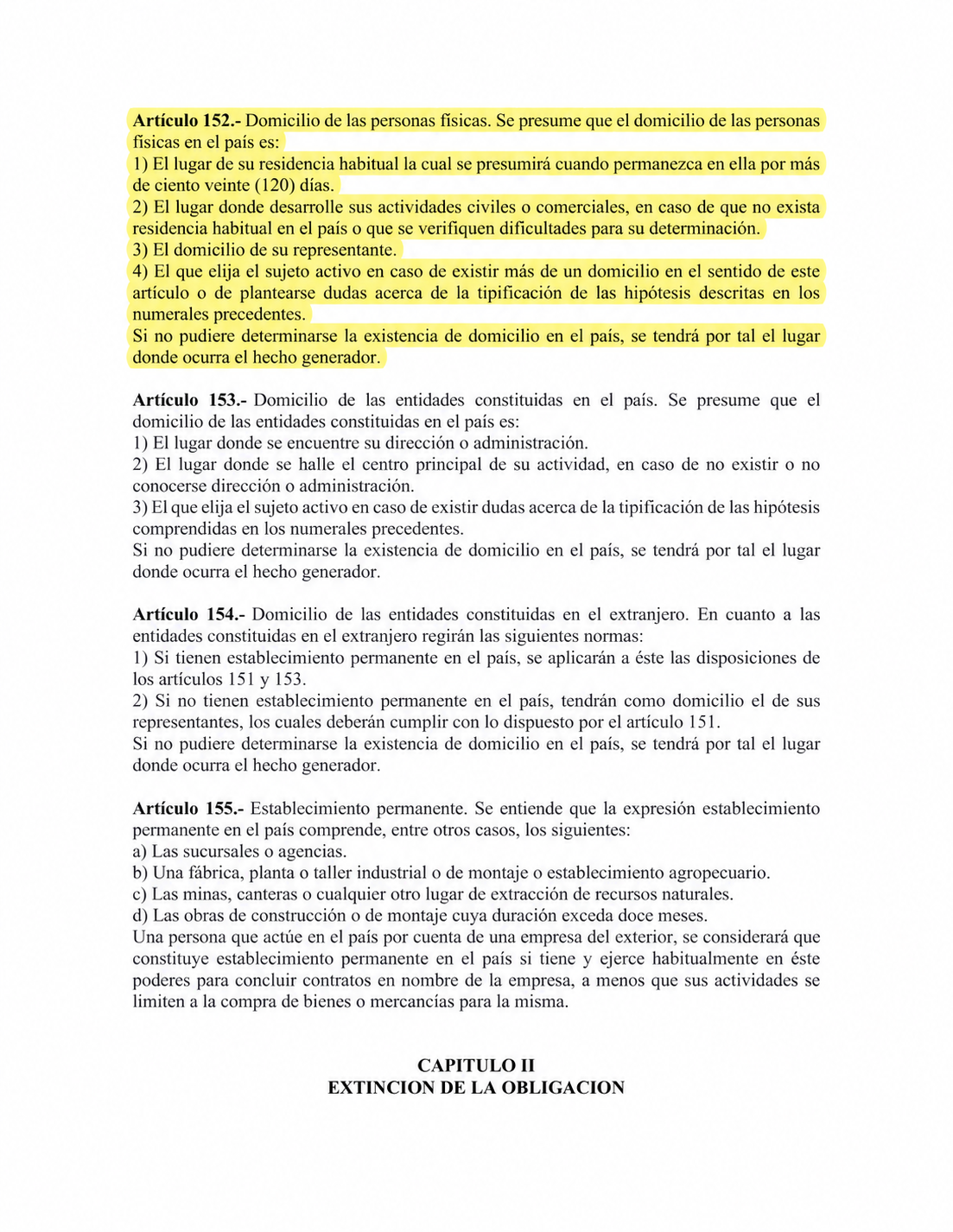
The 120 days appear in Law 125/1991, Article 152. But this article does not talk about the tax residency certificate. It talks about the domicile of individuals.
The law explains that the domicile of an individual in Paraguay may be presumed to be the place of habitual residence when the person remains there for more than 120 days.
It also provides other criteria, such as the place where the person carries out civil or commercial activities, the domicile of their representative, or the place where the taxable event occurs if no domicile can be determined.
The important word here is domicile.
Not tax residency.
What do the 120 days actually mean?
In simple terms, the 120 days mean this:
If you spend more than 120 days in Paraguay, Paraguay may consider that your home, habitual residence or administrative point of connection is in Paraguay.
This is a presumption of domicile.
It can help determine where you are administratively connected inside the country.
But it does not mean that the 120 days are an automatic obligation to obtain or maintain Paraguayan tax residency.
You must clearly separate two concepts:
- domicile: your address, your home, your administrative point of connection;
- tax residency: your status with the Paraguayan tax administration.
These two concepts may overlap, but they are not identical.
A simple example to understand the difference
Imagine two situations.
First situation: you spend more than 120 days in Paraguay in the same home.
In that case, Paraguay may consider that your habitual domicile is in Paraguay. In simple terms, this means that your home or main address of connection is here.
Second situation: you spend less than 120 days in Paraguay, but you have an active RUC, tax filings, residency in Paraguay, a Paraguayan cédula and a coherent tax file.
In this situation, the 120 days are not automatically the factor that decides everything. Your file must be analyzed under the tax procedure, General Resolution 65/2020 and the documents requested.
This is why it is wrong to simply say:
“You need 120 days to be tax resident in Paraguay.”
The correct wording is rather:
“The 120 days relate to the presumption of domicile. Tax-resident status must be assessed under the applicable legislation; General Resolution 65/2020 governs the certificate procedure.”
Why the 183-day rule should not be automatically applied to Paraguay
The 183-day rule is very well known worldwide.
In many countries, spending more than 183 days per year in the country may create tax residency. It is a simple rule, easy to understand, and widely used.
But Paraguay should not be analyzed only through this framework.
For Paraguay, you need to look at Paraguayan texts and Paraguayan administrative practice.
General Resolution 65/2020 regulates the issuance of the tax residency certificate. It talks about RUC, tax obligations, identity documents and migration movements. No general 183-day threshold appears in that provision.
It is therefore a mistake to copy and paste European tax rules onto Paraguay.
Paraguay tax residency does not mean “no obligations”
Be careful: saying that there is no fixed day threshold in General Resolution 65/2020 does not mean that there is nothing to do.
That is the opposite mistake.
Some people hear “no mandatory 183 days” and think it is enough to open a RUC and forget about the file.
That is risky.
A strong Paraguayan tax residency position requires real administrative and tax consistency.
You should notably:
- obtain a RUC;
- keep your RUC active;
- file the necessary tax returns;
- remain tax compliant;
- keep supporting documents;
- keep a valid identity document;
- maintain coherent migration residency;
- be able to present the Constancia de Movimiento Migratorio;
- request the tax residency certificate with a complete file.
Paraguay can be a simple and attractive jurisdiction, but simple does not mean improvised.
The RUC: the foundation of your Paraguay tax residency
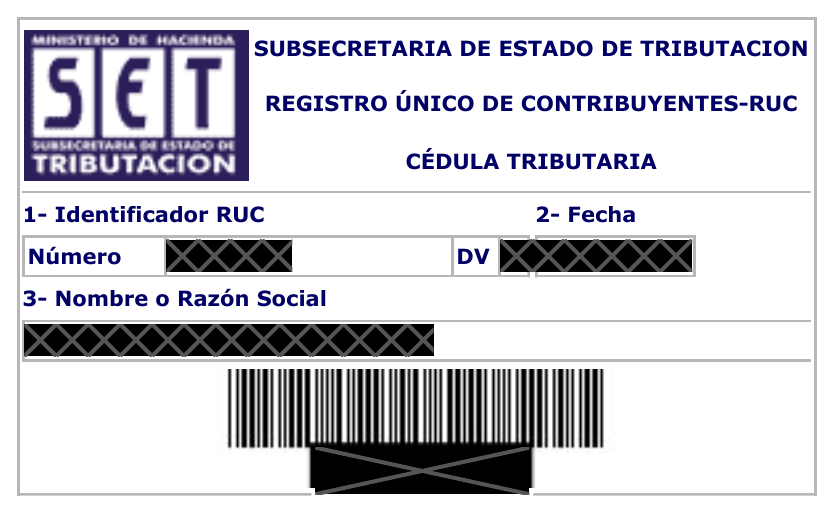
The RUC is the Paraguayan tax identification number.
It is one of the most important pillars of a Paraguayan tax residency position.
Without a RUC, it is difficult to demonstrate a clear tax existence in Paraguay. The RUC allows you to be identified by the tax administration, declare an activity, file tax returns, obtain tax certificates and build a defensible file.
But opening a RUC is not enough.
A RUC must be maintained.
Depending on your situation, you may have monthly filings, annual obligations, invoices to manage, supporting documents to keep and accounting in Paraguay to maintain.
An active but poorly managed RUC can become a problem instead of an advantage.
What is the tax residency certificate used for?
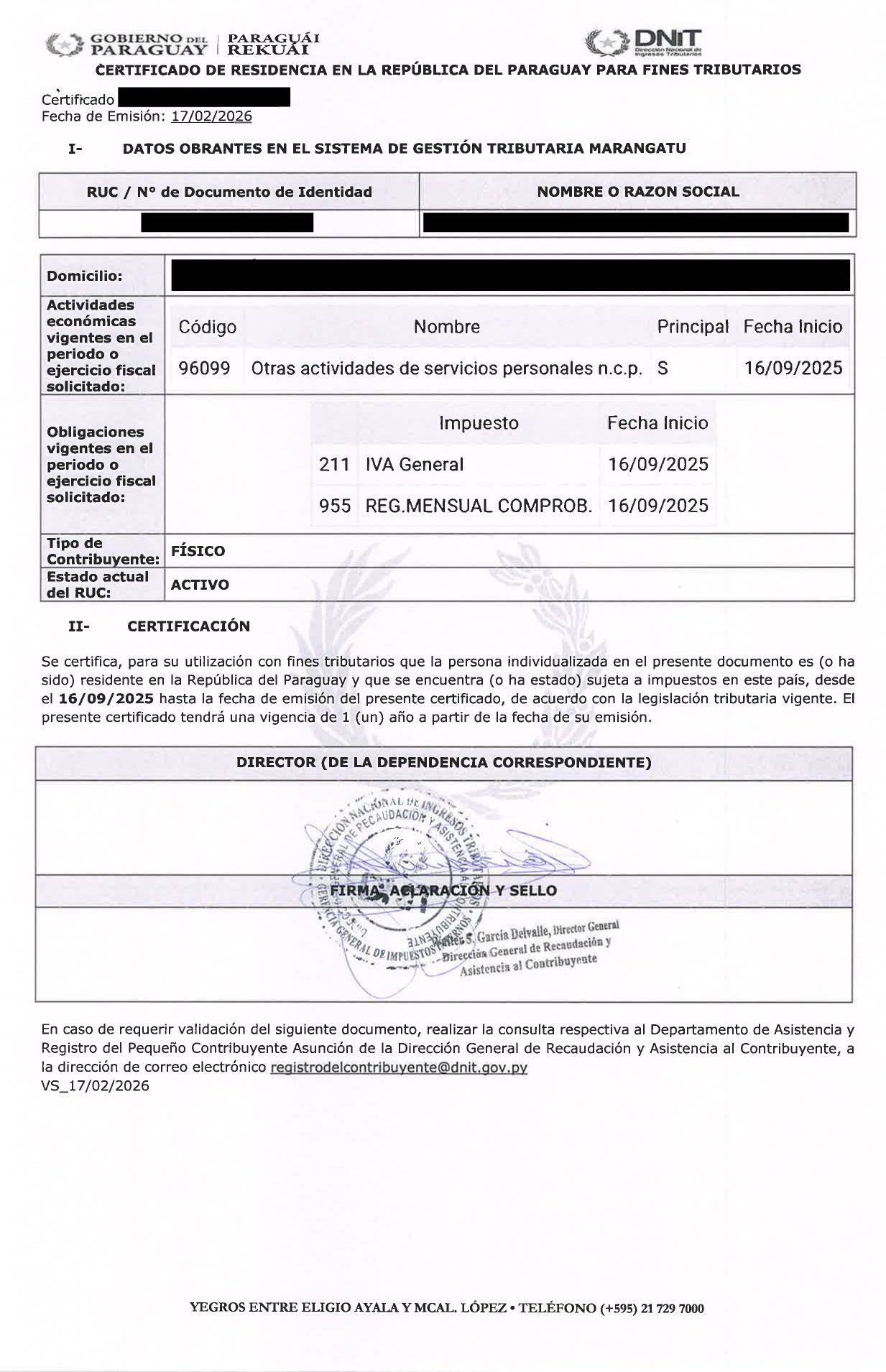
The tax residency certificate is the document proving that Paraguay recognizes you as a tax resident for a given period.
General Resolution 65/2020 provides that this certificate allows a Paraguayan taxpayer to support their status as a Paraguayan tax resident before the tax authority of another State.
It also states that the tax residency certificate issued by the Paraguayan tax administration is valid for one year from its date of issuance.
This document may be requested by:
- a bank;
- a broker;
- a financial platform;
- a foreign tax administration;
- a business partner;
- a tax advisor;
- a country with which you need to clarify your status.
This is why tax residency should not be prepared superficially.
A tax certificate must be based on a coherent file.
Tax residency and immigration residency: two different matters
Tax residency and immigration residency are not the same thing.
Immigration residency gives you the right to live legally in Paraguay. It concerns your status with Migraciones.
Tax residency concerns your status with the Paraguayan tax administration.
The two matters are different, but they are connected.
To build a strong position, it is preferable to have:
- valid immigration residency;
- a Paraguayan cédula;
- an active RUC;
- tax filings up to date;
- a coherent administrative situation.
A person can have immigration residency without having properly structured their tax residency.
But to defend a Paraguayan tax position, it is better for both aspects to be aligned.
How to build strong tax residency in Paraguay
The right approach is not to focus only on the minimum number of days.
The right approach is to build a clean file.
1. Obtain immigration residency
Residency in Paraguay gives you a legal basis for your presence in the country.
Depending on your profile, you may apply for temporary residency, permanent residency, an investor route or another immigration status.
2. Obtain a cédula
The Paraguayan cédula is the Paraguayan ID Card.
It facilitates banking, administrative, tax and contractual procedures.
3. Open a RUC
The RUC in Paraguay identifies registered taxpayers.
It allows you to be identified by the DNIT and file the required tax returns.
4. File tax returns
An active RUC must be followed.
Depending on your profile, you may have monthly IVA filings, an annual declaration or other tax obligations.
5. Keep clean accounting
Accounting in Paraguay helps document your situation.
It helps avoid inconsistent filings, missed obligations, penalties and weak files.
6. Prepare the tax residency certificate
Once the file is structured, it is possible to request the tax residency certificate.
The application must be complete, coherent and compliant with General Resolution 65/2020.
Mistakes to avoid
Mistake #1: thinking the 183 days are mandatory
General Resolution 65/2020 does not mention a general 183-day requirement to request a Paraguayan tax certificate.
Mistake #2: confusing 120 days with tax residency
The 120 days relate to the domicile of individuals under Law 125/1991. They do not create an automatic tax residency rule.
Mistake #3: thinking that a RUC is enough
For applicants who are taxpayers, the RUC is required, but it must be maintained. You must file the necessary tax returns and remain tax compliant.
Mistake #4: ignoring the Constancia de Movimiento Migratorio
Even though it does not create an automatic day-counting test, it is part of the documents requested for individuals in the tax certificate procedure.
Mistake #5: requesting the certificate without preparation
A tax residency certificate should be requested with a clean file: RUC, identity document, tax compliance, filings and complete documents.
Mistake #6: forgetting immigration documents
Your tax file should remain coherent with your immigration file. To avoid mistakes from the beginning, it is important to properly prepare the mandatory documents and apostilles for residency in Paraguay.
Who is Paraguay tax residency interesting for?
Paraguay tax residency may be interesting for several profiles.
Entrepreneurs
Entrepreneurs may look for a simpler tax base, especially if they work internationally and want to structure their income properly.
Digital nomads
Digital nomads may be interested in Paraguay if they want clear tax residency without having to live in the country all year.
Retirees
Retirees may look for a stable, affordable and tax-attractive country to organize their new life.
Investors
Investors may combine residency, taxation, real estate, banking and wealth planning.
Crypto profiles
Paraguay attracts certain crypto profiles, but tax residency must be prepared seriously. Simplicity should not be confused with the absence of obligations.
Tax expats
Tax expats must analyze their country of origin, personal ties, center of interests, immigration residency, RUC and documentation.
What Destination Paraguay can do for you
Destination Paraguay assists foreigners with residency, cédula, RUC, accounting and tax residency in Paraguay.
We can help you:
- obtain residency in Paraguay;
- prepare your Paraguayan cédula;
- open your RUC in Paraguay;
- manage your IVA filings;
- organize your accounting in Paraguay;
- prepare your annual declaration;
- maintain your tax compliance;
- request your tax residency certificate;
- structure your file according to your profile.
The goal is simple: to build a clean, coherent and defensible tax position.
To discuss your situation, you can contact Destination Paraguay or write to us directly on WhatsApp: https://wa.me/595986100745
Read also on Destination Paraguay
- Accounting in Paraguay: IVA, RUC and tax obligations
- Residency in Paraguay: our support services
- Contact Destination Paraguay
FAQ — Paraguay tax residency and minimum number of days
What is the minimum number of days to be tax resident in Paraguay?
General Resolution 65/2020 does not establish a mandatory minimum number of days to request the tax residency certificate. The file mainly relies on the RUC, tax compliance, identity document, Constancia de Movimiento Migratorio and the required documents.
Do you need to live 183 days in Paraguay?
No. The 183-day rule is known in many countries, but it is not mentioned as a general requirement in General Resolution 65/2020.
Do you need to spend 120 days in Paraguay?
No. The 120 days are not an automatic tax residency condition. They relate to the concept of domicile under Law 125/1991.
What does the 120-day rule mean?
If you spend more than 120 days in Paraguay, Paraguay may consider that your habitual domicile, meaning your home or reference address, is located in the country.
What is the difference between domicile and tax residency?
Domicile refers to your address or administrative point of connection. Tax residency refers to your status with the Paraguayan tax administration.
Why is the Constancia de Movimiento Migratorio requested?
It documents your entries and exits from Paraguay. It is part of the documents requested for individuals in the tax certificate procedure.
Is the RUC enough to be tax resident?
For applicants who are taxpayers, the RUC is required, but it is not enough by itself. It must be active, properly maintained, and your tax obligations must be up to date.
Can you obtain the tax residency certificate with little presence in Paraguay?
General Resolution 65/2020 does not set a mandatory day threshold. However, the file must remain coherent, complete and compliant.
Is the tax residency certificate valid for life?
No. General Resolution 65/2020 provides that the Paraguayan tax residency certificate is valid for one year from its date of issuance.
Conclusion
Paraguay tax residency should not be reduced to a 183-day or 120-day rule.
If you carefully read General Resolution 65/2020, you will not find any mention imposing a mandatory number of days to request a Paraguayan tax residency certificate.
The 120 days mentioned in Law 125/1991, Article 152, concern the concept of domicile. This means that if you spend more than 120 days in Paraguay, the country may consider that your home, habitual residence or reference address is located here.
But domicile and tax residency are not the same thing.
To build strong tax residency in Paraguay, you mainly need to prepare a coherent tax file: RUC, filings, tax compliance, identity documents, migration movements, immigration residency and tax residency certificate.
Destination Paraguay can assist you with all these steps.
Official sources used
- General Resolution No. 65/2020, issued by the SET and hosted by the DNIT: procedure for issuing the tax residency certificate for tax purposes.
- Law 125/1991, Article 152: domicile of individuals and presumption of habitual residence after more than 120 days.