

Destination Paraguay · Official texts consulted on 8 October 2026 Paraguay 183-day rule: distinguish presence thresholds, domicile rules and tax certificate documents using the official legal texts.
Do you have to spend 183 days per year in Paraguay to maintain your tax residency? No: General Resolution 65/2020 does not impose 183 days of presence per year. This threshold should therefore not be presented as a requirement under that resolution.
General Resolution 65/2020 governs the issuance of tax residency certificates. It sets neither an annual 183-day threshold nor a standalone rule for maintaining tax residency. For a taxpayer, Article 3 requires a RUC, compliance with tax obligations and a valid cédula. An individual must also provide a record of immigration movements for the relevant period.
No annual 183-day requirement under RG 65/2020. Maintaining your tax status depends on the rules applicable to your circumstances and compliance with your obligations. Having a RUC alone does not establish an unconditional right to maintain tax residency with zero days of presence.
183-day rule: 183 days, 120 days: what does the certificate procedure require?
No 183-day threshold is written into RG 65/2020.
No: Law 125/1991 uses this as a presumption of habitual residence to determine domicile.
In RG 65/2020. This does not mean “guaranteed tax residency with 0 days per year”.
183-day rule: Maintaining tax residency and renewing your certificate
The certificate and tax status must be distinguished: Article 6 of RG 65/2020 gives the certificate a validity of one year from issuance. This period is not a requirement to stay for 183 days. A travel calendar does not replace a residency file. Before counting days, identify the decision you need: a resident card, a tax certificate for a specific year or recognition of your new circumstances in another country.
The most useful approach is to address these matters separately, then check that they are consistent. Ask which legal provision applies, which period is being examined and which documents support your position. A broad statement such as “fewer than 183 days is enough” answers none of these questions.
183-day rule: RG 65/2020: no 183-day threshold in the procedure
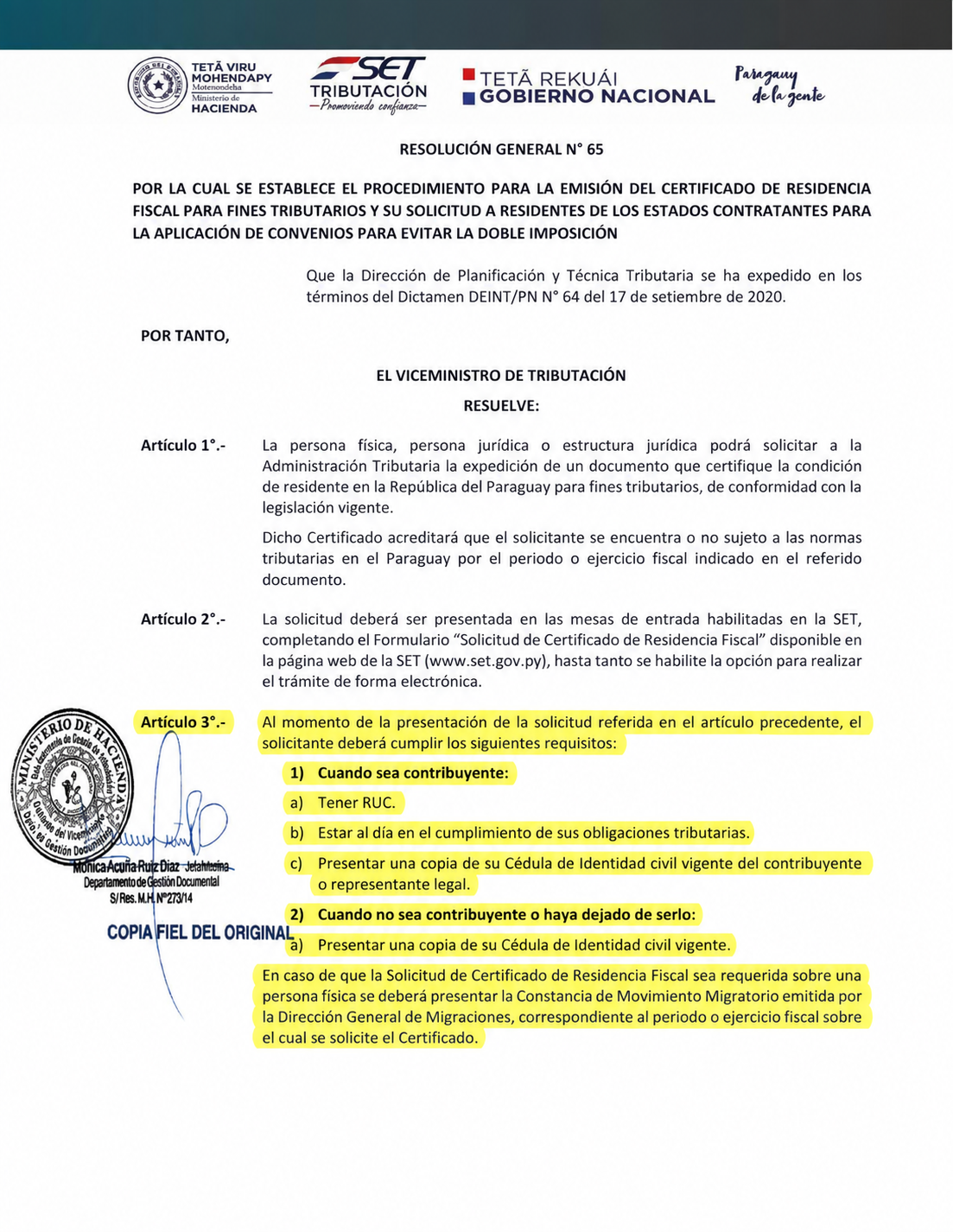
The resolution governs the issuing of the certificate. Article 3 distinguishes taxpayers, who must have a RUC, be up to date with their tax obligations and provide a valid cédula, from non-taxpayers or former taxpayers, for whom a valid cédula is required.
Tener RUC.
Estar al día en el cumplimiento de sus obligaciones tributarias.
Constancia de Movimiento Migratorio
Separate extracts from Article 3, in Spanish. Editorial highlighting added; these extracts do not reproduce the text in full.
For an individual, the migration record must cover the requested period. Travel is therefore documented even without a 183-day threshold in this procedure. Article 1 refers to the applicable legislation; submitting a file does not automatically establish the status.
Read General Resolution 65/2020 on the DNIT website.
183-day rule: What about 120 days? Law 125/1991 addresses domicile
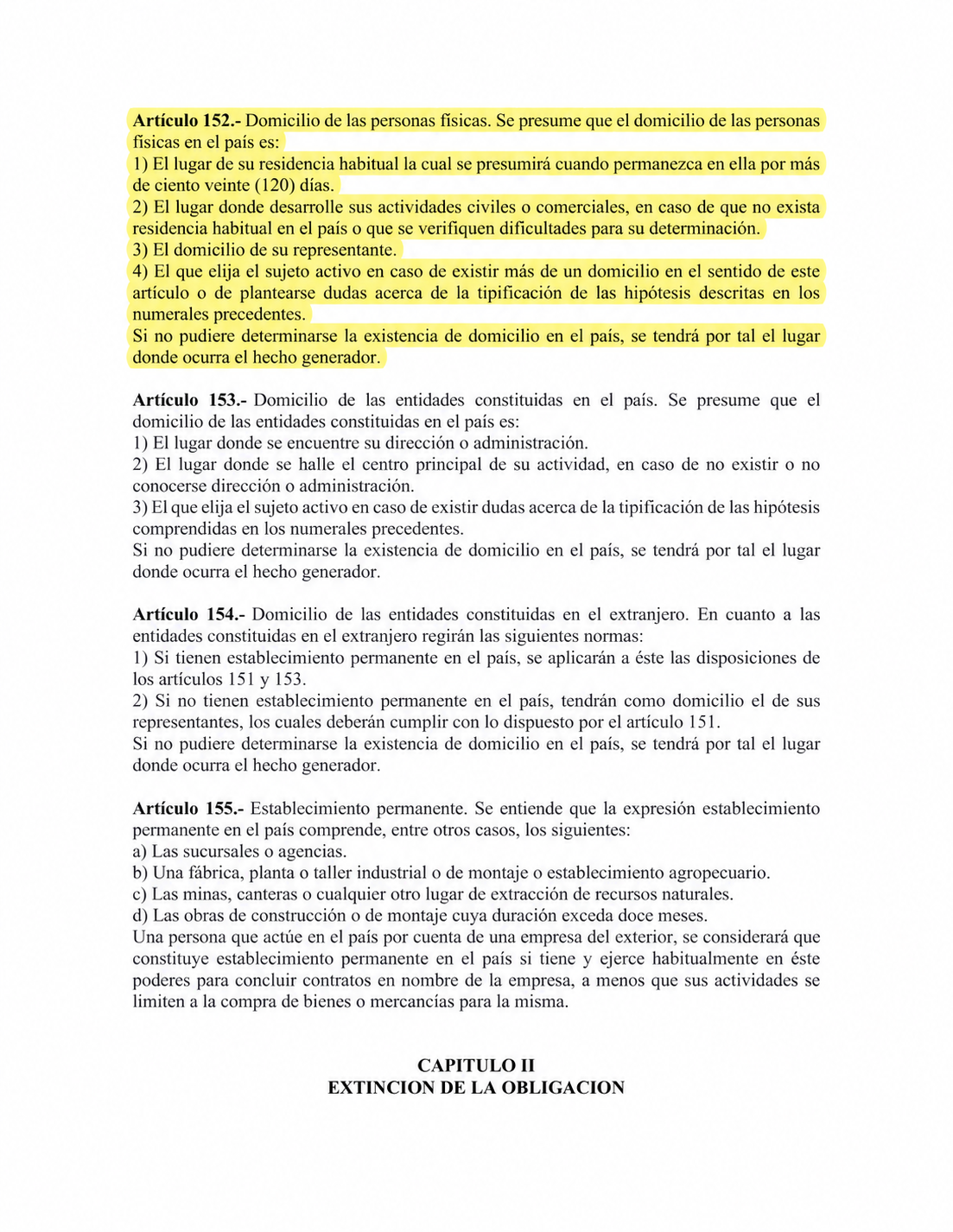
The correct reference is Law 125/1991, Article 152. It addresses the domicile of individuals. Its first criterion concerns habitual residence, presumed after more than 120 days:
El lugar de su residencia habitual la cual se presumirá cuando permanezca en ella por más de ciento veinte (120) días.
Extract from Article 152. Editorial highlighting added. Meaning in English: habitual residence is presumed when the person stays there for more than 120 days.
The text also provides for the location of civil or commercial activities when habitual residence is absent or difficult to determine, then the representative’s domicile and other methods of determination. The 120 days should neither be ignored nor turned into the sole annual condition for every procedure.
This provision concerns domicile: on its own, it does not state that a person can obtain a tax certificate without physical presence or that 120 days settle their international position.
Read Law 125/1991, Articles 151 and 152, at BACN.
Resident card, RUC and tax residency: three different functions
In its guidance on non-resident income tax (INR), the DNIT recalls that Article 2 of Decree 3181/2019 refers to Permanent Residency when treating an individual as resident for tax purposes in that framework.
This reference must be included in the analysis. Presenting a temporary resident card and a RUC as a universal guarantee would be insufficient. The cédula identifies a person; the RUC registers them with the administration; their tax classification depends on the rules applicable to their circumstances.
Source: official DNIT guidance on INR.
Can you freely remain outside Paraguay?
Absences are also governed by immigration law. Law 6984/2022 provides consequences for an unjustified absence exceeding one year for a temporary resident or three consecutive years for a permanent resident, subject to the authorisations provided for. Articles 54 and 55 must be distinguished from tax rules.
The National Directorate of Migration has also published Resolution 376/2026 on cancellation procedures and absence authorisations. Before a prolonged absence, have your category, exact dates and applicable procedure checked. An occasional return should not be presented as a universal tax solution.
Law 6984/2022, Articles 54 and 55 · Official Migraciones resolutions directory.
Questions to ask before planning your move
| Your objective | What to check |
|---|---|
| Maintain your immigration status | Residence category, document validity and authorised absences. |
| Support your tax position | Applicable legal basis, relevant year and supporting documents. |
| Present a certificate abroad | Intended use, period covered and the receiving authority’s criteria. |
| Plan your travel | Actual itinerary, entry and exit records, and obligations in each country concerned. |
Organise your file by year. Gather identity and residence documents, relevant tax evidence and a clear record of your stays. Then explain your actual plans: housing, work, family and the countries where you continue to spend time. This preparation enables an individual assessment rather than an answer based on a single number.
Frequently asked questions
Does “no 183-day rule” mean “no conditions”?
No. A procedure without that threshold still has criteria, supporting documents and an administrative decision. The absence of a number from one text does not remove the need to examine other relevant rules.
Should you stop counting days of presence?
No. Keeping a reliable calendar makes discussions with authorities and professionals reviewing your file easier. Record entries and exits throughout the year instead of reconstructing your travel afterwards.
Where should you start?
First define your objective and the relevant year. Then request a combined review of immigration status, domicile and tax classification. You can organise your procedures and travel around your actual circumstances.
Plan residency in Paraguay around your goals
A sound plan starts with a clear description of your life and activities. Do you want to settle permanently, divide your time between countries or invest while keeping an activity elsewhere? Explain this from the first conversation.
To continue preparing, see our overview of residency procedures in Paraguay and our guide to days of presence and tax residency. Destination Paraguay can help organise your procedures and identify matters that need to be assessed for your file.