
Paraguay tax residency: this guide explains the practical steps, documents and points to check when preparing your plans. How do you obtain tax residency in Paraguay? For a foreign national following the ordinary resident-taxpayer route, the process is usually organised around four documents: a Temporary Residency card, a Paraguayan cédula, registration in the RUC and a Tax Residency certificate issued by the DNIT.
Each document serves a different purpose. Immigration permission allows you to reside in Paraguay. The cédula identifies you. Your RUC registers you with the tax administration. The Tax Residency certificate provides official evidence for the period stated in that certificate. Having one document does not automatically replace the others.
This guide explains the conditions, supporting documents, authorities and practical order of the process. It draws on the Destination Paraguay free guide and official Migraciones, National Police and DNIT sources checked on 2 October 2026. The illustrations below are specimens or anonymised examples.
The four-document roadmapResidencia temporal → Cédula → RUC → Certificado de residencia fiscal
| Document | Authority | What it establishes | Next step |
|---|---|---|---|
| Temporary Residency card | Dirección Nacional de Migraciones (DNM) | Your approved temporary immigration status. | Prepare the separate identity-card application. |
| Temporary-resident cédula | Policía Nacional — Departamento de Identificaciones | Your Paraguayan civil identity document. | Prepare individual tax registration. |
| RUC / tax registration | Dirección Nacional de Ingresos Tributarios (DNIT) | Your taxpayer registration, declared activities and obligations. | Keep the registration accurate and comply with the obligations that apply. |
| Tax Residency certificate | DNIT | Official certification for the stated period or tax year. | Use it for the relevant tax purpose and monitor its validity. |
This is the usual taxpayer route, not a universal four-document legal test. Article 3 of General Resolution 65/2020 separately addresses applicants who are not taxpayers or have ceased to be taxpayers. Permanent residents and other immigration categories may also have different starting points. This article focuses on a foreign individual using temporary residency under Law 6984/2022.
1. Obtain temporary residencyResidencia temporal — Carnet de residencia temporal
The Temporary Residency card is issued by Migraciones. Under the general procedure, residence may be granted for up to two years and extended for an equal period. It is normally the first immigration stage before a later application for Permanent Residency.
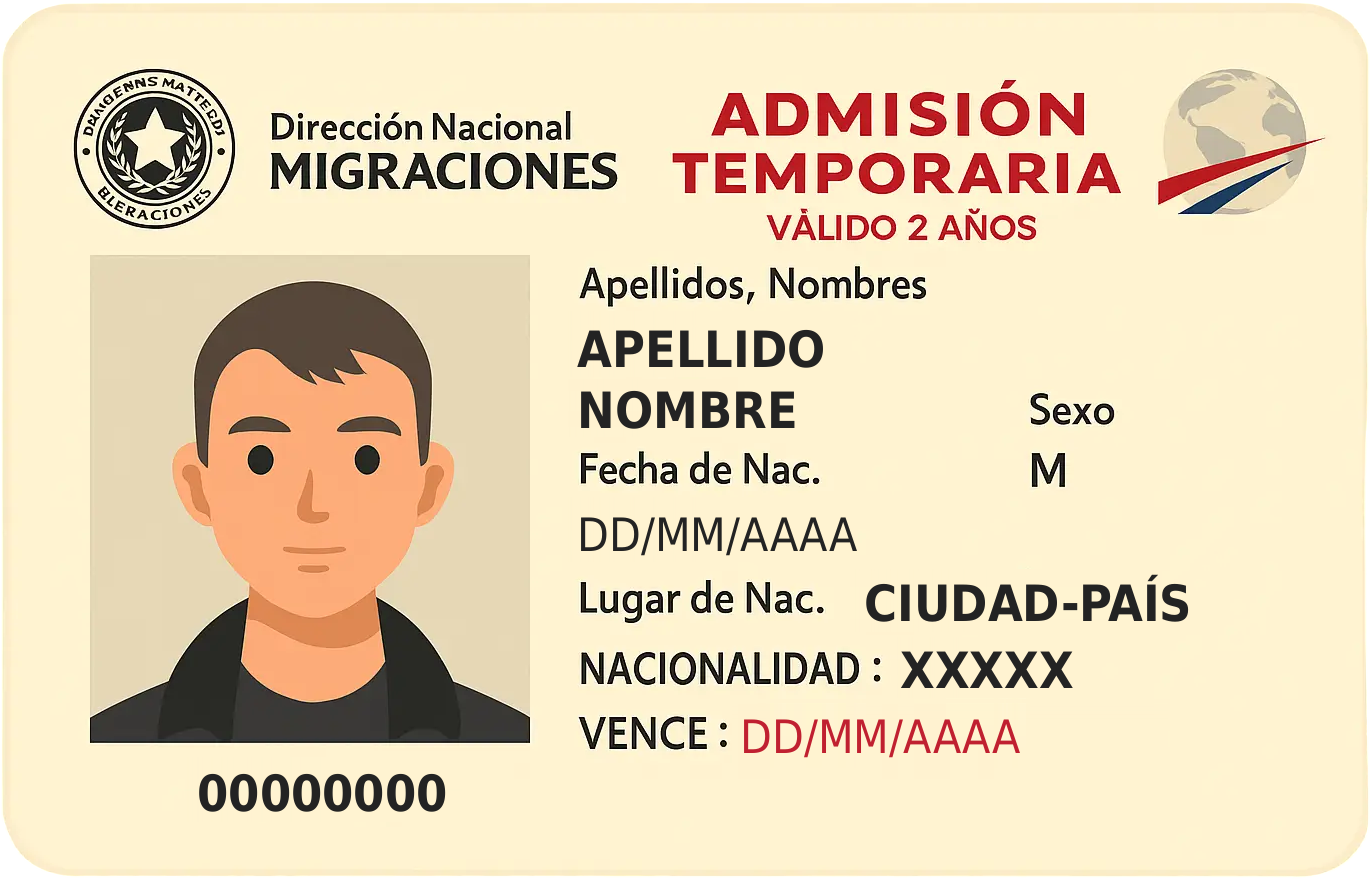
What must you prepare?
- A valid passport or accepted national identity document, with the required certified copy.
- A consular visa and Ministry of Foreign Affairs verification, if your nationality requires them.
- Proof of entry into Paraguay: the migration entry slip or passport entry stamp.
- A birth certificate and the applicable marriage, divorce or spouse’s death document, duly apostilled or legalised.
- A current national or federal criminal record from the relevant country, generally from age 14. If you have lived in another country for more than one year during the last three years, the latest residence-country record and proof of residence are relevant.
- A Paraguayan INTERPOL certificate and the police background certificate for foreigners, generally from age 14.
- The declarations generated by Migraciones concerning respect for the Constitution and laws, your occupation or activity, and your address in Paraguay.
Foreign-language documents need an accepted Spanish translation. Migraciones accepts a registered Paraguayan public translator or an authorised foreign translation that is duly apostilled or legalised. Portuguese documents issued in Brazil are exempt from translation. Prepare the original documents and required notarised copies before attending.
Where to apply: Migraciones. Its headquarters is at Caballero No. 201, corner of Eligio Ayala, Asunción. The initial application must be submitted personally. Additional family documents apply to minors, and the authority can request further supporting evidence.
Choose the correct immigration route. Temporary MERCOSUR residence has a separate checklist and different rules for access to the cédula. Do not combine its conditions with those of the general Law 6984/2022 route.
Official source: Migraciones temporary-residency requirements.
2. Obtain your temporary-resident cédulaCédula de Identidad Civil — residente temporal
The cédula is the ID Card issued by the National Police. In this context, “temporary cédula” means a cédula linked to temporary immigration residence. It is not the same card as the one issued by Migraciones. Under the general temporary-residency procedure, its validity corresponds to the Temporary Residency.
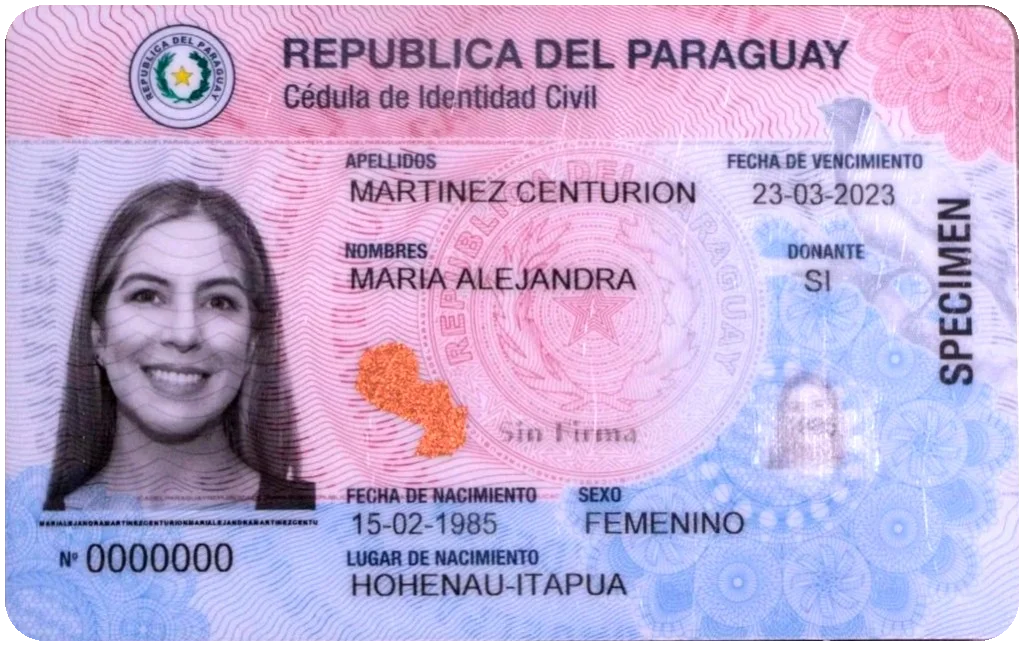
Prepare a separate identity-card file
The Police’s first-application page covers foreign nationals with temporary or Permanent Residency and cites Resolution 717/2026, Articles 24–25. Its document list includes:
- The residence certificate and a certified copy of the valid residence card.
- A certified copy of the valid identity document from your country of origin.
- A certified copy of the valid foreigners’ registration card, Carnet del Registro de Extranjeros.
- The apostilled or legalised birth certificate.
- Applicable INTERPOL, police and foreign criminal-record documents, generally from age 14, with the required authentication or legalisation.
- The Certificado de Vida y Residencia from the competent police station or Juzgado de Paz, with the Police authentication and legalisation required for this file.
- The civil-status documents applicable to marriage, divorce or widowhood, and other documents relevant to the applicant’s situation.
Source detail to check before filing: although the Police page heading explicitly includes Temporary Residency, two checklist entries still use the word “permanent”. Confirm the applicable temporary-category documents with Identificaciones instead of assuming those two entries exclude temporary residents. The same page provides for partial documentary exemptions by a reasoned Police decision for two-year identification.
Where: Departamento de Identificaciones, National Police. The central office is at Denis Roa and Avenida Boggiani, Asunción. Prepare the identity-card application separately from your Migraciones file; one approved application does not automatically complete the other.
Official source: first cédula application for foreign residents.
3. Register in the RUCRegistro Único de Contribuyentes
The RUC is Paraguay’s taxpayer register. Your registration identifies you to the DNIT and records the activities, tax address and obligations declared for your situation. The Cédula Tributaria and registration record are tax documents; neither is the civil cédula nor the Tax Residency certificate.
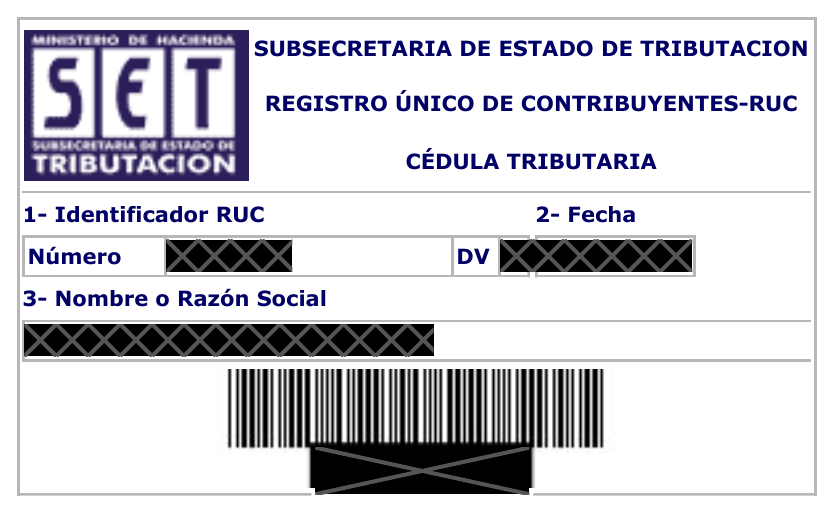
Identity documents and online registration
For a foreign individual, the updated Annex 1 of General Resolution 133/2023 lists a valid civil ID Card or passport issued in Paraguay. In the ordinary route described here, the Paraguayan cédula is the identity document used for registration; do not assume any foreign passport meets this wording.
The DNIT instructions require clear, complete PDF scans made from the original documents, including both sides of an ID Card. Each document file must not exceed 10 MB. Individuals must also attach a clear colour photograph showing their face while holding the front of their identity document next to it. If called in to approve the application, the applicant must present the original identity document.
Prepare your Paraguayan address, contact information and an accurate description of your economic activity. Register the tax obligations that actually apply to that activity and keep supporting address information available. Special activities and business structures can require additional documents; an individual RUC application is not the same as incorporating a company.
Where: DNIT’s Marangatu tax-management system and the relevant DNIT service office when attendance is requested. Retain your registration record and arrange secure access to your own account and notifications.
Keep your registration compliant
A RUC creates an ongoing administrative relationship with the tax authority. Check which returns, payments, invoicing rules and updates apply to your registered profile. Do not assume that every resident owes the same taxes or files the same returns. Equally, do not stop filing an applicable return merely because there was no income that month.
The RUC is not an automatic certificate of Tax Residency. Registration is a requirement for the taxpayer branch of the certificate procedure. The DNIT still examines the application and the period concerned. Keep immigration residence, taxpayer registration and certification distinct.
Official source: updated RUC registration documents, General Resolution 133/2023, Annex 1.
4. Apply for the Tax Residency certificateCertificado de Residencia Fiscal
The certificate is issued by the tax administration to establish the applicant’s situation for the stated period or tax year under Paraguayan tax law. It can support proof of Tax Residency before another tax authority. It does not by itself cancel Tax Residency or obligations in another country.
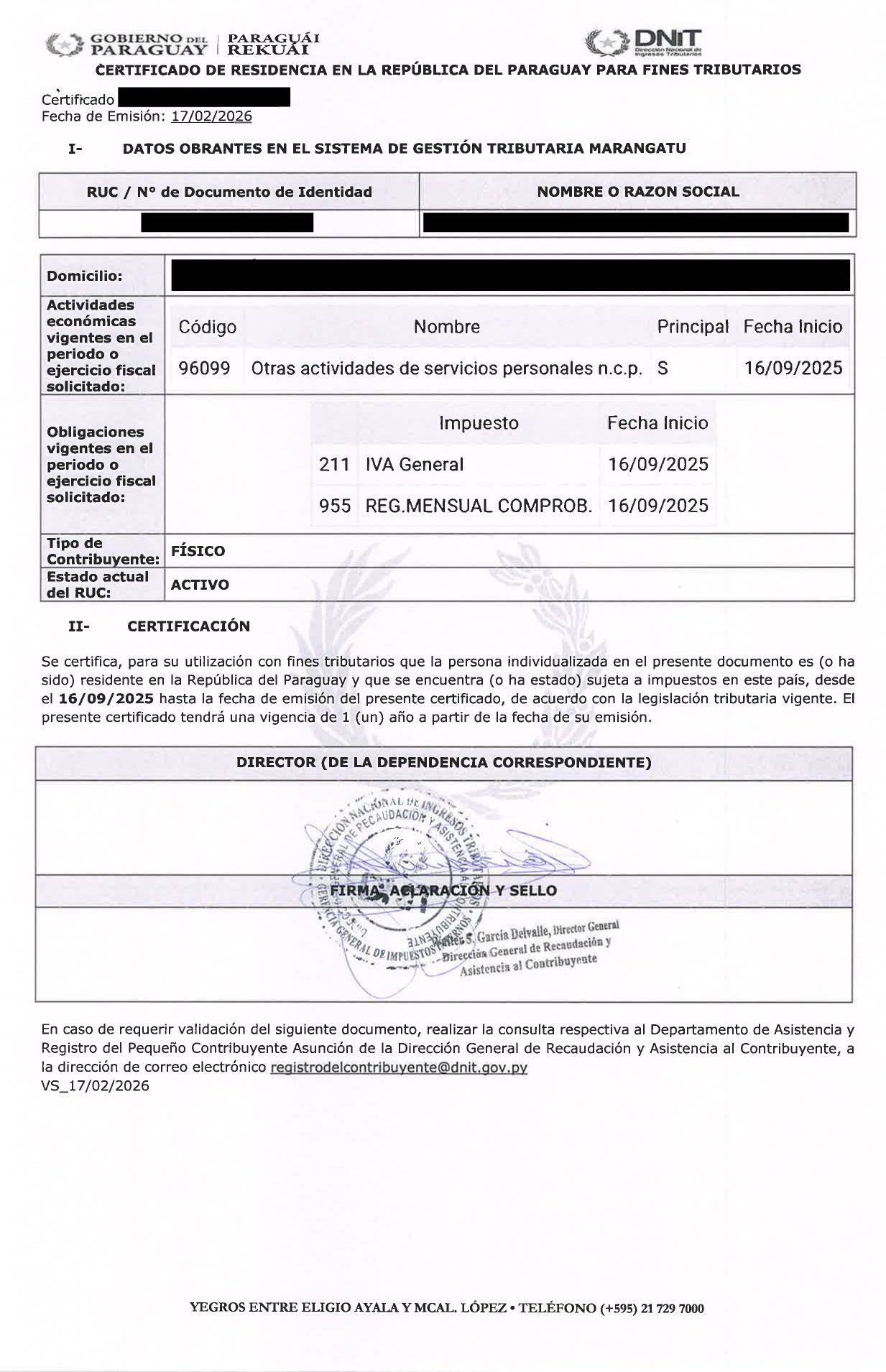
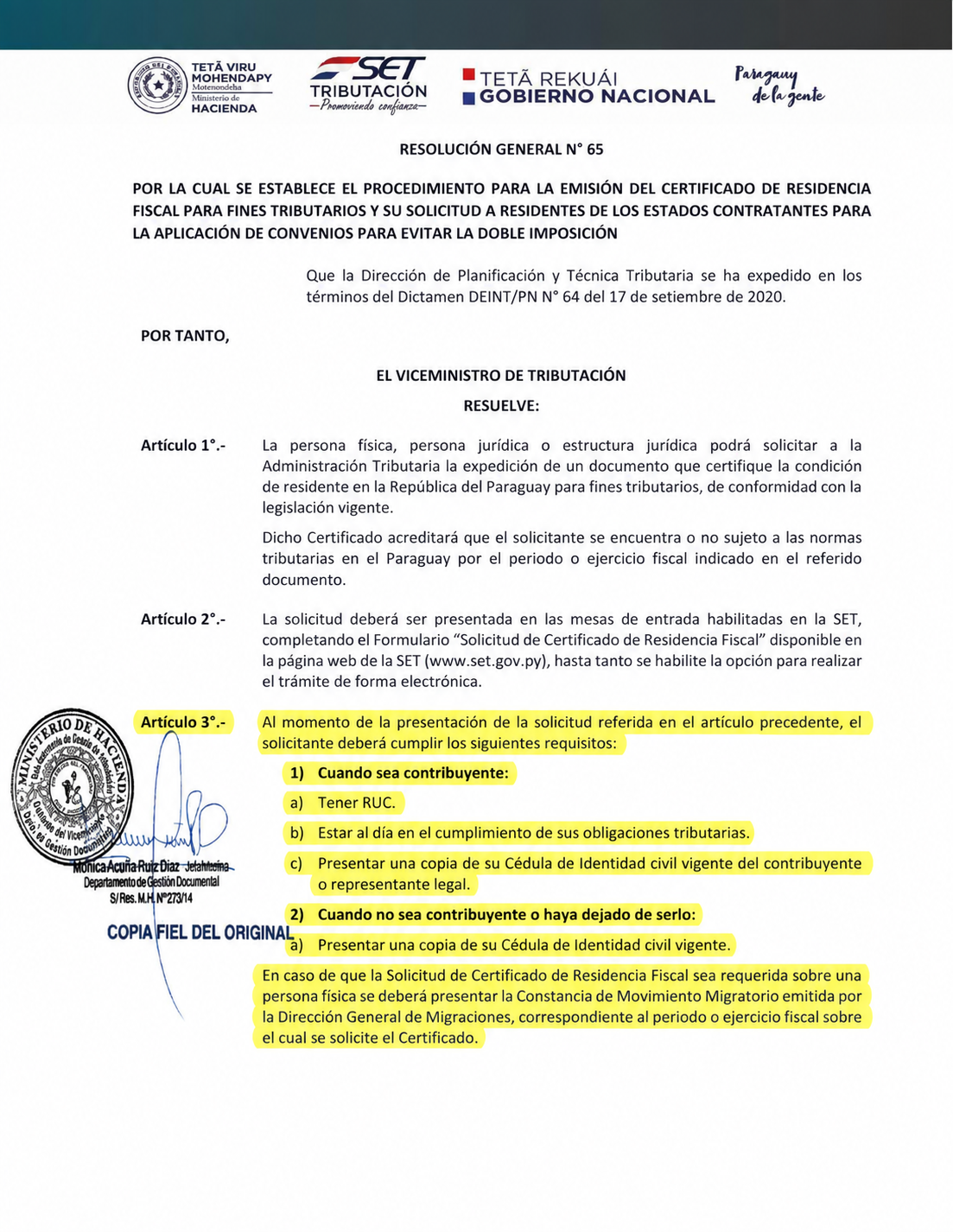
The exact Article 3 requirements
| Applicant | Requirements under General Resolution 65/2020 |
|---|---|
| Taxpayer | Have a RUC; be up to date with tax obligations; provide a copy of the valid civil ID Card of the taxpayer or legal representative. |
| Non-taxpayer or former taxpayer | Provide a copy of the valid civil ID Card. This is a separate branch expressly included in the resolution. |
| Individual, in either branch | Provide the Constancia de Movimiento Migratorio issued by Migraciones, covering the period or tax year for which the certificate is requested. |
The completed application is also required. Use the official Solicitud de Certificado de Residencia Fiscal and make the requested period clear. An individual applying as a taxpayer therefore needs more than just a RUC number and a photograph of a cédula: compliance, a valid identity document, the movement record and a complete application all matter.
How to submit the request
Article 2 provides for filing at the tax administration’s authorised intake desks until an electronic procedure is enabled. Use the DNIT’s current certificate service page to obtain the application form and confirm the accepted filing channel before submission. If a representative files on your behalf, confirm the required authorisation and identity documents with the receiving office.
The resolution still contains a temporary COVID-era email rule in Article 10. That historical clause should not be presented as a permanently available filing channel without confirmation from the DNIT. Likewise, the online “Certificado de Cumplimiento Tributario” is a different document: do not select it thinking it is the Tax Residency certificate.
Processing, rejection and validity
Article 4 provides for issuance within ten working days after filing where the request is analysed and accepted. An incomplete or non-compliant application can be rejected. The applicant may submit a new request after correcting the grounds for rejection; this is why a fixed overall delivery date should not be promised.
The decision is communicated through the Marandu electronic tax mailbox and/or the email address declared in the application. Under Article 6, the issued certificate is valid for one year from its issue date. Its one-year validity and the tax period it certifies are different pieces of information: check both.
About the guide’s practical recommendation: the Destination Paraguay guide recommends establishing a history of genuine tax filings before applying. Its suggestion of three months of non-zero IVA returns is not a minimum period stated in Article 3 of Resolution 65/2020. Returns must reflect real activity and the obligations actually applicable to the taxpayer; that recommendation should not be treated as a universal legal requirement or a guarantee of acceptance.
The supporting document people often forgetConstancia de Movimiento Migratorio
This Migraciones document certifies the entries into and exits from Paraguay recorded at authorised immigration checkpoints. It supports the Tax Residency certificate application for an individual and must cover the requested period or tax year.
It is not the entry stamp used in your first residence application, and it is not the Certificado de Radicación proving immigration registration. Request the correct document and check that the dates and identity details correspond to your records.
Where: Migraciones. Consult its current movement-record checklist for the identity-document copy and, where relevant, proof of representation or relationship. Request the period you need for the DNIT file, rather than assuming an arbitrary recent extract will be sufficient.
Presence, domicile and your previous country of residence
Article 3 of Resolution 65/2020 does not set a universal 183-day minimum for the certificate application. But that does not mean a residence card guarantees certification with no factual review. Individuals must provide their movement record, and other legal rules remain relevant.
Article 152 of Law 125/1991 addresses presumed tax domicile. It refers to habitual residence, presumed after more than 120 days, and also to other connecting factors such as the place of civil or commercial activities and the representative’s domicile. The provision should not be reduced either to a universal 120-day certificate rule or to an unconditional “zero days always works” promise.
Moving your tax position internationally also requires examining your former country’s residence tests and any applicable tax treaty. Family, home, work and economic connections can matter under the relevant rules. A Paraguayan certificate is evidence for the purpose stated; it is not an automatic release from foreign filing or tax obligations.
For a focused discussion, read our Paraguay tax residency guide to minimum-day rules. This article concentrates on the documents and application sequence.
Final checklist before requesting the certificate
- Confirm that your immigration status and cédula are valid and that the names match your tax registration.
- Check the RUC status, declared address, activities and applicable obligations.
- Resolve overdue returns or payments relevant to your taxpayer profile.
- Obtain the movement record for the exact period or tax year requested.
- Complete the official certificate application and attach legible supporting documents.
- Confirm the current DNIT filing channel and any requirements for a representative.
- Monitor Marandu and the email address supplied, then check the issued certificate’s data, period and expiry.
Frequently asked questions
Do I have to wait for permanent residency?
The taxpayer certificate checklist requires a valid cédula, a RUC, tax compliance and the individual’s movement record; it does not state that permanent immigration residence is mandatory. Under the general temporary-residency route, access to the cédula is available. The DNIT still assesses the actual certificate application.
Does obtaining a RUC automatically make me tax resident?
Do not treat registration as automatic proof of every aspect of Tax Residency. The RUC identifies your taxpayer registration. A certificate application is a separate procedure, assessed for a specified period, and international residence questions require their own analysis.
Is a RUC always mandatory for the certificate?
It is required in the taxpayer branch of Article 3. The same article expressly includes a different branch for non-taxpayers or former taxpayers. Individuals must provide the movement record in either case.
Are three months of IVA returns an official condition?
No such fixed minimum is stated in Article 3 of Resolution 65/2020. The guide’s recommendation concerns preparation in practice. Your declarations must reflect genuine activity and your actual tax obligations.
How long is the Tax Residency certificate valid?
Article 6 gives it one year of validity from issuance. Check the separate period or tax year certified and obtain a new certificate when required for your purpose.
Is the tax compliance certificate the same document?
No. Certificado de Cumplimiento Tributario and Certificado de Residencia Fiscal serve different purposes. Select the residence-certificate procedure and its application form.
Can a certificate end my tax obligations abroad?
Not automatically. The other country’s rules and any applicable treaty must be considered. Use the Paraguayan certificate as part of a properly documented change of circumstances.
Official references
- Migraciones: Temporary Residency under Law 6984/2022
- National Police: first cédula for foreign residents
- DNIT: updated RUC requirements, Resolution 133/2023
- DNIT: Tax Residency certificate, Resolution 65/2020
- DNIT: certificate information and official application form
- National Congress: Law 125/1991, Article 152