
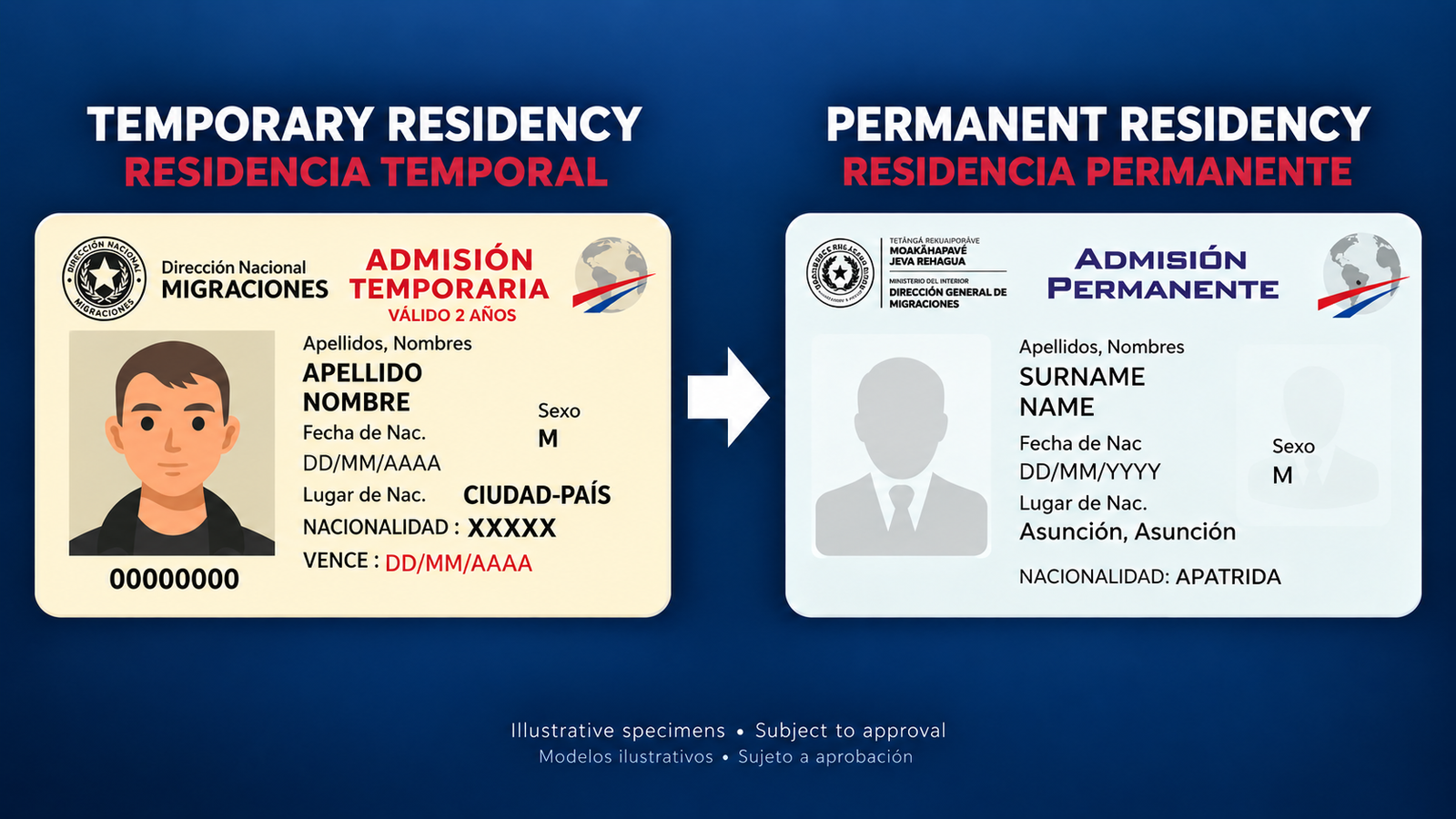
Permanent residency in Paraguay: this guide explains the practical steps, documents and points to check when preparing your plans. Permanent residency in Paraguay allows you to reside in the country indefinitely once your application has been approved by the Dirección Nacional de Migraciones (DNM). Start by distinguishing the standard change from temporary to permanent status from the special procedure for eligible investors. Your bank balance alone does not determine which route applies.
This guide explains the deadlines, evidence of financial means, illustrated documents, Investor Pass and SUACE requirements and separate cédula application. It draws on the Destination Paraguay guides and official references reviewed on 2 October 2026. Recheck the requirements when you apply, especially if your family, employment or immigration circumstances have changed.
Cover image: illustrative card specimens adapted from the Destination Paraguay free guide. A change from temporary to permanent residency requires an application and approval.
What does permanent residency in Paraguay allow?
Permanent status and the physical documents have different validity periods. The DNM describes an indefinite right of residence, while the residence card must be renewed every ten years. The cédula issued under this category also has a ten-year validity period. This does not make permanent status a ten-year permit or remove your immigration obligations.
Temporary residency, generally granted for two years under the route discussed here, is the preceding stage for a change of category. Temporary residents can already apply for a cédula under the applicable procedure. The main distinction is therefore the immigration category, its duration and the conditions for renewal or transition.
A Permanent Residency card does not guarantee a bank account, permission to practise every regulated profession or a tax exemption. Banks, professional bodies and public authorities apply their own requirements. Prepare evidence relevant to your actual plans as well as your immigration application.
Permanent residency: Which route applies: temporary-to-permanent or investment?
The routes covered here fall into two groups. A change of category applies to an existing temporary resident. The investor procedure allows an eligible applicant to apply directly for permanent status after the project-specific checks. Other individual circumstances may fall under separate rules.
| Route | Who it is for | Main requirement |
|---|---|---|
| Temporary, then permanent residency | Temporary residents approaching the change-of-category window who meet the applicable conditions. | Apply on time with the general, family and financial evidence relevant to your case. |
| Investor route: CIE, MIC and SUACE | Investors whose projects qualify under an official category. | Obtain the required investor certificate, then submit a separate immigration application. Capital alone does not guarantee approval. |
See the illustrated change-of-category documents below, followed by Investor Pass investment options and the SUACE productive-business conditions.
Permanent residency: Preparing your change of category, step by step
First establish which card you hold, when it expires and which procedure fits your situation. Moving from temporary to permanent residency is different from a first investor application. Forms, civil-status records and financial evidence are not interchangeable. Use the official checklist for your category and check every document before booking travel.
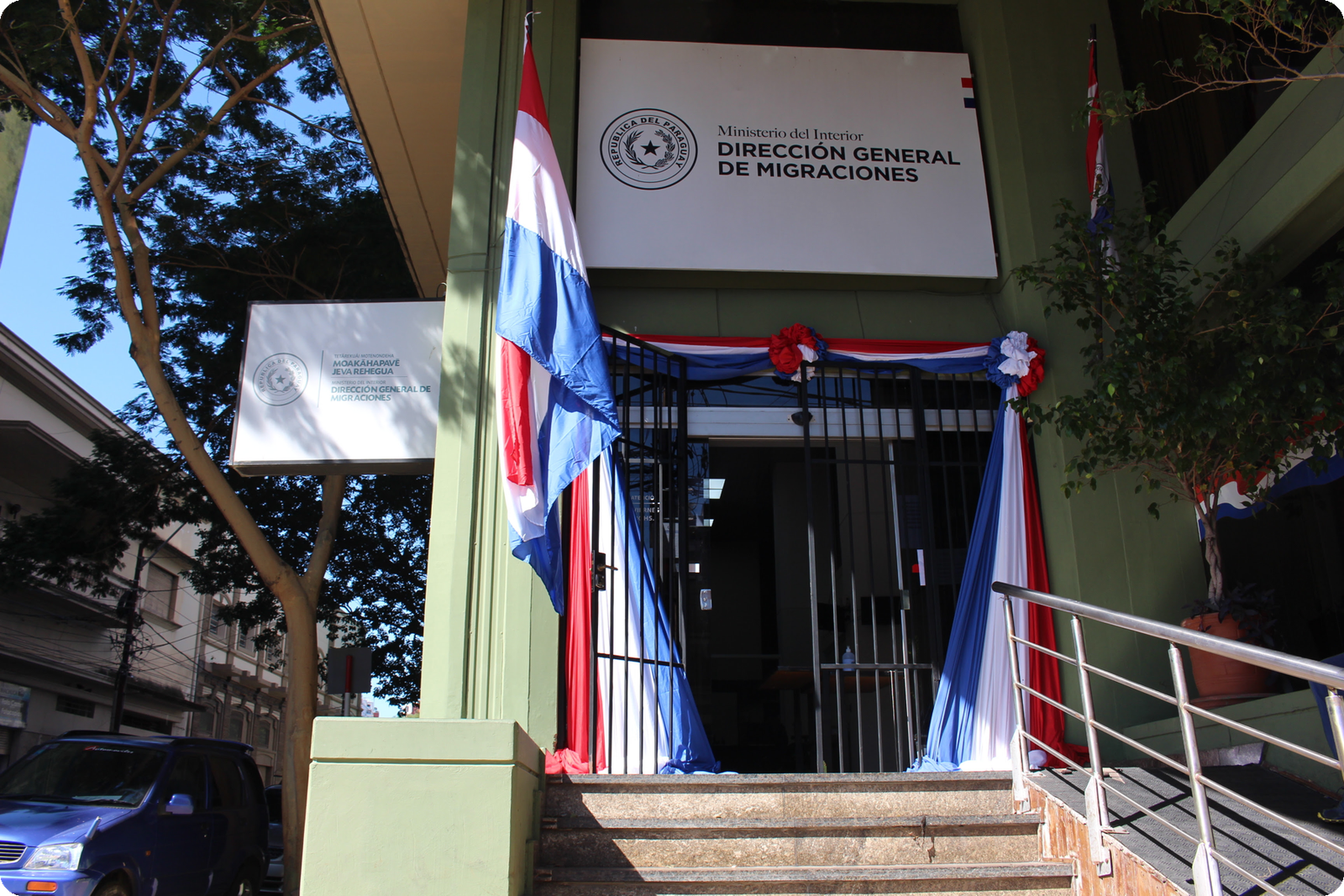
1. Check your dates and personal details
Keep photographs of both sides of your residence card and cédula. Note the expiry dates, document numbers and exact spelling of your names, then compare them with your home-country identity document. Changes to your name, occupation or civil status must be documented. For a lost or stolen document, obtain the appropriate report and check which replacement Migraciones accepts.
For a change of category, the DNM provides for filing within the three months before temporary residency expires. During the month after expiry, the change remains possible with the applicable fine. Beyond that, the official guidance refers to an extension of temporary residency, within six months after expiry. The case must be assessed individually; neither automatic cancellation nor unrestricted late payment should be assumed.
2. Select the right financial-means category
Employees, self-employed people and pensioners use different evidence. List your actual resources: employment, pension, professional activity, company ownership or another accepted category. Match each resource with the corresponding official proof. Your application should be verifiable and consistent with your work and family circumstances. Do not create fictitious activity or report income you have not earned to imitate another applicant’s file.
3. Organise local and foreign documents
Separate documents that you already hold and that remain valid, documents to obtain in Paraguay, and documents requiring action by a foreign authority. Record the issuer, original-document requirements, copies and authentication or translation formalities. An apostille, a translation and a copy certified by a Paraguayan notary serve different purposes.
4. Apply in person and retain your records
The DNM states that the application is personal and must be made in person. Follow-up may be handled by the applicant or a legal representative. Keep copies of your submitted file, filing receipt and payments. Respond precisely to requests for additional evidence. Filing is not approval: ask what document you should use while the application is being assessed, particularly if you plan to travel or your card is close to expiry.
5. Check the documents issued
Verify all personal details when your card arrives. Migraciones issues the residence card; the Department of Identifications handles the cédula. If you have a tax registration, separately review your DNIT records and any required updates. Receiving a residence card does not automatically update your banking, tax or professional files.
Documents for permanent residency in Paraguay
For the standard change of category after temporary residency, prepare the following documents. Plan around the filing window before your temporary card expires rather than waiting for its second anniversary.
1. PassportPasaporte
Provide your valid passport. Migraciones also accepts a valid home-country ID Card or national identity document under the applicable checklist.
Format: original and a copy certified by a notary in Paraguay.
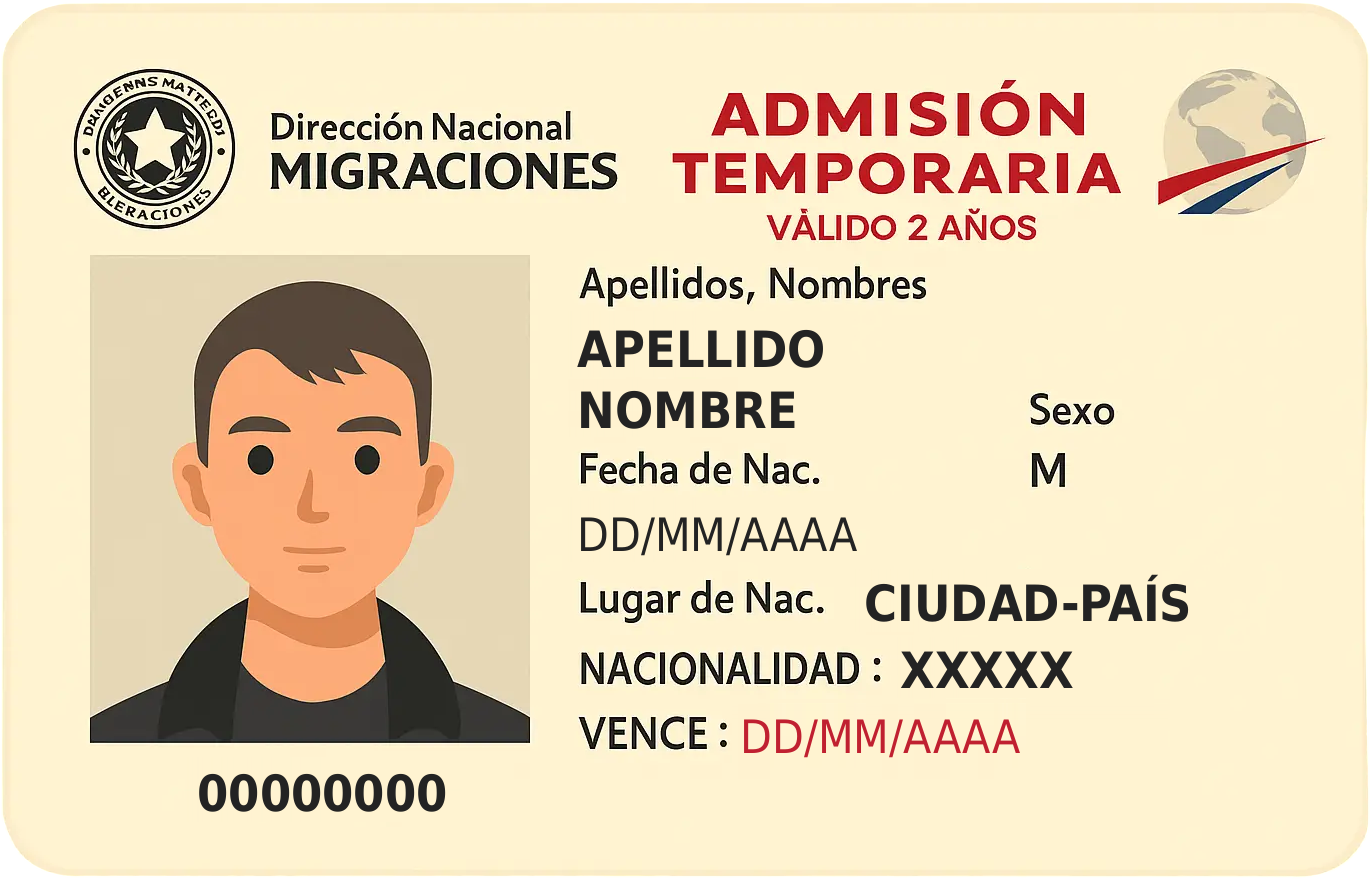
2. Temporary Residency cardCarnet de admisión temporaria
Provide the Temporary Residency card issued during your temporary-residency period.
Format: original and a copy certified by a notary in Paraguay.
3. Temporary-resident cédulaCédula de residente temporal
Provide your Paraguayan ID Card.
Format: original and a copy certified by a notary in Paraguay.
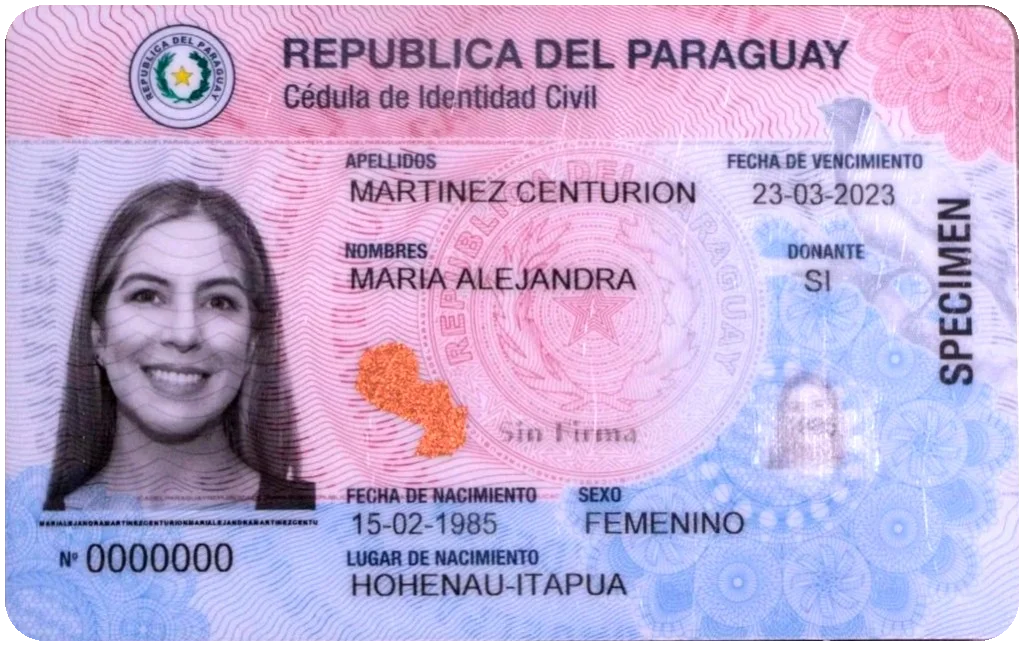
4. Evidence of changes in personal circumstances
This applies if your circumstances have changed since your previous application: civil status, profession, occupation or activity, given name or surname, or other personal information. Supply reliable documentary evidence.
Format, where applicable: original and a copy certified by a notary in Paraguay.
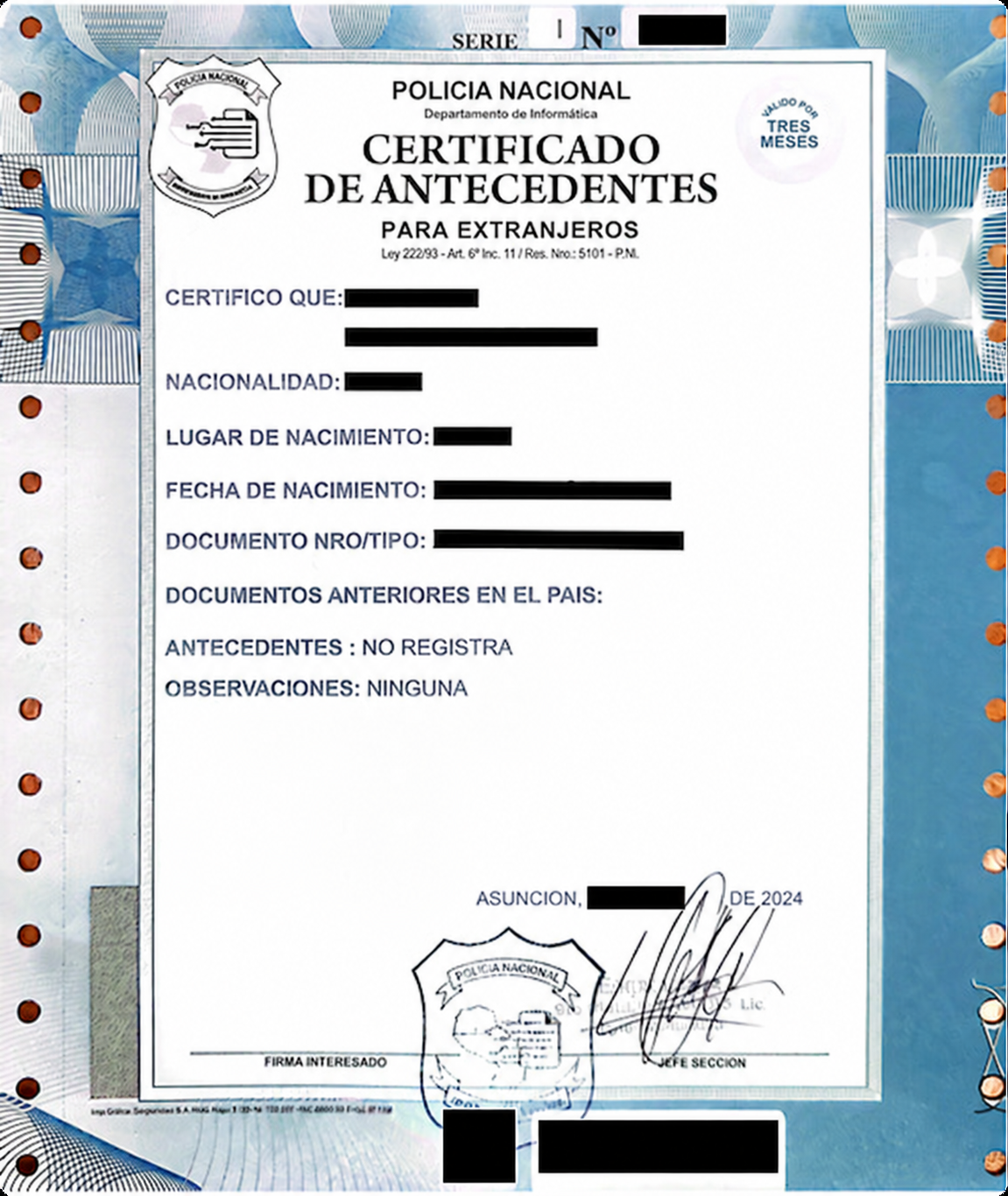
5. Police record for foreignersCertificado de antecedentes para extranjeros
Required from age 14. Obtain it from the Departamento de Informática of the Policía Nacional. The address listed in the official documentation is Avenida Boggiani and R.I. 2 Ytororó, Asunción.
Format: original and a copy certified by a notary in Paraguay.
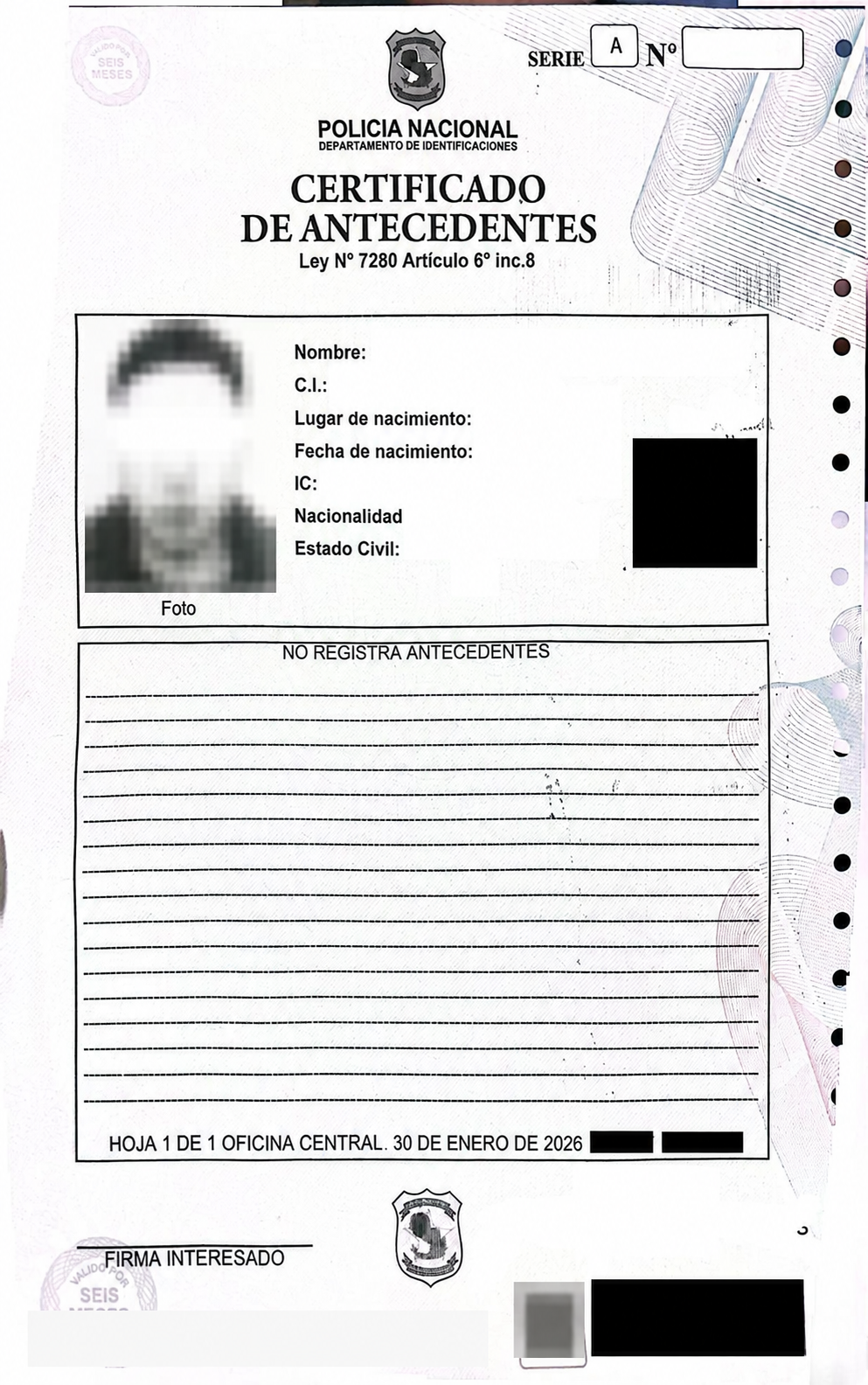
6. Good-conduct certificateCertificado de antecedentes de buena conducta
Required from age 14. Obtain it from the Departamento de Identificaciones of the Policía Nacional. Its listed central office is at Denis Roa, corner of Avenida Boggiani, Asunción.
Format: original and a copy certified by a notary in Paraguay.
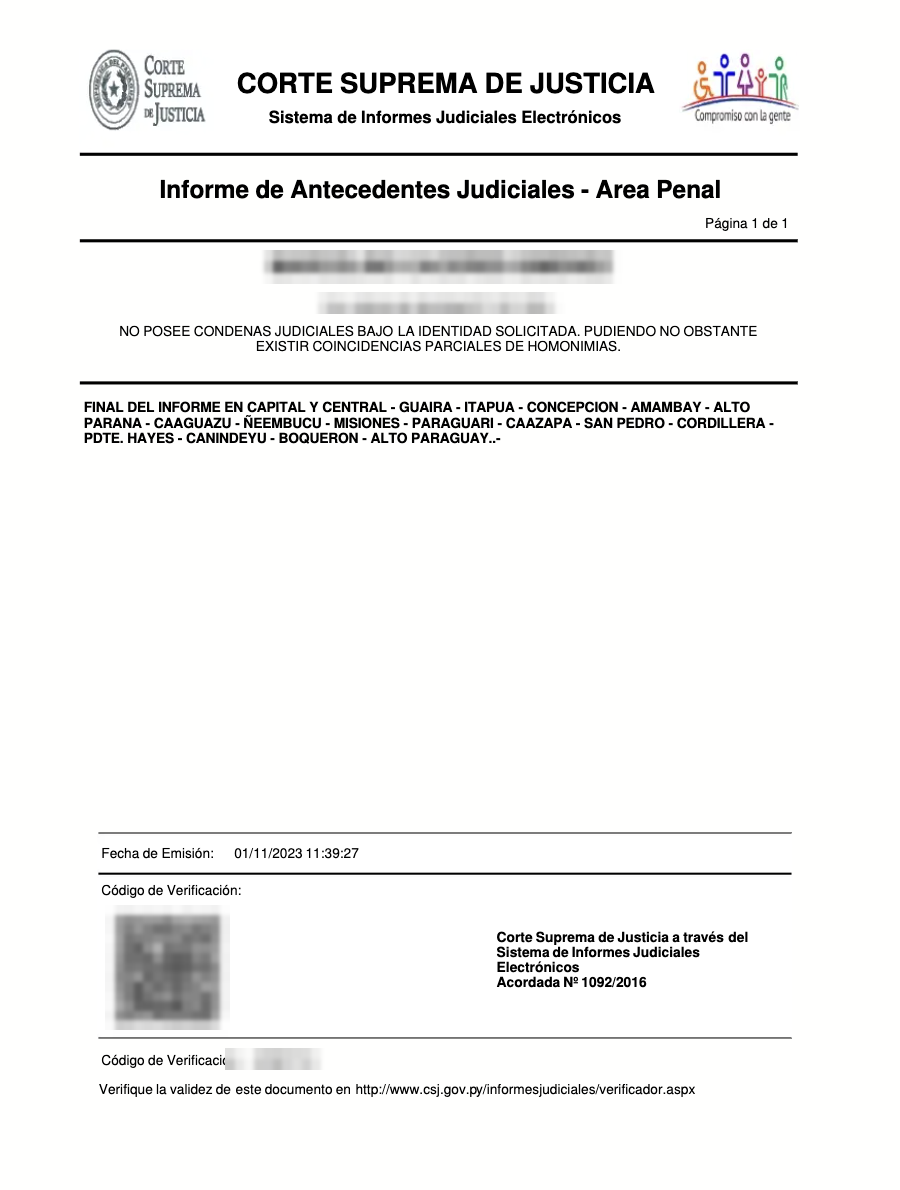
7. Judicial-record certificateCertificado de antecedentes judiciales
Required from age 14. Obtain it through Portal Paraguay’s online judicial-record service or the relevant Poder Judicial services, as applicable.
Format: original and a copy certified by a notary in Paraguay.
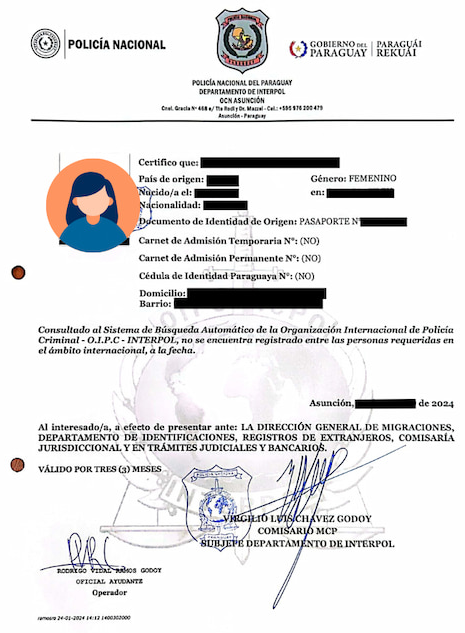
8. INTERPOL background-check certificateCertificado de antecedentes de INTERPOL
Required from age 14. Obtain it from the Policía Nacional’s INTERPOL department. The listed address is Cnel. Gracia No. 468, between Tte. Rodi and Dr. Mazzei, Asunción.
Format: original and a copy certified by a notary in Paraguay.
9. Proof of financial solvencyAcreditación de solvencia económica
Under DNM Resolution 407/2026, permanent-residency applications require evidence of genuine income, activity or economic resources. The category must match your actual circumstances. A diploma alone or the former USD 5,000 bank-deposit approach does not replace the current evidence required.
Professionals
- A professional university qualification registered and endorsed by the MEC.
- Evidence of actual activity: IPS coverage, an employment contract approved by the Ministry of Labour, or the previous three months’ IVA returns showing activity / the previous year’s IRP return.
- The required tax-compliance certificate and evidence of actual activity. The qualification alone is insufficient.
Technicians
- A technical qualification registered and endorsed by the MEC.
- Evidence of actual practice: IPS coverage, an approved employment contract, or the previous three months’ IVA returns showing activity / the previous year’s IRP return.
- The required tax-compliance certificate and evidence of actual activity. The technical qualification alone is insufficient.
Traders, service providers and self-employed applicants
- An active RUC and proof of individual taxpayer registration.
- The previous three months’ IVA returns showing activity, or the previous year’s IRP return, as applicable.
- A tax-compliance certificate and evidence of genuine activity.
The documents must reflect the activity actually carried out. Another financial-means category may be suitable for your profile; never invent turnover to complete an application.
Remote workers and digital nomads
- An apostilled or legalised employment certificate or equivalent proof.
- The document must establish the working relationship, income received and how the salary or fees are paid.
- A Spanish translation where required.
Property owners
- A title registered with the public property registry / Registro Unificado Nacional (RUN).
- The property must have been registered within the previous two years.
- The authority may request additional evidence of income generated by the property.
Retirees and pensioners
- An apostilled or legalised retirement or pension certificate.
- The amount received and the financial channel through which it is paid.
- A Spanish translation where required.
Document format: original and a Paraguayan notarised copy, according to the type of evidence required.
Other financial-means categories recognised by the DNM
The official list also covers employees, partners or shareholders, farmers and livestock producers, religious workers, dependants and adult students. Do not apply the self-employed checklist to every applicant. For employees, the list refers to IPS coverage or a duly registered employment contract. Partners must document their actual company participation; EAS companies have a specific supporting document.
Dependants must document their family relationship and the identity of their financial supporter as applicable. Adult students need evidence of their studies, continuity and adequate means of support; enrolment alone is insufficient. Read the relevant category in the official annex before selecting your documents.
Tax returns and compliance documents must reflect real activity. The alternative between three IVA returns and the previous year’s IRP return must be assessed within the relevant category.
Apostilles, legalisation and translations
Foreign documents must follow the applicable apostille or legalisation procedure. The issuing country and type of document determine the process. Check the competent authorities and timing before ordering multiple copies.
The DNM accepts a public translator registered in Paraguay or an authorised foreign public translator; in the latter case, the translation must have the required apostille or legalisation. Portuguese-language documents issued in Brazil are exempt from translation under the DNM guidance. It is therefore incorrect to say that all foreign translations are refused. Check the police requirements for the cédula separately.
Do not assume that every document has a universal six-month validity. Check its issue date, its own validity and the requirements of the procedure at filing. A document accepted for one procedure may not be sufficient for another.
Investor Pass: apply directly for permanent residency
Eligible investors can apply for permanent residency without first completing the temporary-residence stage. The Paraguay Investor Pass framework includes different investment categories. Below are the real-estate, financial and tourism alternatives, followed by the productive-business route.
These are alternative investment categories, not three amounts that must be added together. The MIC issues the Constancia de Inversionista Extranjero (CIE) through SUACE; Migraciones then assesses the separate permanent-residency application. Direct access does not mean automatic approval or a guaranteed delivery date.
| Investor Pass category | Minimum investment | Core official conditions |
|---|---|---|
Investment real estateInversión inmobiliaria | USD 200,000 | Property acquisition, development or exploitation intended to generate economic benefit. Exclusively personal or family use is excluded. Submit the registered transfer deed or the accepted private purchase contract with notarized signatures; for the contract route, at least 30% of the declared total investment must have been paid. The investment-evidence documents must satisfy the 180-day recency rule. No business plan or job creation is required for this category. |
Financial instruments / Paraguayan securities marketInversión mediante instrumentos financieros | USD 200,000 | Document the investment through an entity authorized by the Banco Central del Paraguay’s Superintendencia de Valores. Maintain the investment for at least two years, with the annual reporting obligation. Evidence must state the investment value and meet the 180-day recency rule. No business plan or job creation is required for this category. |
Tourism investmentInversión turística | USD 150,000 | A concrete tourism project supported by a previously approved business plan and financial-capacity evidence. The plan identifies the company, location, tourism activity, eligible assets, financing and implementation schedule. Six-monthly progress reports are required. This category concerns a tourism investment project, not personal travel spending. |
The minimum is assessed per applicant, or in its official guaraní equivalent. Each applicant must also provide identity and entry documents, a visa where required, applicable foreign criminal/police records, INTERPOL Paraguay evidence and a sworn statement on the lawful origin and traceability of funds. Foreign documents follow the applicable apostille/legalization and translation rules.
Government references: MIC Resolution 0283/2026, Annex I, articles 1 and 4–6 · SUACE’s current investor-certificate checklist · Official government announcement of Investor Pass.
Permanent residency: SUACE productive-business route: a real company and at least five formal jobs
The productive-investment category is intended for a genuine industrial, commercial or service business in Paraguay. It requires at least USD 70,000 in eligible investment per applicant and at least five formal jobs. Simply registering a company or keeping money in a bank account does not satisfy the project requirements.
SUACE is the government’s business-registration and investor-certification channel. It also processes the CIE used for the other investment categories above; it is not an unrelated second residency permit.
| Requirement | What it means |
|---|---|
Establish the companyApertura o participación en una empresa | For a new company, identify its legal form and partners. An existing company must provide its incorporation documents and, where applicable, share-transfer and beneficial-owner evidence. Establish and formalize the business in Paraguay through the applicable registration procedure. |
At least five formal jobsMínimo de cinco empleos formales | Create real jobs in Paraguay that comply with labour law. Prepare employment documentation and the applicable employer, IPS and MTESS registrations. The current resolution defines formal employment by compliance with labour legislation; it does not expressly impose a separate universal “five full-time contracts” condition. |
A concrete project for government reviewPlan de negocios y evaluación técnica | Submit the business plan to MIC/SUACE: company details, partners, activity and CIIU code, actual production/commercial/service model, location, detailed investment budget, financing and implementation schedule. The authority reviews the supporting documents and evaluates the plan through a technical report. |
Premises and an address in ParaguayLocal y domicilio administrativo | Identify the planned operating location, address, city and whether the premises are owned or rented. If a physical site has not yet been selected, the resolution allows you to state that it is being sought or planned and declare a temporary administrative office in Paraguay. A completed lease for a permanent office is therefore not an absolute requirement for every initial CIE application. |
Commercial and municipal authorizationPatente comercial y licencia municipal | Obtain the registrations and operating permissions applicable to your municipality and activity. SUACE lists commercial patents and municipal licences among the formalization procedures it facilitates in Asunción, alongside employer registration. These operating requirements must be distinguished from the documents required at the initial investor-certificate stage. |
USD 70,000 in eligible business assetsInversión productiva elegible | Document the investment in assets used by the activity: commercial property, machinery, equipment, tools, operational vehicles, furniture, construction and technical installations. Rent, salaries, utilities and recurring operating costs do not count towards this threshold. Each investor must meet the minimum individually. |
Financial capacity and lawful fundsSolvencia y origen de fondos | Support the financing with the accepted bank statements, investment holdings or documented assets and valuations. Provide the sworn declaration on lawful source and traceability of funds. The plan must be financially supported, not just a written intention. |
Verification and follow-upVerificación y seguimiento | SUACE checks the documents and plan, coordinates verification against the proposed project and monitors compliance. The investor must submit six-monthly implementation reports. Missing evidence or an inadequate project can prevent issuance of the CIE. |
Once the CIE has been issued, submit the separate permanent-residency file to Migraciones. The investor file has its own identity, civil-status, background-check, entry and authentication requirements; do not substitute the temporary-to-permanent checklist above for it.
The implementation schedule must be stated in the plan. Resolution 0283/2026 replaced Resolution 1052/2025; confirm the schedule approved for your project rather than relying on older summaries.
Government references: MIC Resolution 0283/2026, main articles 2–5 and Annex I articles 1–3 · SUACE investor requirements · SUACE company-registration and municipal-licensing functions · Migraciones investor-residency checklist.
Permanent residency: From a temporary-resident cédula to a permanent-resident cédula
If you already hold a temporary-resident cédula, obtain Permanent Residency from Migraciones first, then prepare the renewal of your cédula with Identificaciones using the National Police renewal requirements — Article 27, Resolution 717/26. This is the reference checklist for the temporary-to-permanent transition discussed here. The residence decision does not automatically update your ID Card. If your cédula is still valid, confirm the timing and handling of its update with Identificaciones. The published rule mentions an expired card.
The official renewal guidance for foreigners, referencing Resolution 717/26, lists the expired cédula or loss report, authenticated Permanent Residency card, INTERPOL and police records, life-and-residence certificate, home-country identity document and a valid Carnet del Registro de Extranjeros. Follow the specified authentication and legalisation requirements for police documents.
For your first cédula, including your first application with Temporary Residency, use the Police checklist under Articles 24–25 of Resolution 717/26. The official page explicitly covers temporary or permanent residents; its URL mentions Permanent Residency only. This first-application checklist differs from renewal. Consult the first cédula: temporary or Permanent Residency and official renewal page before preparing copies.
The first-application page gives an indicative processing time of 90 working days. This is not a contractual guarantee and should not automatically be applied to renewals. Check the arrangements when you file and retain your application references.
Family applications: special rules for children
Each family member’s circumstances must be assessed individually. A child’s file is not simply a copy of a parent’s. The DNM distinguishes children accompanied by both parents, one parent or a third party. Documents must establish identity, family relationship and permission to reside in Paraguay. Check birth certificates, parental-responsibility decisions and authorisations before travelling.
| Situation | What to prepare |
|---|---|
| Both parents accompany the child | The DNM checklist provides for both parents’ signatures and their identity and residence documents under the applicable procedure. |
| Only one parent accompanies the child | Express notarised permission from the absent parent or the applicable court decision. If a parent has died, provide the death certificate. |
| A third party accompanies the child | Custody, guardianship and permission documents must reflect the actual circumstances. Judicial recognition may be required. |
| Child under 14 | The change-of-category checklist exempts the child from criminal, judicial and police background certificates. |
| Child aged 0–17 | The children-and-adolescents category is exempt from proving personal financial means; economic responsibility rests with the legal representative. |
Separation, shared custody and guardianship require particular care. Check the wording of the authorisation, not just the signature. Permission to travel does not necessarily authorise residence. Confirm the full checklist and any additional evidence with the DNM before filing.
Planning your application and processing time
Separate the time needed to collect documents, assessment by Migraciones and issuance of the cédula. A timeframe for one authority does not cover the other stages. Missing documents, corrections or additional checks can change the schedule. Do not organise your relocation around a commercial promise of approval “guaranteed in fifteen days” without procedure-specific official confirmation.
The number of trips depends on the application, personal formalities and follow-up arrangements. Ask for a written schedule showing when your presence is required and allow time for additional appointments or documents. The investor route allows a direct application for permanent status; it does not mean an immediate positive decision.
Immigration residency, tax residency and citizenship are separate
Permanent residency authorises long-term residence. The cédula is an identity document. The RUC is a tax registration. A tax-residence certificate involves another procedure with the DNIT. These documents may all be relevant to a relocation project, but none automatically replaces the others.
For the tax-certificate procedure, RG 65/2020 distinguishes taxpayers, who must be compliant, from non-taxpayers or former taxpayers. It requires identity documents and, for individuals, migration movements for the relevant period. Obtaining the certificate does not automatically end tax obligations in another country; both sides of the situation must be assessed.
A foreign client does not automatically make services performed from Paraguay foreign-source income. The place and nature of the activity, type of taxpayer and applicable tax regime matter. Avoid choosing an immigration route on the basis of a blanket “zero tax” promise without assessing the reporting obligations associated with your activity.
Naturalisation is a separate procedure with its own authorities and conditions. A Permanent Residency card does not automatically grant Paraguayan citizenship or a passport. Indefinite residency also does not mean an absence of obligations: keep documents current and check the consequences of lengthy absences before moving abroad.
Frequently asked questions about permanent residency
Can I obtain permanent residency without temporary residency first?
Eligible investors can use the direct investor route after obtaining the required CIE and meeting Migraciones’ separate conditions. The standard non-investor route described above is a change from Temporary Residency.
Are USD 200,000 in property, USD 200,000 in financial instruments and USD 150,000 in tourism cumulative?
No. They are alternative investment categories. Choose the category corresponding to the actual investment and meet its documentary requirements. The minimum must be met by each applicant.
Does buying a USD 200,000 home for myself qualify?
Not under the real-estate category if it is exclusively for personal or family use. The official definition concerns an investment intended to generate economic benefit through rent, appreciation or productive use.
Do the real-estate and financial categories require five employees?
No. Those two categories are expressly exempt from a business plan and job creation. The five-formal-job minimum belongs to the productive-business category.
What does the USD 150,000 tourism category require?
A qualifying tourism project, an approved business plan, financial-capacity evidence and the applicable personal documents. The plan includes the location, activity, eligible investment, schedule and six-monthly progress reporting.
Is a company registration and USD 70,000 enough for SUACE?
No. The productive route requires a real supported business project, at least five formal jobs, eligible investment and the required government review and monitoring. Payroll, rent and recurring operating expenses are excluded from the investment threshold.
Must I already rent a permanent office before applying?
The plan must identify the project’s location. If premises are still being sought or planned, Resolution 0283/2026 permits that situation to be declared with a temporary administrative office in Paraguay. Operating licences and activity-specific requirements still need to be addressed.
Is direct investor residency guaranteed within five working days?
No. The resolution’s five-working-day provision concerns the investor-certificate stage and is suspended for observations, corrections or additional evidence. It is not a five-day guarantee for Permanent Residency or the cédula.
When should a temporary resident apply for permanent status?
Use the expiry date on the temporary card. The DNM provides for filing during the three months before expiry. Prepare the documents and the financial-solvency evidence in advance.
What is point 9: proof of financial solvency?
It is evidence of actual income, activity or resources under the category that matches your situation. Professionals, employees, self-employed applicants, remote workers and pensioners do not all use the same documents. A diploma alone does not establish actual income or activity.
Can everything be completed remotely?
Migraciones describes the application as personal and in person. Preparation and follow-up may be organized with a representative, but required personal formalities still apply.
Does permanent residency automatically grant tax residency or citizenship?
No. Immigration status, the cédula, the RUC, tax-residence certification and naturalisation involve different procedures and conditions.
Official sources
Source review: 2 October 2026. This guide explains general procedures; additional requirements and decisions remain the responsibility of the competent authorities.
- DNM: change of category, documents and financial means
- DNM: permanent residency for SUACE investors
- MIC: Resolution 0283/2026 on investor certification
- SUACE: investor-certificate document checklist
- National Police: ID Cards for foreigners
- DNIT: tax-residence certificate
- DNIT: Law 6380/2019 and taxation
- SUACE: employer registration, commercial patent and municipal licence
- DNM: Resolution 407/2026 financial-solvency update
Prepare your application with Destination Paraguay
Tell us about your current situation, your card’s expiry date and your relocation plans. Our team can help you identify the steps to prepare and the scope of support suited to your case.