
Want to obtain tax residency in Paraguay? This guide takes you through the steps in order: the documents to prepare before you travel, the procedures to complete in Asunción and the applications to submit to each authority.
Your temporary resident card, temporary Cédula, RUC — Paraguay’s tax identification number — and tax residency certificate make up the set of documents to obtain through this pathway to formalise your tax residency in Paraguay. The certificate issued by the DNIT provides official confirmation for the period stated.
We will show you how to obtain each document, step by step. Start in your home country or country of residence by collecting your records and arranging their apostilles. Once you arrive in Asunción, you can prepare the local part of your file and work through the remaining applications.
Paraguay uses a territorial tax system: income that qualifies as foreign-source may benefit from 0% Paraguayan income tax. The source of the income matters: payment from a foreign client does not make it foreign-source if the work is performed in Paraguay. You also need to address your tax position in the country you leave.
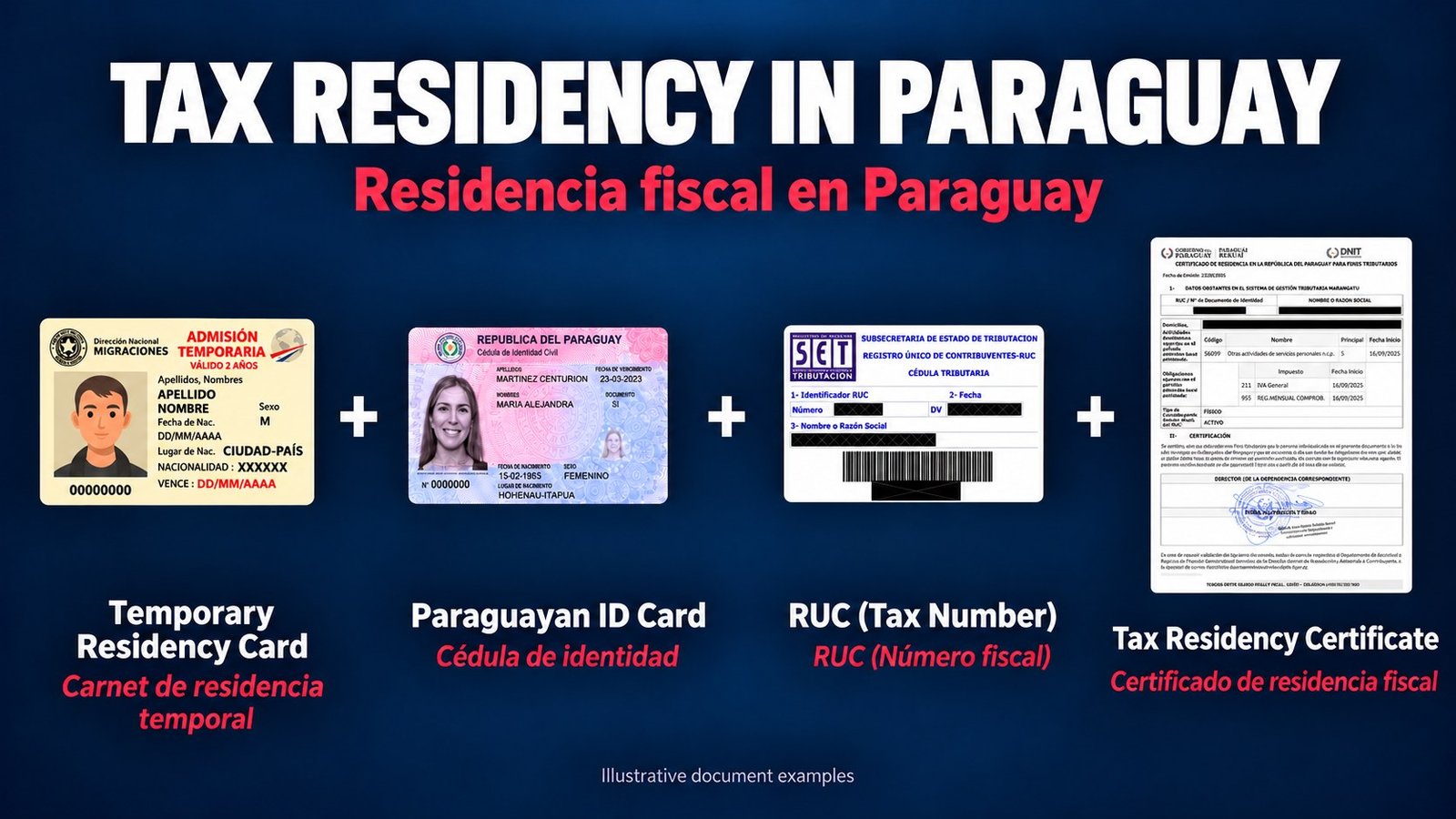
What is the main purpose of each document?
| Example | Document | Main purpose |
|---|---|---|
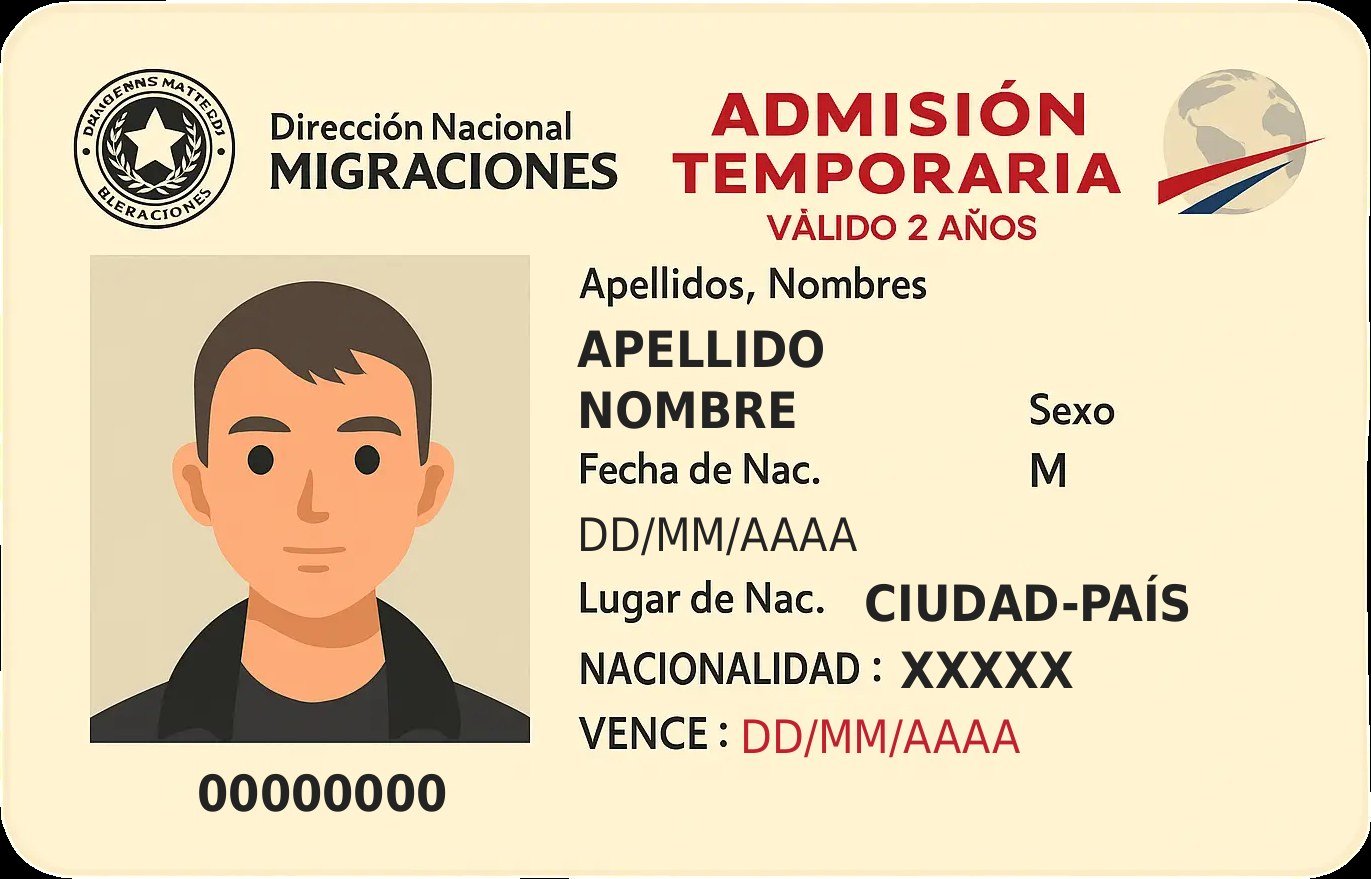 | Temporary resident cardCarnet de Admisión Temporaria | Gives you the right to reside in Paraguay for the authorised period, normally two years. It is a residence permit: it does not, by itself, establish your tax residency. Time to obtain the document: 3–4 months. This is the time the Paraguayan authorities need to produce and issue the temporary resident card after the application is submitted. |
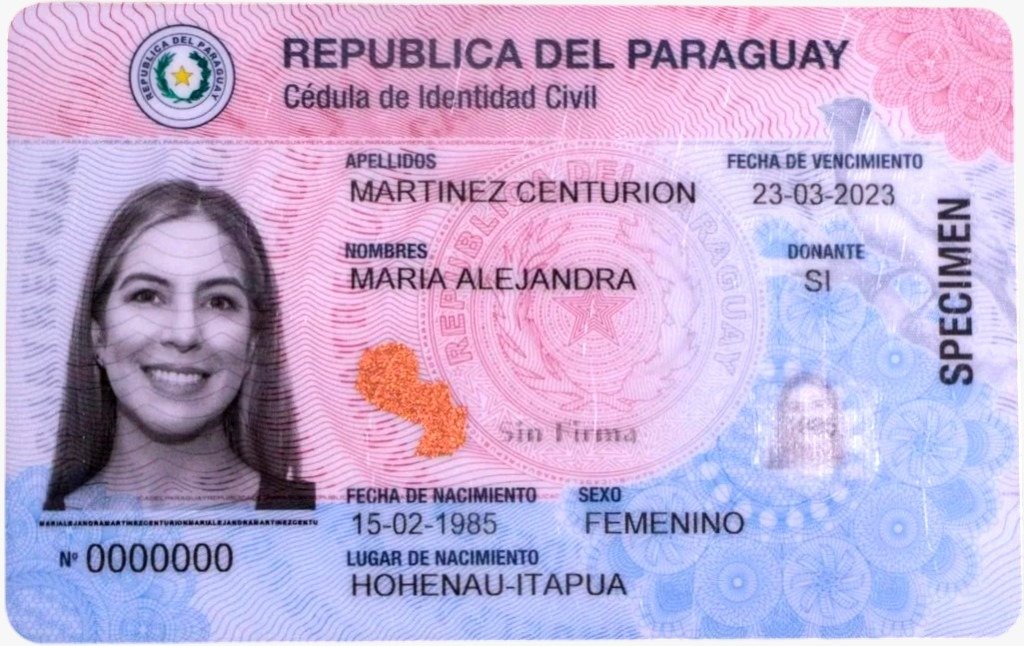 | Paraguayan CédulaCédula de Identidad Civil | Your Paraguayan ID Card and the key document for everyday administrative life. It proves your identity in Paraguay and is used to obtain your RUC and apply for bank accounts. It also supports travel within Mercosur where accepted under the rules applicable to your nationality and destination. Time to obtain the document: 1–8 months. This is the time the Paraguayan authorities need to produce and issue your Cédula after you submit the application. |
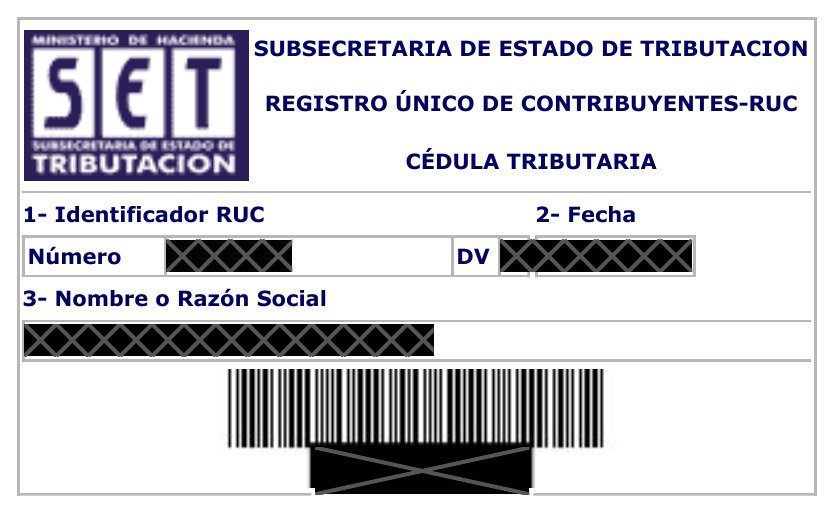 | RUC — tax numberRegistro Único de Contribuyentes | Officially registers you as a taxpayer with Paraguay’s tax administration. It gives you your tax identification number, enables you to file returns and pay the Paraguayan taxes applicable to your activity, and forms part of your tax-residency file. Time to obtain the document: 1–8 weeks to obtain your RUC tax number and the corresponding registration document. |
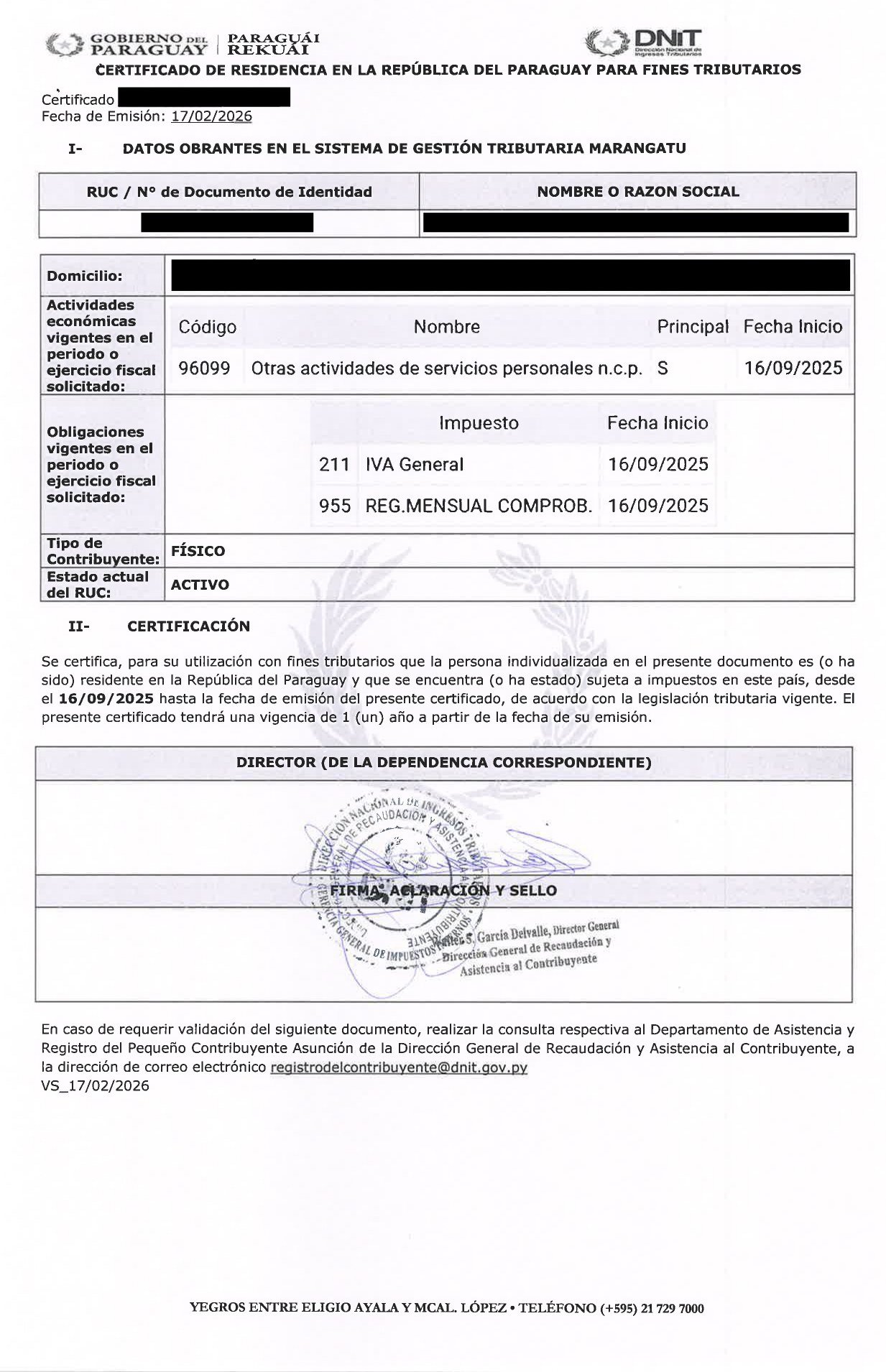 | Tax residency certificateCertificado de Residencia Fiscal | The DNIT document certifying your tax-residency situation for the period stated, for presentation to the relevant foreign administration or institution. Time to obtain the document: 2–4 weeks for the DNIT to issue your tax residency certificate. |
The Cédula is therefore the central identity document linking several stages of your application. Bank approval and travel-document acceptance have their own conditions. For foreign residents, a Paraguayan Cédula is not a universal replacement for a passport: check the official entry and exit requirements before travelling.
RUC registration formalises your taxpayer registration. The tax residency certificate provides the separate certification of tax residency; the number alone does not establish that you have ceased being resident for tax purposes elsewhere.
Start before you travel. Collect the right foreign documents, arrange their apostilles or legalisation, and check your residence history. Once in Paraguay, prepare the local certificates and translations, submit your residency file, complete your first Cédula application, register for the RUC and prepare your tax residency certificate request.
Step 1: collect your foreign documents before travelling
The first step begins in your country of origin or residence. You will need to collect the documents listed below and have the relevant public documents apostilled before travelling to Paraguay. Where the apostille procedure does not apply, arrange the required legalisation instead.
Start with your birth certificate, the criminal record corresponding to your residence history and, where applicable, your marriage certificate or divorce judgment. Below, you will find an example of each document, followed by the apostille images.
Do not confuse the country issuing a document with the country where you currently live. Your birth certificate comes from the authority holding your birth registration. Your marriage certificate comes from the authority that registered the marriage. The relevant criminal record depends on your residence history.
| Example | Document to prepare | Where to obtain it and how to prepare it |
|---|---|---|
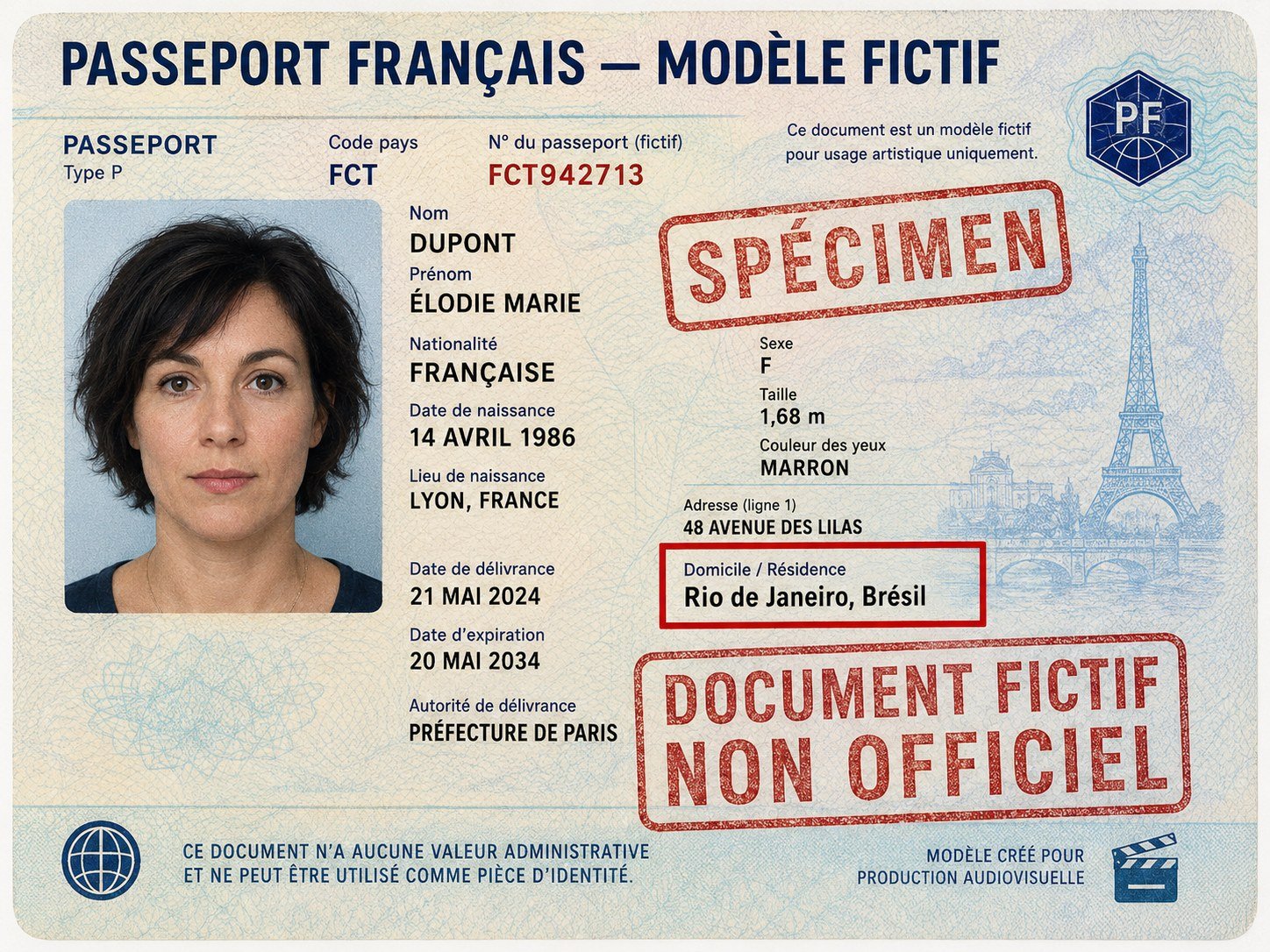 | Valid passport or qualifying national identity documentPasaporte / Documento de Identidad | Your country’s passport or identity authority. Check validity, spelling and consistency with your other records. Bring the original; local certified copies are prepared for the application. |
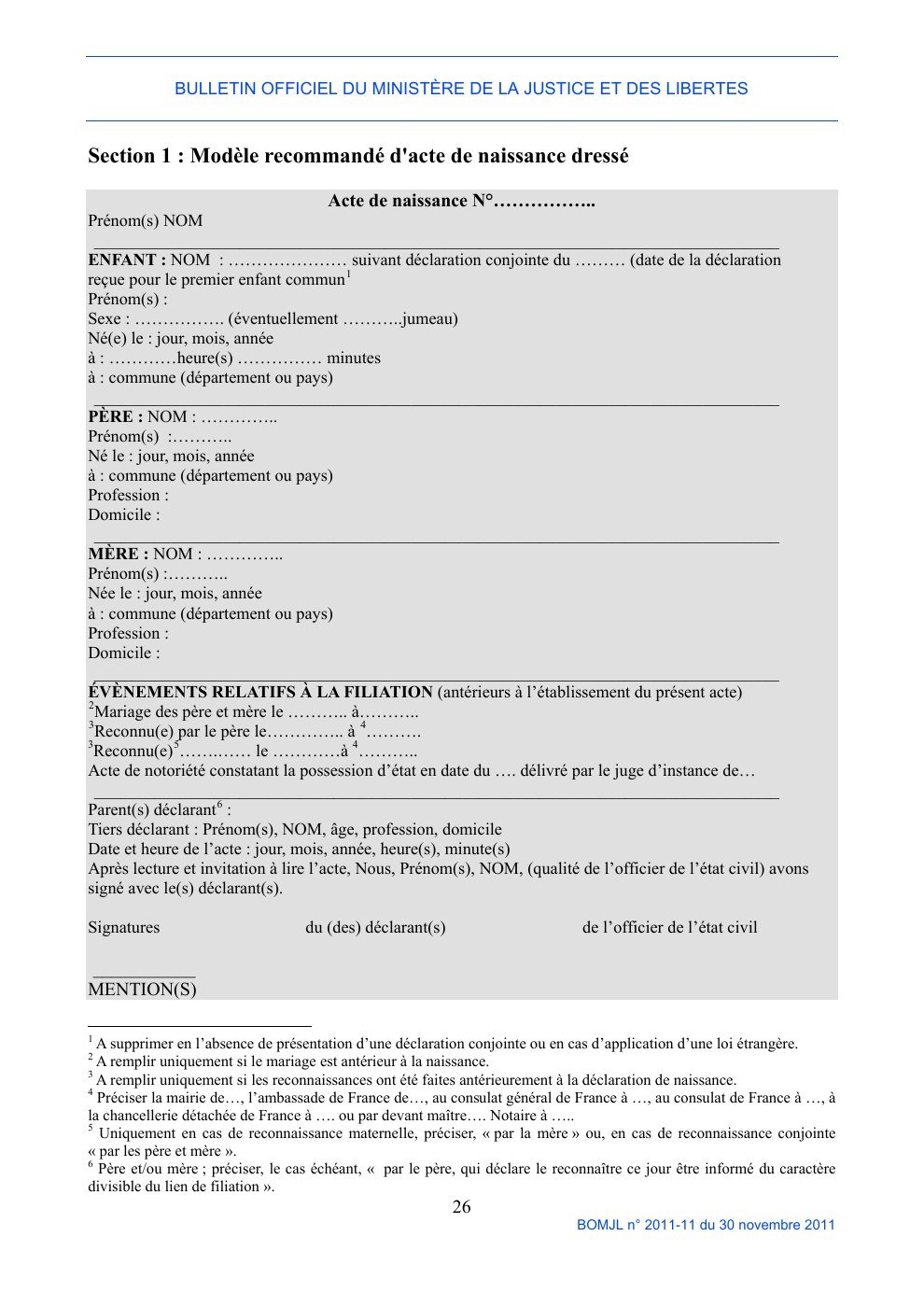 | Birth certificateCertificado de Nacimiento | The competent civil registry or issuing authority. Obtain the official document and its apostille or applicable legalisation. |
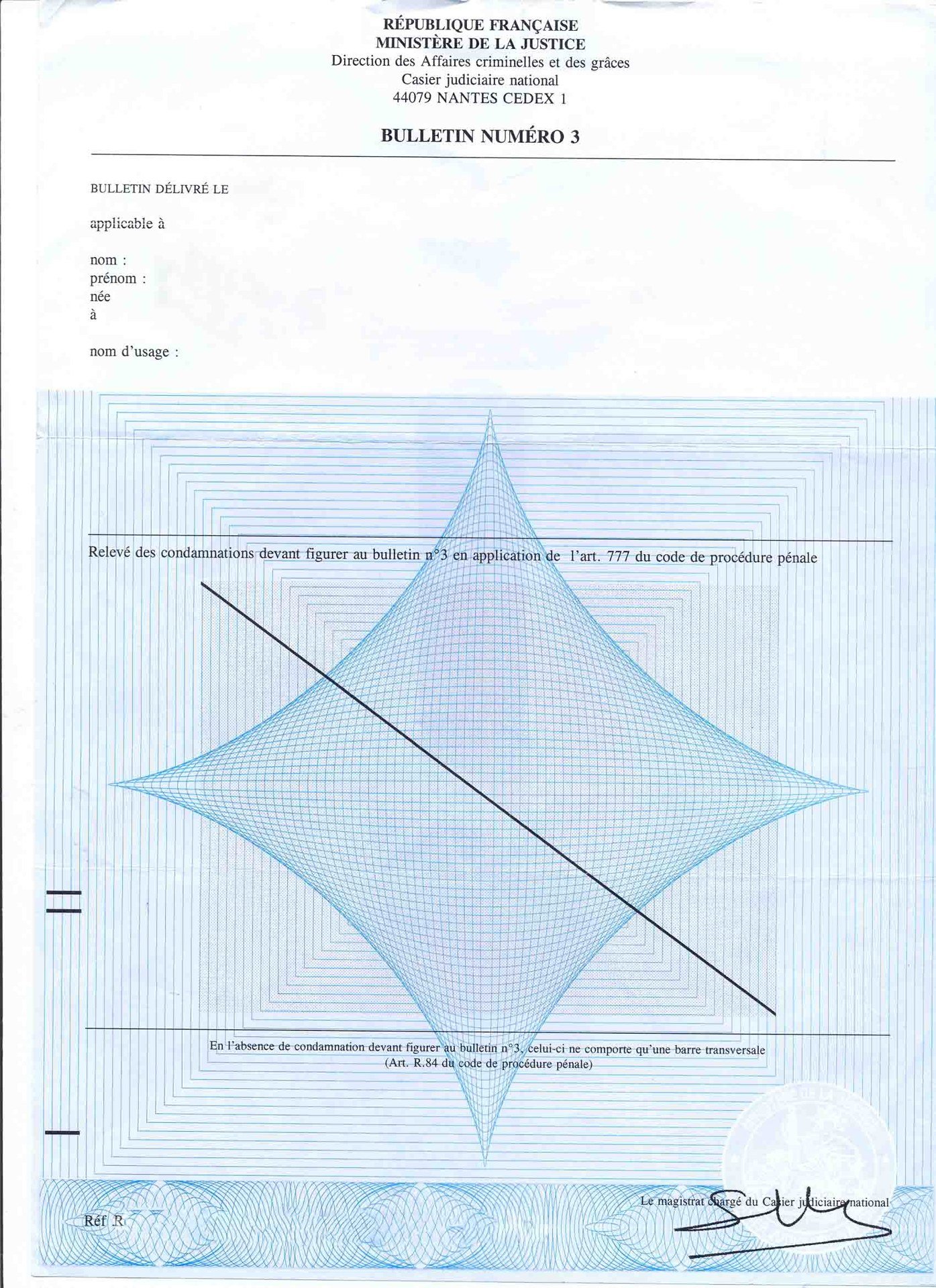 | Criminal or police recordCertificado de Antecedentes Penales o Policiales | The national or federal authority in the relevant country of origin or residence. Select the right country using your recent residence history, then arrange authentication. |
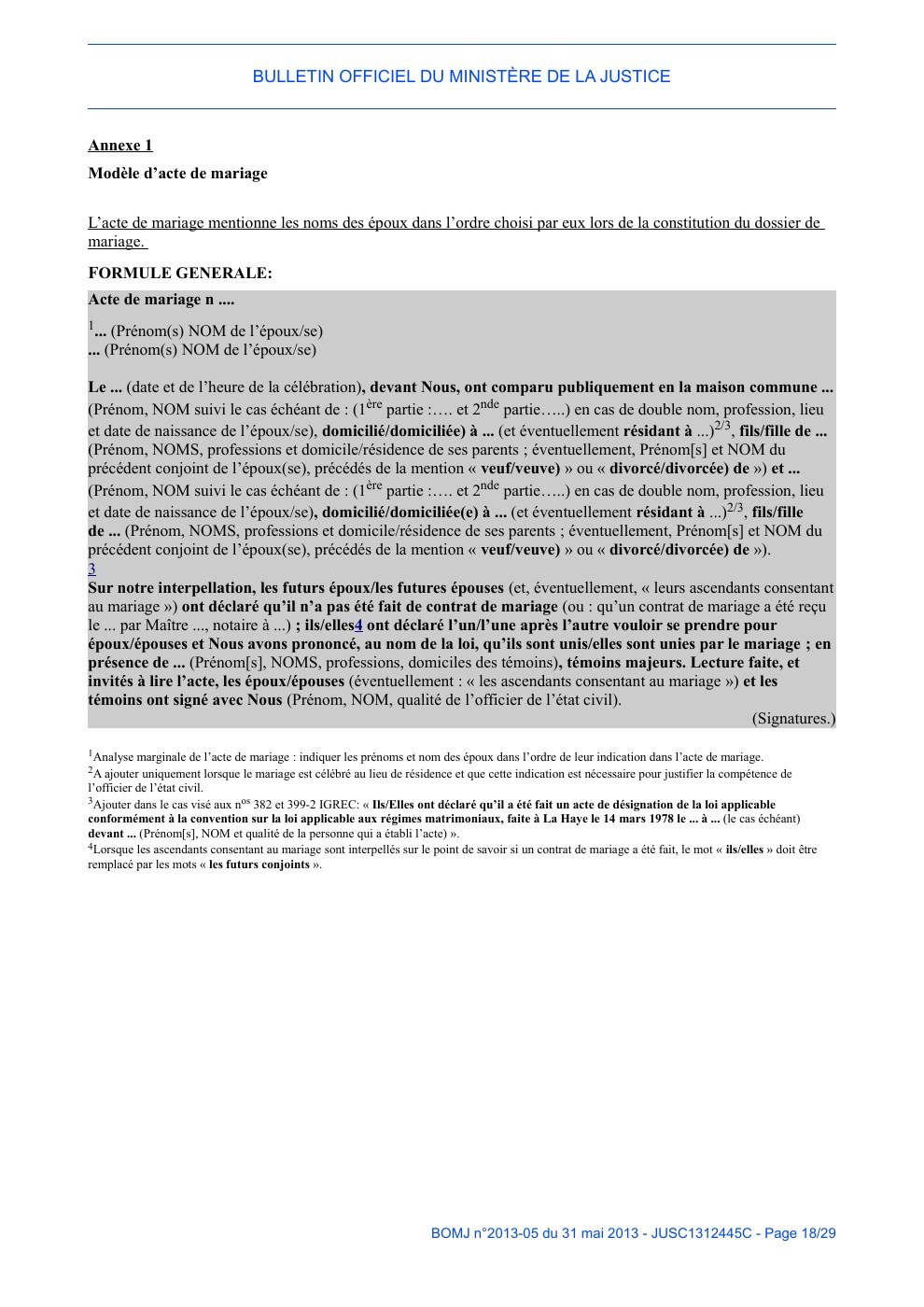 | Marriage certificate, when applicableCertificado de Matrimonio | The authority that registered your marriage. Obtain an apostilled or legalised document. |
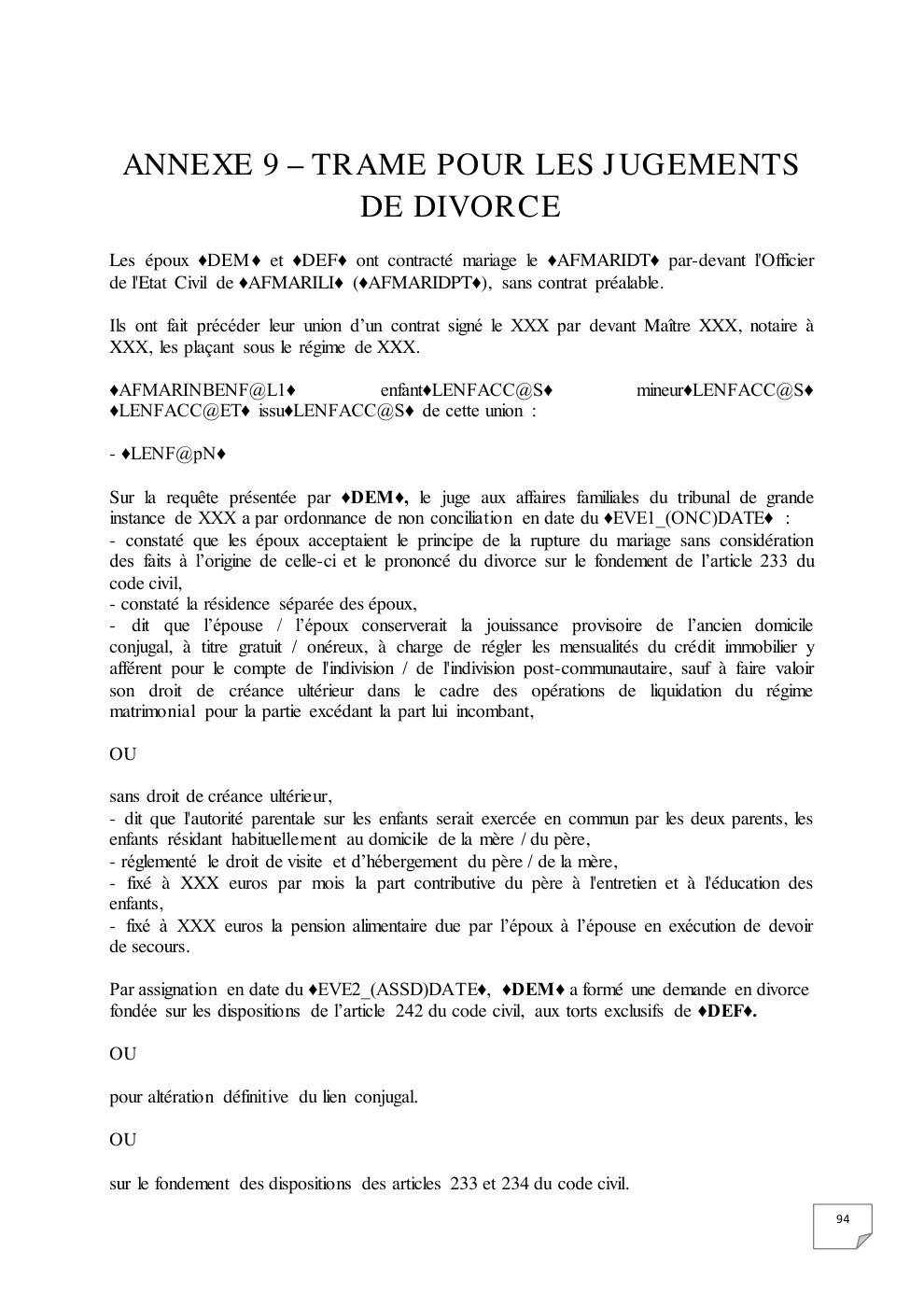 | Divorce judgment, when applicableSentencia de Divorcio | The court or competent authority that issued the judgment. Prepare the official judgment and its apostille or legalisation. |
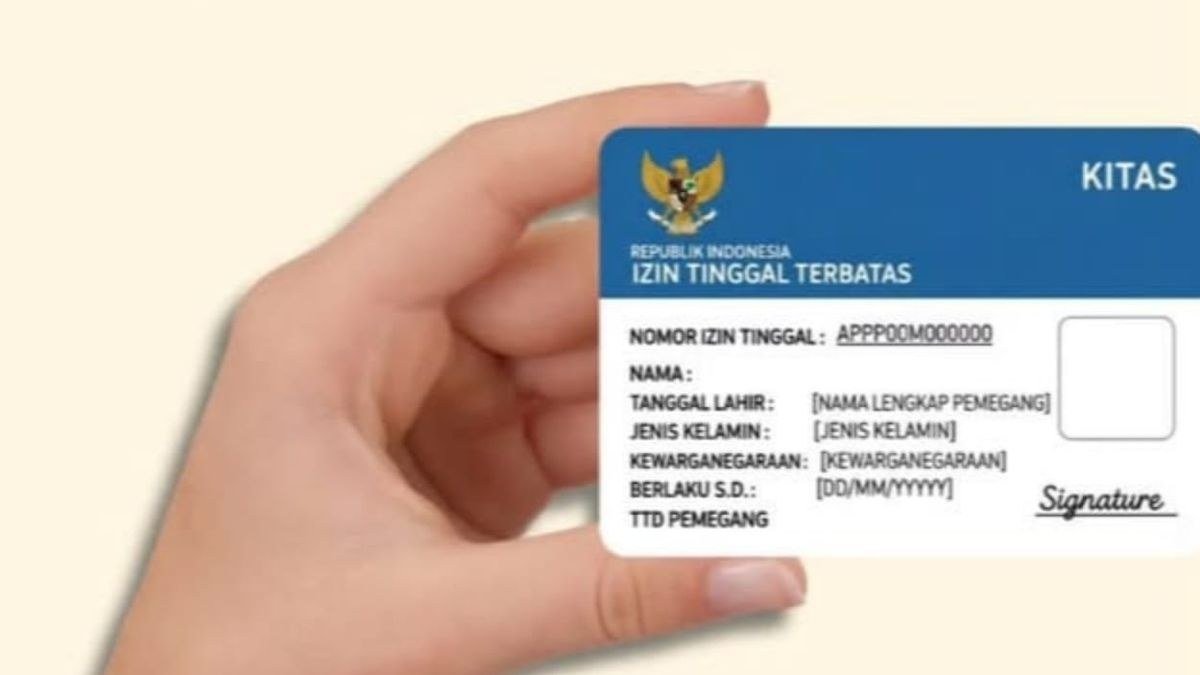 | Evidence of residence in another country, when applicableDocumento que acredite la residencia | The relevant immigration, registry or other competent authority. Prepare evidence supporting the country and period of residence declared in your file. |
Apostille or legalisation: what should you arrange?
An apostille is an international certification used to authenticate a public document for use abroad. More precisely, it certifies the authenticity of the signature, the capacity of the signatory and, where applicable, the seal or stamp. It does not certify that every statement in the document is true.
Obtain the apostille in the country that issued the document. In practice, that can be your country of origin or your country of residence: a French birth certificate is apostilled in France, while an Indonesian criminal record is apostilled through the competent Indonesian authority.
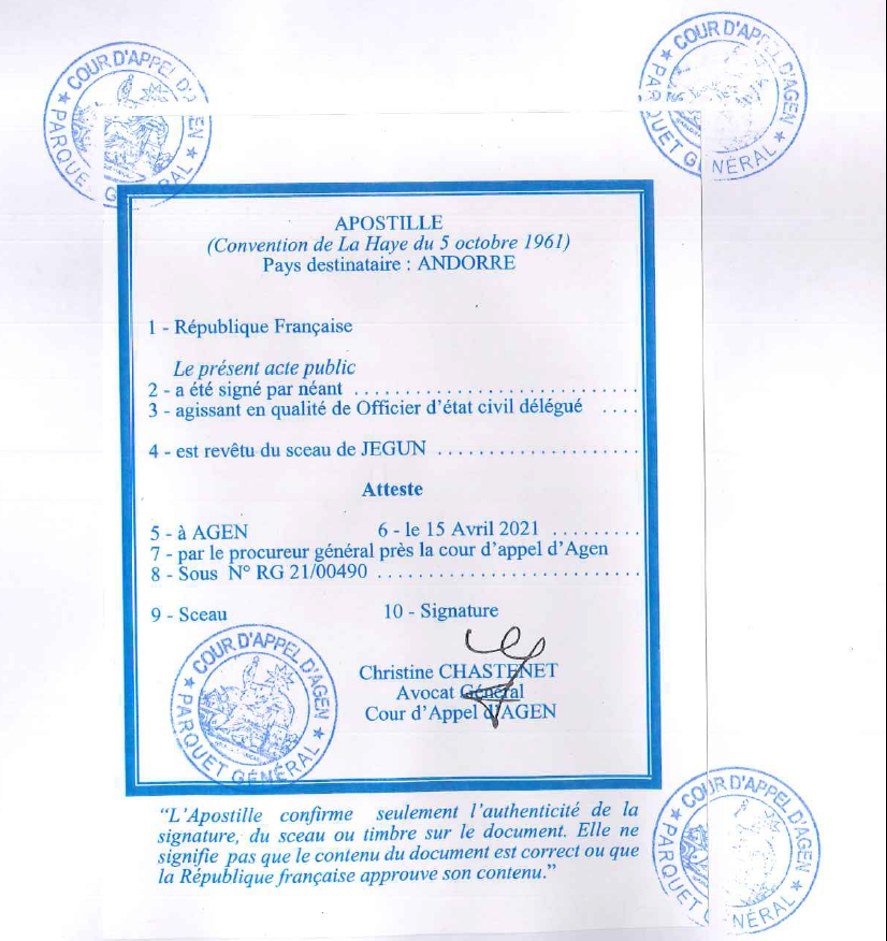
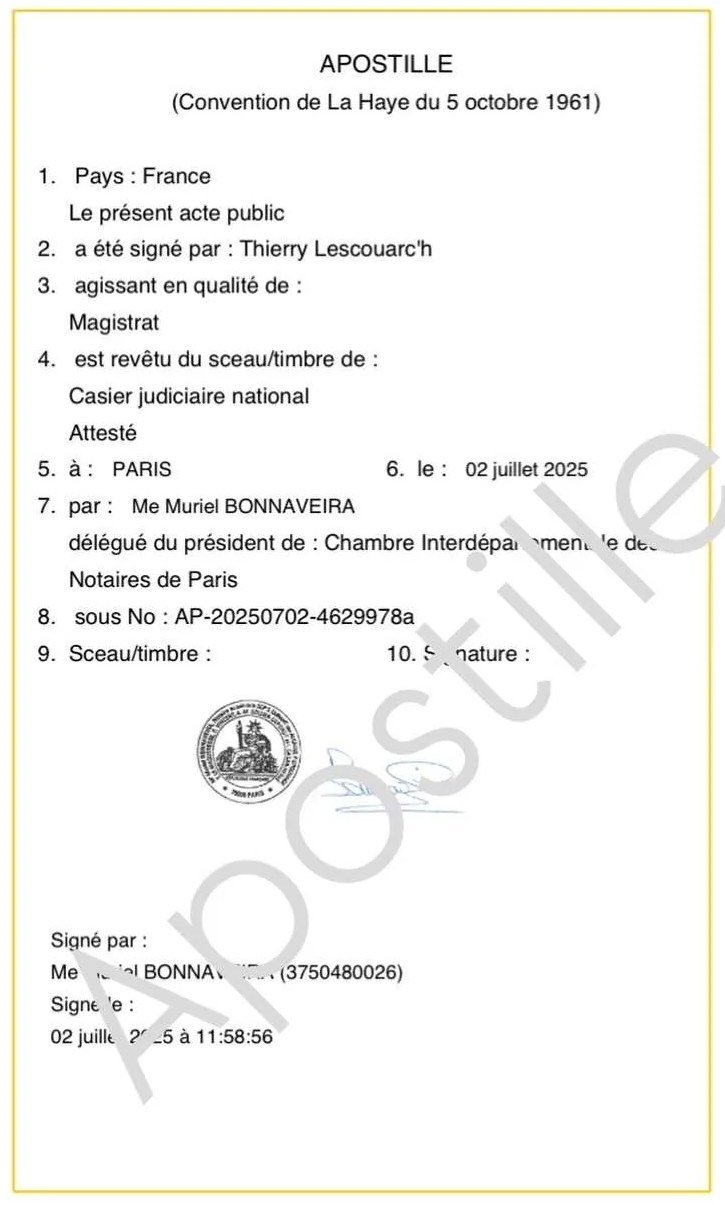
Without the required apostille, or the applicable legalisation alternative, the foreign documents concerned will not be accepted as properly authenticated for your residency or Cédula application. Have this completed before travelling so the application file is not held up by missing authentication.
Contact the government or designated apostille authority in the issuing country to find out how to apply, which documents it accepts and what format it issues. The procedure varies by country and document type.
If the applicable route is consular legalisation instead, follow the Paraguayan consular and Ministry of Foreign Affairs requirements. Do not pay for both routes automatically. The Paraguayan Ministry of Foreign Affairs explains the treatment of foreign apostilled documents.
Check the complete document, including all pages and the authentication. A missing page, inconsistent surname or unreadable apostille can create an avoidable observation later.
Check expiry dates before planning the trip
Our residence guide uses six months from issue as the planning window for the foreign criminal record. Count from the certificate’s issue date, not the apostille date, and verify acceptance for your exact document before travel. Obtaining a new apostille does not make an old criminal record newly issued.
Keep clear scans and the original documents together. You will need to distinguish originals, translations and notarised copies throughout the process.
Which criminal record certificate should you obtain?
Your nationality alone does not determine the answer. Before ordering the certificate, write down the countries where you lived during the last three years and the length of each stay.
| Your situation | What to prepare |
|---|---|
| You live in your country of origin. | The national or federal criminal/police record from that country, with the required authentication. |
| You lived in a different country for more than one year during the last three years. | The criminal record from that country of residence, together with evidence that you lived there. Arrange apostille or legalisation as applicable. |
| You have lived in Paraguay for more than three years. | Migraciones publishes a specific route involving a Paraguayan judicial record and a sworn declaration. Your length of residence must be supported by the relevant records. |
| You lived in several countries or your documents show conflicting addresses. | Have the complete timeline reviewed before requesting certificates. Establish which records and evidence are required for your circumstances. |
Two examples: a French citizen living in France or in Bali
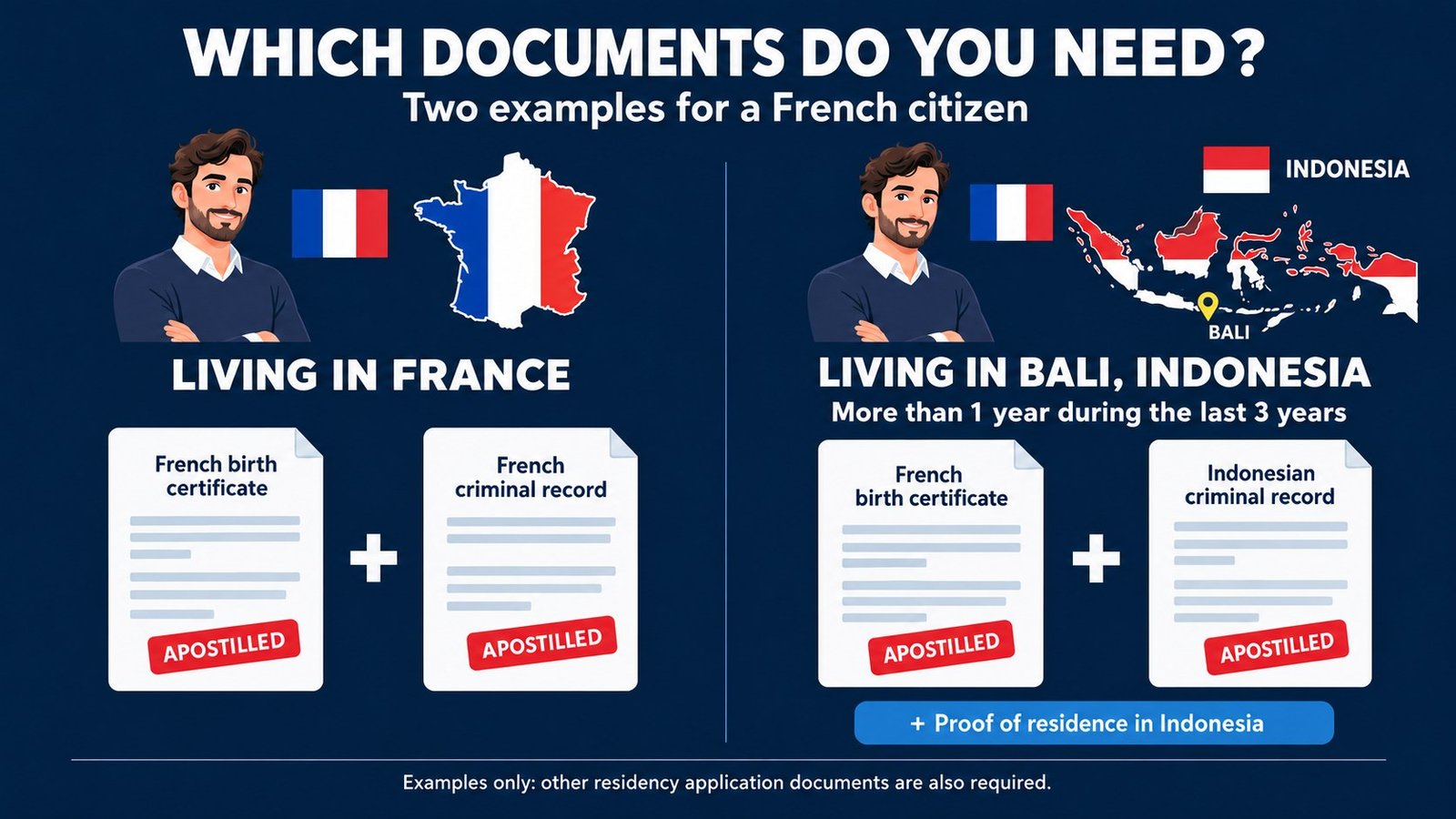
A French citizen living in France: prepare your French birth certificate and French criminal record, with their apostilles. Other documents, including civil-status records where applicable, remain part of the full application.
If you are French but have lived in Indonesia for two years, ordering only the French criminal record on the assumption that nationality decides the requirement can leave your file incomplete. Prepare the Indonesian record and evidence of residence for the relevant period, following the applicable authentication procedure.
Our guide also highlights residence information appearing in a passport. Check that information against your actual history. An outdated address should be explained and supported rather than ignored or treated as a substitute for the full residence timeline.
Additional cases on the Migraciones checklist
For Mexico, the published checklist requires both federal and state records in the cases it specifies. Criminal-record requirements generally start at age 14, with published exceptions for certain adolescents where the relevant country does not issue the document. Confirm any age-based exception before relying on it.
Check the official residence-history and criminal-record conditions.
Your documents are ready: fly to Asunción
Once you have collected the required documents and arranged their apostilles or legalisation, you can book your flight and come to Asunción, Paraguay. Check any visa requirements before booking, and bring your original documents together with their authentication and clear digital copies.
Once you arrive in Asunción, the local application process begins. You will now obtain the Paraguayan documents needed to complete your temporary residency file: proof of entry, the local background certificates, certified Spanish translations where required and notarised copies. The next section takes you through these steps in order.
Step 2: temporary residency, the complete process in Asunción
Residencia temporal · Carnet de Admisión Temporaria
The temporary resident card is your residence permit: it gives you the right to reside in Paraguay for the authorised period, normally two years. Its main purpose is immigration permission. It is not your ID Card or tax residency certificate. Once you arrive, complete the Paraguayan part of your file.
Your entry evidence, local background certificates, translations and notarised copies need to be ready before submission. Migraciones also generates declarations during the application process.
Time to obtain the document: 3–4 months. This is the time the Paraguayan authorities need to produce and issue the temporary resident card after the application is submitted.
Documents to prepare for your application
This practical checklist includes a visual example for every document. Select an example to enlarge it. The French models illustrate the document format; obtain the apostille separately. Check the official checklist applicable to your circumstances before submission.
Your foreign documents and entry evidence
| Example | Required document | Where and how to obtain it |
|---|---|---|
| Your home-country passport | Bring your valid passport issued by your home country, then prepare a notarised copy in Paraguay. |
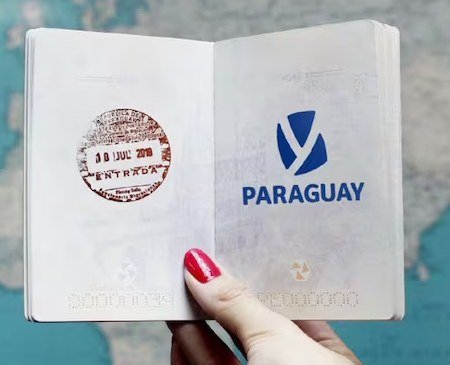 | Paraguay entry stamp | You receive it at the airport immigration checkpoint on arrival in Paraguay. Keep the stamped migration slip if that is how your entry is recorded. For a land arrival, retain the entry evidence issued at the border. |
| Apostilled birth certificate | Obtain your birth certificate from the competent civil registry, then have it apostilled in the issuing country, or legalised where applicable. Arrange a certified translation of the document and its authentication where required. |
| Apostilled criminal record certificate | Request the national or federal certificate corresponding to your residence history, following the distinctions explained above. It must be valid and apostilled or legalised, with a certified translation where required. This requirement applies from age 14. |
| Apostilled marriage certificate or divorce judgment, if applicable | Obtain the marriage certificate or divorce judgment from the issuing authority, then arrange the apostille or legalisation and any required certified translation. The example shows a marriage certificate. |
Paraguayan documents to obtain locally in Asunción
| Example | Required document | Where and how to obtain it |
|---|---|---|
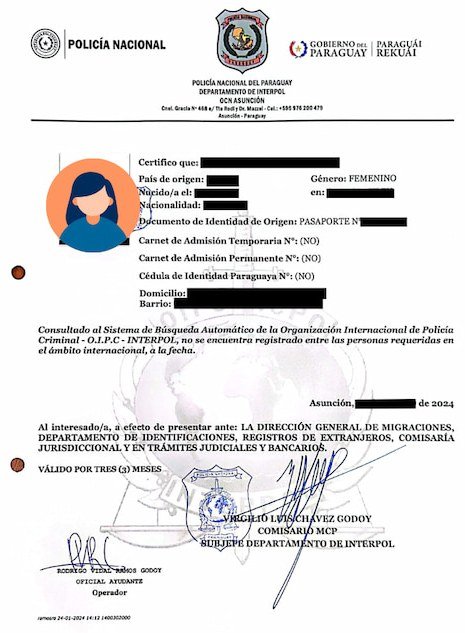 | Paraguayan Interpol certificate | Obtain it locally from the Paraguayan National Police Interpol department, from age 14. Prepare a notarised copy as well. Time to obtain the document: 1–10 days. |
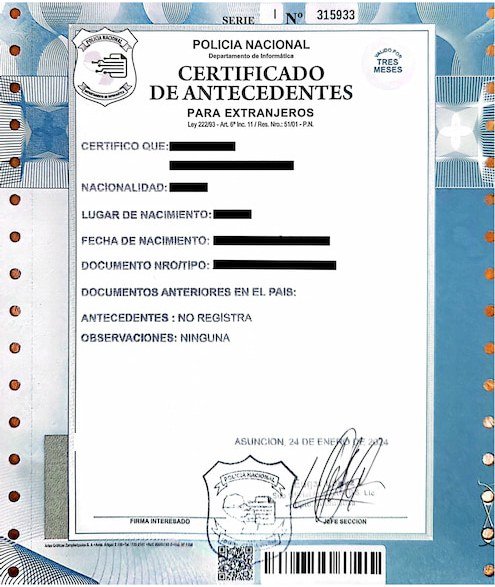 | Background certificate for foreigners | Obtain it from the National Police Departamento de Informática, from age 14. This is separate from the Interpol certificate. Time to obtain the document: 2 hours to 3 days. |
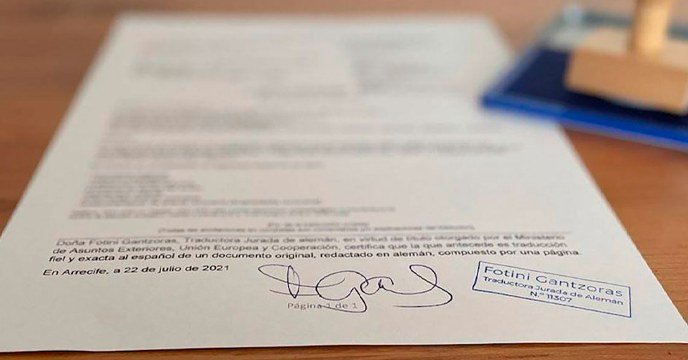 | Sworn Spanish translations | Have foreign documents translated where required by an authorised public translator. Include the apostille or legalisation in the translation. Portuguese documents benefit from the exception stated in the official checklist. Time to obtain the document: 1–5 days. |
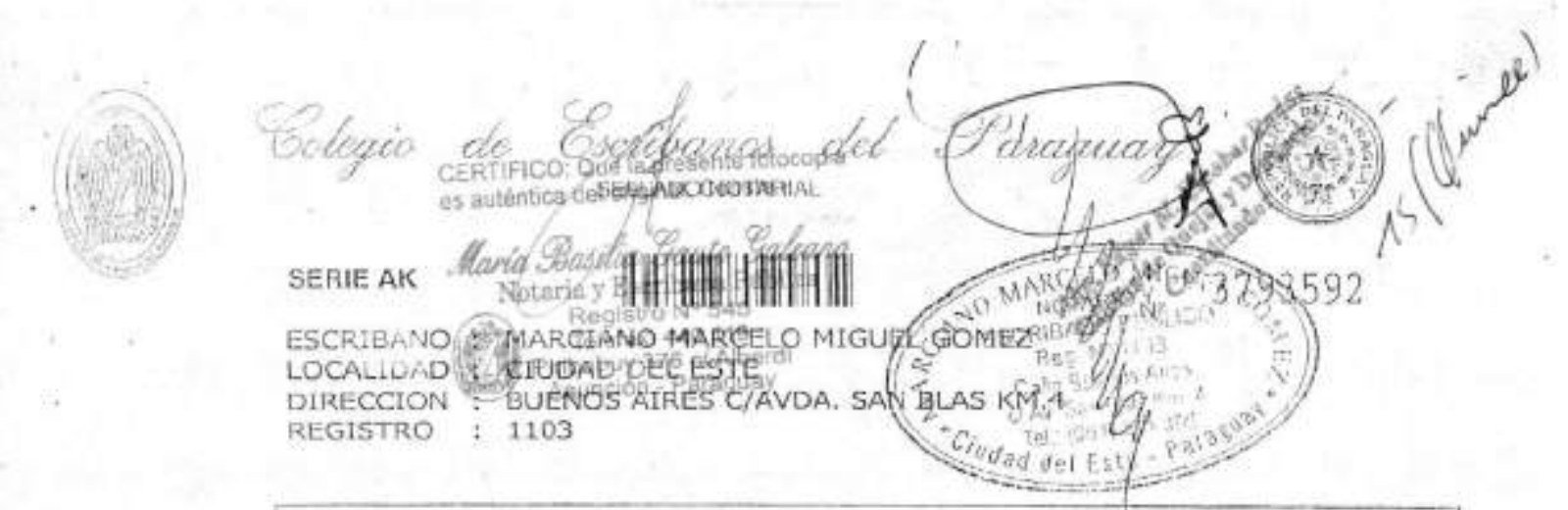 | Notarised copies of all application documents | Ask a Paraguayan notary (escribano) to authenticate copies of the documents required for your file: passport, entry evidence, foreign records, translations and local certificates. Bring both the originals and the copies to submission. |
 | White-background ID photographFoto tipo carnet · Fondo blanco | Prepare a recent front-facing photo with your face clearly visible against a plain white background. Confirm the quantity, format and submission arrangements with the office: the general Migraciones checklist does not separately list a printed photo to bring. |
In Paraguay: the local procedures in practice
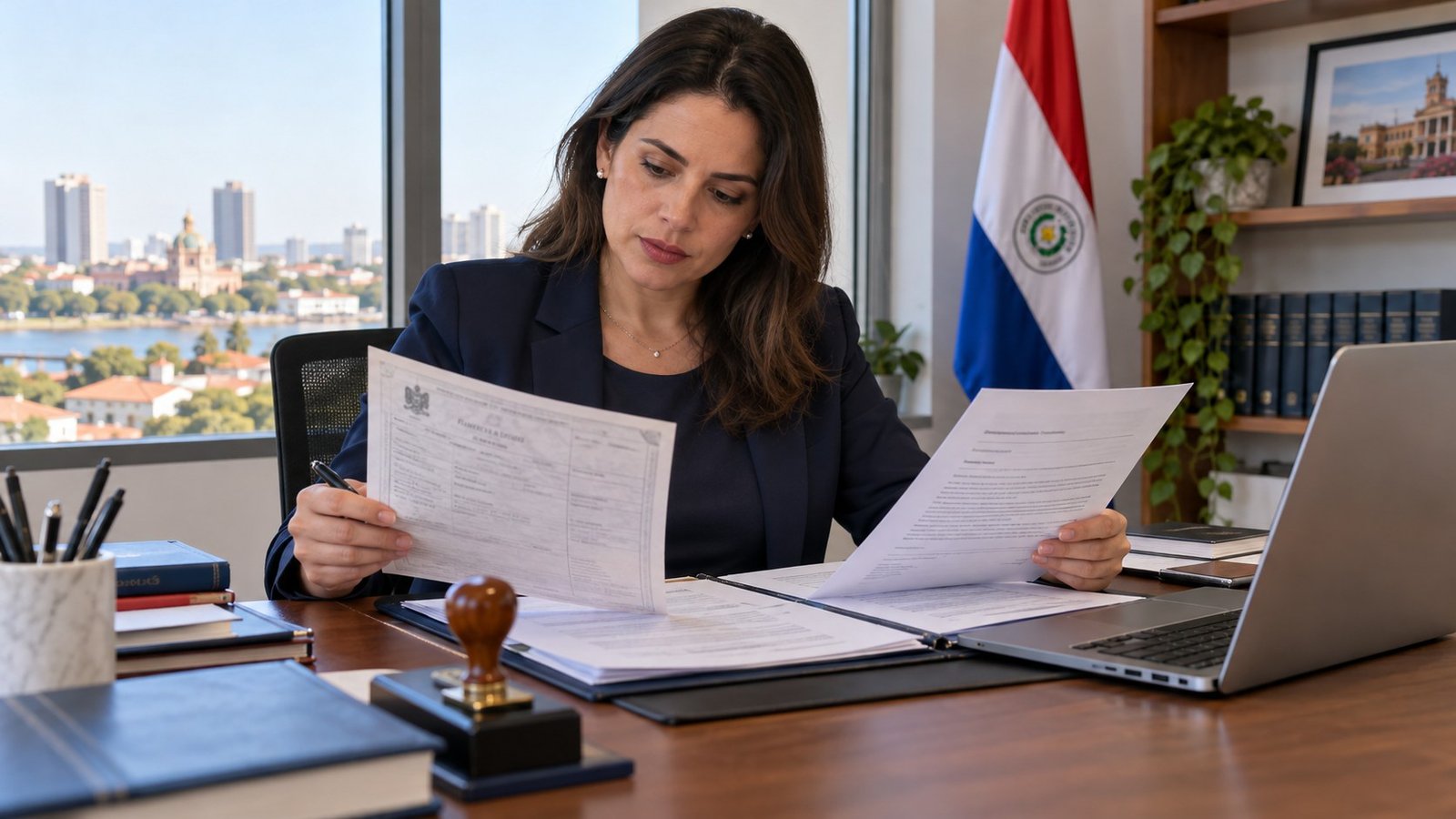
1. Find a sworn public translator in Paraguay
Time to obtain the document: 1–5 days
Traductor público matriculado · Traducción pública al español
For the pathway explained in this guide, have your sworn translations prepared in Paraguay only, by an authorised public translator. Choose a professional registered with Paraguay’s Supreme Court of Justice and qualified for your documents’ language.
Provide your foreign records together with their apostilles or legalisations: birth certificate, criminal record and, if applicable, marriage certificate or divorce judgment. Request a complete signed and stamped translation, then check that names, dates and numbers match the originals.
Documents already in Spanish do not need translating into Spanish. Migraciones also provides an exception for Portuguese documents issued by Brazil. Check professional registration information with the Paraguayan judiciary.
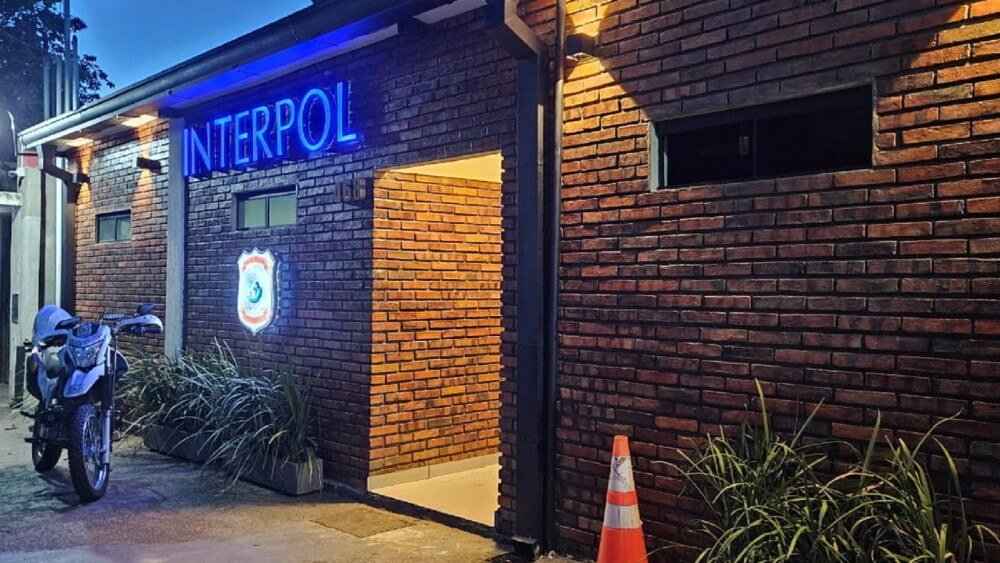
2. Obtain the Interpol certificate in Asunción
Time to obtain the document: 1–10 days
Certificado de Antecedentes de INTERPOL
Visit the Paraguayan National Police Interpol department in Asunción to request your local certificate. It is required from age 14 for the temporary residency application. It does not replace the apostilled criminal record obtained abroad.
Prepare your identity document and the documents required by the service before visiting. When collecting the certificate, check your identity details and its validity, then retain the original for notarised copies and submission.
Do not wait for an email or message notification: arrange follow-up and collection of the certificate with Interpol.
3. Collect the background certificate for foreigners
Time to obtain the document: 2 hours to 3 days
Certificado de Antecedentes para Extranjeros
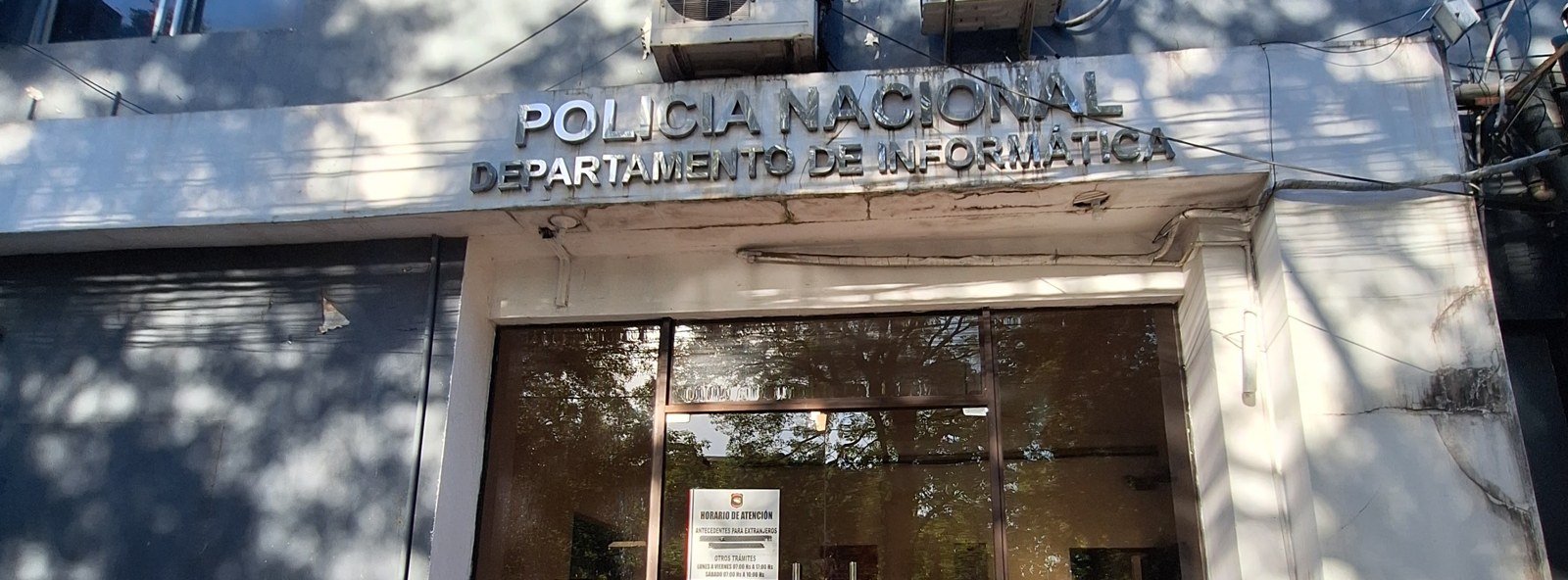
Request this certificate from the National Police Departamento de Informática, beside the Identificaciones area in Asunción. The department lists its address as R. I. 2 Ytororó near Boggiani. This is the police informatics office, separate from the Cédula application counter.
This local certificate is also required from age 14. It complements your Interpol certificate and foreign criminal record. The photographs below show the entrance and the blue certificate example to help you recognise them. Check the Departamento de Informática contact details before travelling.
4. Have copies of each document notarised
Time to obtain the document: confirm with the notary, depending on the number of documents
Copias autenticadas por Escribanía Pública
Once your documents, local certificates and translations are ready, visit a Paraguayan notary — an escribano — to authenticate copies of every document required for the application. Bring the originals: passport, entry evidence, foreign records with apostilles, translations and Paraguayan certificates.
Request a complete legible set and file each original alongside its notarised copy for submission to Migraciones. An ordinary photocopy is not an authenticated copy. Apostilles, translations and copy authentication each serve a different purpose.

The notary compares each copy with the original, then adds the certification, signature and stamp. The excerpt above shows what this certification can look like. Bring the original and its authenticated copy to submission.
Children and family applications
If children are applying, prepare a separate file for each child. Depending on who accompanies them, the application may require parental signatures, authenticated parental identity documents, the absent parent’s authorisation, a court decision or guardianship documents.
The current Migraciones checklist has separate situations for children accompanied by both parents, one parent or a third party. Foreign parental permissions and court documents also need the appropriate authentication. The adult’s residency application does not automatically constitute the child’s application.
Is your file complete? Go to Migraciones
Time to obtain the document: Temporary resident card: 3–4 months for production and issue after submission
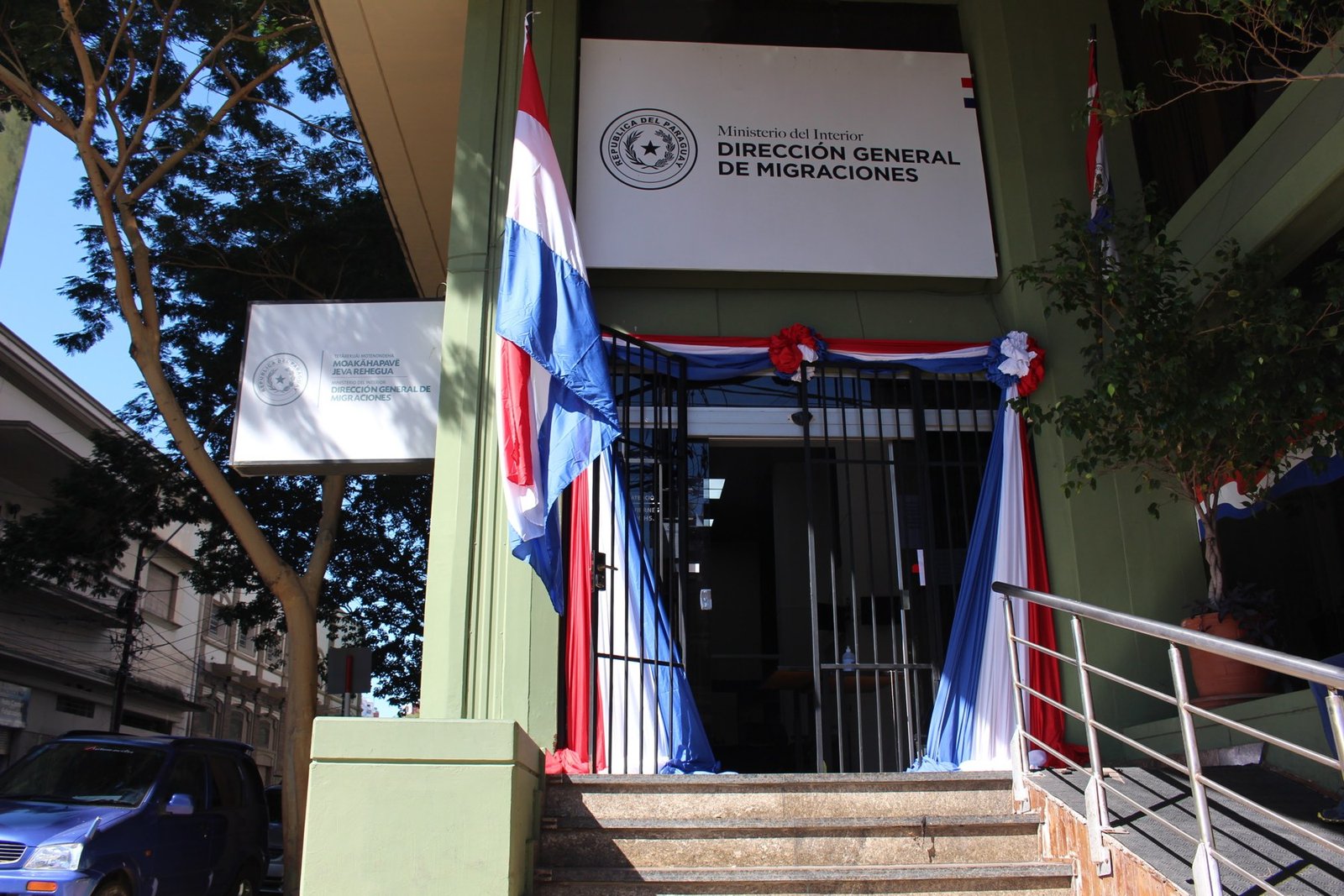
Once your file is complete, go to Migraciones in person with all your documents to submit your temporary residency application. Make one final check of the originals, apostilles, translations and notarised copies before leaving.
Your complete application file
Time to obtain the document: 1–10 days
Add the supporting documents applicable to your circumstances: residence history, civil status, children or representation. Compare your file with the official Migraciones checklist and confirm the submission office and arrangements before travelling.
Submit your temporary residency application
- Have the entire file checked before attending.
- Attend the personal, in-person submission with the required originals and copies.
- Check your recorded name, document number, contact details, activity and domicile.
- Complete the declarations and applicable payment.
- Keep your receipt and file reference.
- Follow up on observations until the decision and card are ready.
Our guide describes the option of authorising a representative for follow-up and collection through a notarised power of attorney. Arrange that before leaving if it is part of your plan. Receiving an application receipt is different from receiving the approved resident card.
Official temporary residency checklist · Our detailed temporary residency guide.
Step 3: apply for your first temporary Paraguayan Cédula
Time to obtain the document: 1–8 months. This is the time the Paraguayan authorities need to produce and issue your Cédula after you submit the application.
Cédula de Identidad Civil · Primera vez
The Cédula is your Paraguayan ID Card: the key document for proving your identity in Paraguay. You use it in everyday life and for many administrative and financial procedures.
Its main uses include:
- Opening bank accounts in Paraguay, subject to each bank’s eligibility criteria and supporting-document requirements.
- Obtaining your RUC, Paraguay’s tax identification number, and identifying yourself to the tax administration.
- Travelling to certain Mercosur countries, where the rules applicable to your nationality and destination accept this document. Foreign residents should also check passport, visa and residence-permit requirements before departure.
- Providing identification for KYC checks on banking platforms, cryptocurrency platforms and brokers that accept the Paraguayan Cédula. Acceptance and any additional supporting documents depend on the institution.
The Cédula and the resident card are different documents
Your temporary resident card is your immigration permit, issued by Migraciones. Your Cédula is your ID Card, issued by the National Police Departamento de Identificaciones.
You must therefore complete a separate procedure to obtain your Cédula: prepare its own application file, provide the required supporting documents and attend Identificaciones for identity checks, a photograph and fingerprints. Submitting a residency application does not automatically result in a Cédula being issued.
The following section explains the documents and procedures to prepare for your first application.
Documents to prepare for your first temporary Cédula
Organise your file in two parts: documents from your country of origin or residence, followed by Paraguayan documents. Each item below includes a visual example.
1. Documents from your country of origin or residence
| Example | Document to prepare | Where to obtain it and how to prepare it |
|---|---|---|
| Valid passportPasaporte | Your home-country passport. Bring the original and arrange a copy authenticated by a Paraguayan notary. |
| Apostilled birth certificateCertificado de Nacimiento | Obtain it from the competent civil registry. Provide the apostilled or legalised original, with a sworn Spanish translation where required. |
| Apostilled criminal record, from age 14Certificado de Antecedentes Penales | Obtain it from the national or federal authority in the country of origin or residence relevant to your history. The certificate must be valid, apostilled or legalised, and translated into Spanish where required. |
| Apostilled marriage certificate or divorce judgment, if applicableCertificado de Matrimonio / Sentencia de Divorcio | Obtain it from the civil registry or court that issued the document. For a foreign record, arrange the apostille or legalisation, any required sworn Spanish translation and a notarised copy. Use the records that apply to your circumstances. |
2. Paraguayan documents to obtain locally
| Example | Document to prepare | Where to obtain it and how to prepare it |
|---|---|---|
| Valid temporary resident cardCarnet de Admisión Temporaria | Issued by Migraciones. Prepare an authenticated copy of your temporary resident card and confirm the migration documents accepted for your first Cédula application. Time to obtain the document: 3–4 months. This is the time the Paraguayan authorities need to produce and issue the temporary resident card after the application is submitted. |
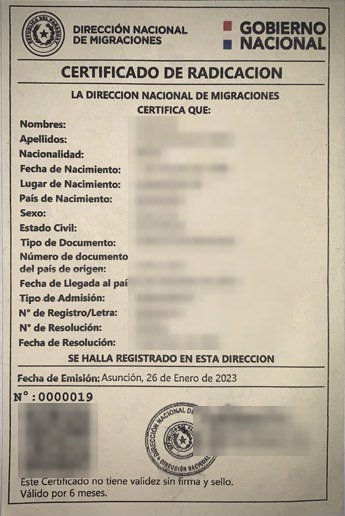 | Immigration residency certificateCertificado de Radicación | Issued by Migraciones. Prepare the original certificate applicable to your status; this is separate from the resident card. |
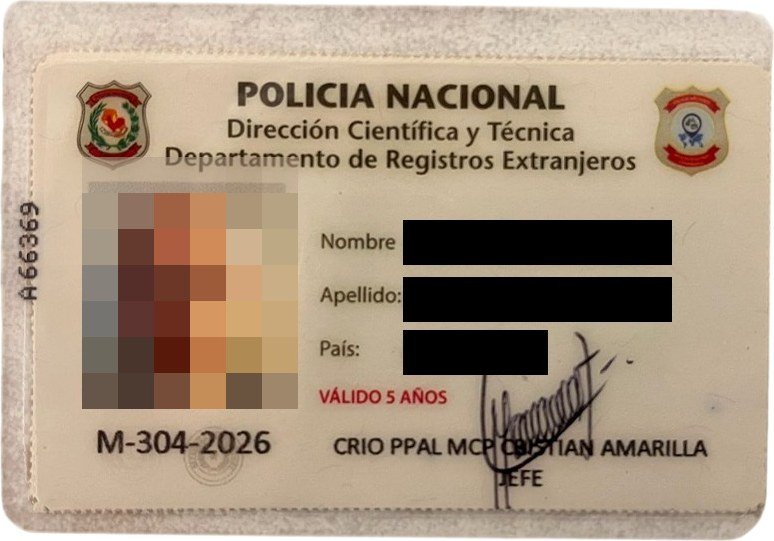 | Valid foreigners’ registration cardCarnet del Registro de Extranjeros | Obtain it from the National Police Departamento de Registro de Extranjeros, in the basement of Interpol in Asunción. Prepare a notarised copy of the valid card. Time to obtain the document: 2–5 days. |
| Interpol certificate, from age 14Certificado de Antecedentes de INTERPOL | Obtain it from the Paraguayan Interpol department. For the Cédula file, complete the prescribed Talento Humano authentication followed by National Police Comandancia legalisation. Time to obtain the document: 1–10 days. Validity: 3 months from issue. Check that the certificate is less than three months old when submitting your Cédula application. |
| Background certificate for foreigners, from age 14Certificado de Antecedentes para Extranjeros | Obtain it from the National Police Departamento de Informática in the Identificaciones area of Asunción. It is separate from the foreigners’ registration card and the Interpol certificate. Time to obtain the document: 2 hours to 3 days. Validity: 3 months from issue. Check that the certificate is less than three months old when submitting your Cédula application. |
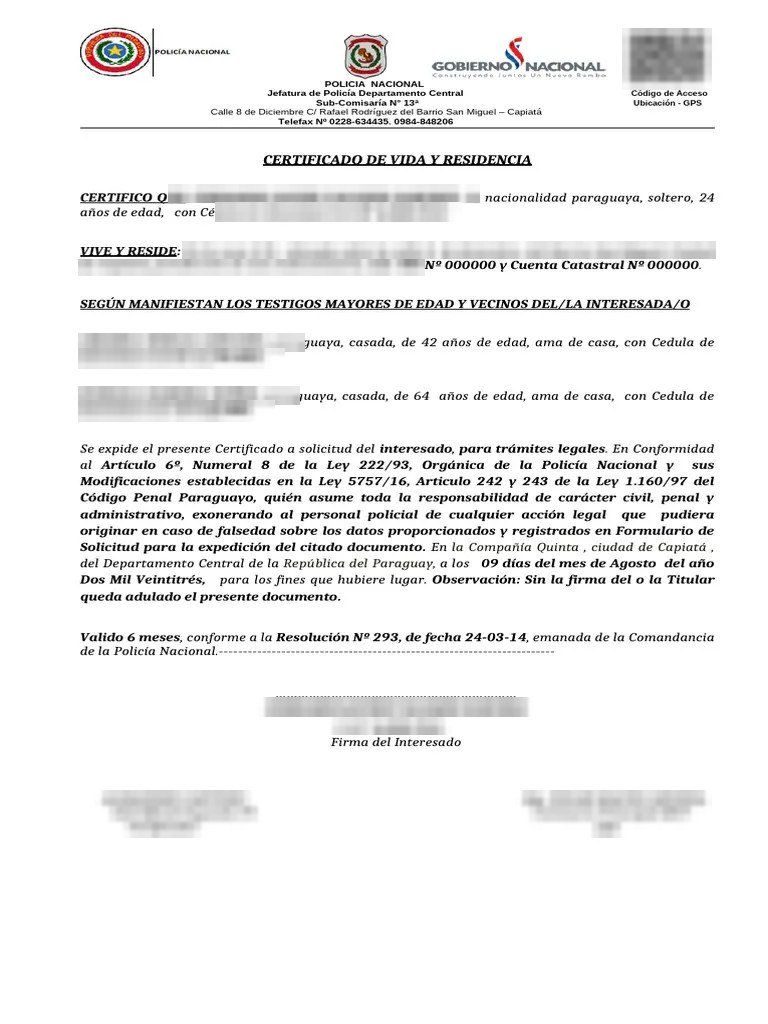 | Life and residence certificateCertificado de Vida y Residencia | Obtain it from your local police station or competent Juzgado de Paz. Complete the Talento Humano authentication and Comandancia legalisation required for the Cédula file. Time to obtain the document: 1–5 days. |
| White-background ID photographs for the Cédula processFoto tipo carnet · Fondo blanco | Prepare recent white-background photos for the supporting procedures. The 2023 SUACE sheet lists two colour photographs measuring 4 × 3 cm for the foreigners’ registration card; the Police sheet provides for an on-site photograph. Confirm whether printed photographs are needed. The photograph for the Cédula itself is taken on site at Identificaciones during the application. |
Keep the originals together with their notarised copies and add any required sworn translations. These images help identify the documents; the French models do not include the apostille, which must be obtained separately.
For applicants declaring a professional qualification, the Police also publishes an academic-title documentation item. Check its applicability and authentication before including a professional title in the file.
Your four-step process in Asunción
- Obtain the Paraguayan Interpol certificate.
- Obtain the background certificate for foreigners.
- Obtain the life and residence certificate, then authenticate and legalise the relevant certificates.
- Apply for the foreigners’ registration card.
This is the practical sequence followed here. Interpol and life/residence can be requested separately; both must be ready for the registration-card application.
1. Obtain the Paraguayan Interpol certificate
Time to obtain the document: 1–10 days
Certificado de Antecedentes de INTERPOL
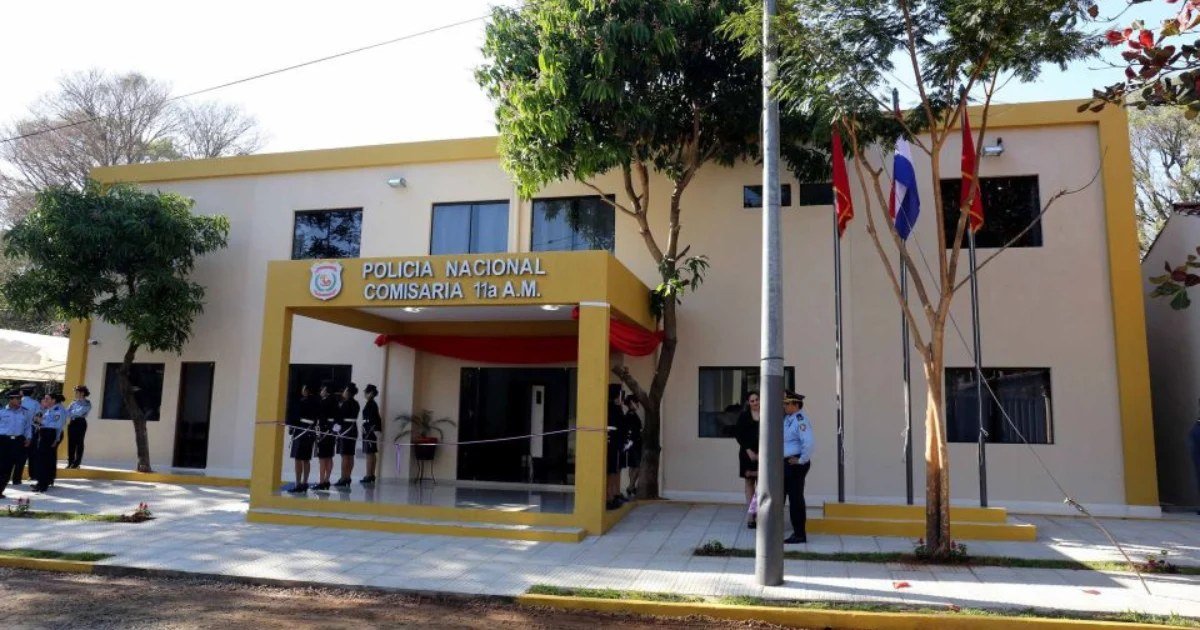
Where to go: Departamento de Interpol, Cnel. Gracia No. 468 near Tte. Rodi, Sajonia, Asunción. The official Identificaciones page lists Gracia and Tte. Rody.
Prepare:
- The Interpol application form.
- Your valid passport or home-country identity document and a copy authenticated by a Paraguayan notary.
- Two passport-style photographs, subject to the service’s arrangements.
- A copy of your Paraguayan Cédula and resident card if you have them.
These documents are described in the regulation published by the Police. The certificate is issued by Interpol in Paraguay. It must be less than three months old for the Cédula application. Do not wait for an email or message notification: arrange follow-up and collection with the service.
2. Obtain the background certificate for foreigners
Time to obtain the document: 2 hours to 3 days
Certificado de Antecedentes para Extranjeros
Where to go: National Police Departamento de Informática, R. I. 2 Ytororó near Boggiani, Asunción, in the Identificaciones area. Published telephone: +595 21 663 555. Official department contact details.
Prepare: your valid passport or home-country identity document and a copy authenticated by a Paraguayan notary. Request the certificate for foreigners.
This blue certificate is separate from the apostilled foreign criminal record and Interpol certificate. Check that it is less than three months old for your Cédula application.
3. Obtain the life and residence certificate
Time to obtain the document: 1–5 days
Go to the neighbourhood police station covering your actual address in Paraguay. Prepare:
- Your identity document and a photocopy. If you do not yet have a Cédula, confirm which foreign identity document to present with the station.
- Two Paraguayan witnesses living within the station’s jurisdiction. Each should attend with their valid Cédula ID Card and a photocopy of that card.
- Proof of your address in Paraguay: an ANDE electricity bill, an ESSAP water bill, a COPACO bill or your rental contract.
- The application form, supplied by the police station.
The general Police information sheet states a minimum of 24 working hours. Use the practical range above when planning your stay and confirm collection with the station.
The certificate for the Cédula application must be signed by the station’s chief or deputy chief. Identificaciones also lists a certificate issued by the competent Juzgado de Paz. Published Police requirements for adults.
Interpol is not listed as a prerequisite in those general requirements. The life and residence certificate and Interpol certificate are separate applications.
Before the registration card: authentication and legalisation
Time to obtain the document: confirm with Talento Humano and the Comandancia
Once you have the Interpol and life and residence certificates, prepare their originals and authenticated copies. For the first Cédula, the official Identificaciones checklist requires:
- Talento Humano: authentication of the certificates.
- Comandancia de la Policía Nacional: legalisation after that authentication.
These steps prepare the certificates for the Cédula file; they are separate from the initial issue of the documents. The 2023 SUACE information sheet also places them before the foreigners’ registration card. Reconfirm its older addresses and opening hours.
Locations published by Identificaciones: Talento Humano at India Juliana and Torreani Viera, followed by the National Police Comandancia at El Paraguayo Independiente and Chile, Asunción. Confirm opening and reception arrangements before visiting.
4. Apply for the foreigners’ registration card
Time to obtain the document: 2–5 days
Carnet del Registro de Extranjeros
Where to go: National Police Departamento de Registro de Extranjeros, Guillermo Arias near Tte. Rodi, beside Comisaría Primera, Sajonia, Asunción. The official first-Cédula checklist places the service in the basement of Interpol.
Prepare this application file:
- Your valid passport and an authenticated copy.
- Your temporary resident card and an authenticated copy.
- The Interpol certificate issued in Paraguay, with its authenticated copy and required endorsements.
- The life and residence certificate issued in Paraguay by the competent police station, with its authenticated copy and required endorsements.
- The application form, to complete on site at the counter.
Bring the originals with the copies. The official Registro checklist requires attendance for fingerprints, a photograph and a signature. In addition, the 2023 SUACE sheet lists two printed colour photographs measuring 4 × 3 cm: confirm this with the counter.
The 2–5 day range is Destination Paraguay’s practical estimate. A Police sheet published in 2022 states ten working days: confirm collection timing at submission.
Once issued, add the registration card and its notarised copy to your first-Cédula file, together with the other certificates, migration documents, foreign records and translations. Check the dates before attending Identificaciones.
Civil status and foreign translations
Use the civil-status documentation that fits your situation. A marriage registered in Paraguay, a marriage abroad, a Paraguayan divorce judgment and a foreign divorce judgment have different documentary treatment. Our guide’s general rule is to bring the foreign records and arrange the applicable Spanish translations and notarised copies.
The Police’s current observations also address qualifying foreign public translations subject to authentication. Have the complete set reviewed; acceptance of a document by Migraciones does not automatically resolve every requirement of the Cédula application.
Documents ready: apply for your Cédula at Identificaciones
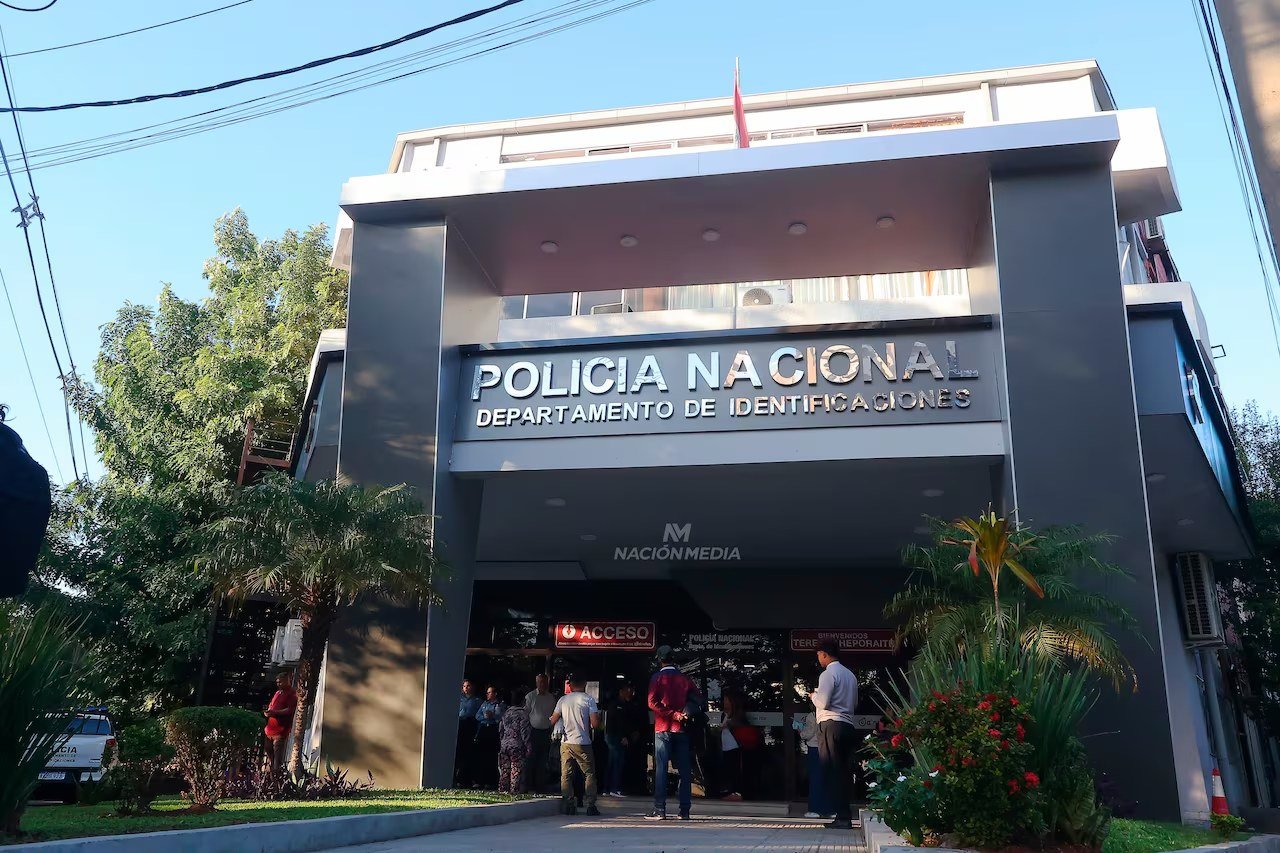
Once you have collected all your documents, go in person to the National Police Departamento de Identificaciones in Asunción to submit your Cédula application.
Denis Roa at the corner of Avenida Boggiani, Asunción, Paraguay.
Address and information on the official Police website
Reminder: the documents to bring for your Cédula
Bring the originals and the required authenticated copies. Assemble the following documents as applicable to your circumstances:
Final check: Interpol and the background certificate for foreigners must be less than three months old. Check the required apostilles, translations and legalisations before submitting.
Submit your Cédula application
- Confirm that the migration documents in your file are accepted for the temporary route.
- Complete the foreign, local Police, address and civil-status documentation.
- Check that the legalisations and notarised copies are present.
- Attend Identificaciones for the personal identity checks, photograph and fingerprints.
- Keep the application receipt and monitor any observations.
- Arrange collection under the applicable collection rules when the card is issued.
Your Cédula: production and issue
Time to obtain the document: Cédula: 1–8 months for production and issue after submission
After submitting, keep your receipt and follow the progress of your application. Submission is not the same as receiving the issued card.
If you plan to leave Paraguay before collection, verify who may collect the specific card and what authorisation is needed. Our guide discusses representative collection, but collection rules depend on the document issued.
Official Police checklist under Resolution 717/2026 · Our Cédula guide.
Step 4: obtain your Paraguay RUC tax number
Time to obtain the document: 1–8 weeks to obtain your RUC tax number and the corresponding registration document.
Registro Único de Contribuyentes
Once you have obtained your Cédula — and only once you have obtained it — you can move on to your RUC application.
The RUC is Paraguay’s tax identification number. It identifies you as a taxpayer with the DNIT, Paraguay’s tax administration.
For the resident pathway explained here, you need your valid Cédula for this application. Your resident card or Cédula application receipt does not replace it.
You use your RUC to file tax returns, pay applicable taxes and prepare your tax residency certificate application.
General Resolution No. 133/2023 links the RUC identifier of temporary or permanent resident individuals to their Cédula number.
Where do you obtain your RUC?
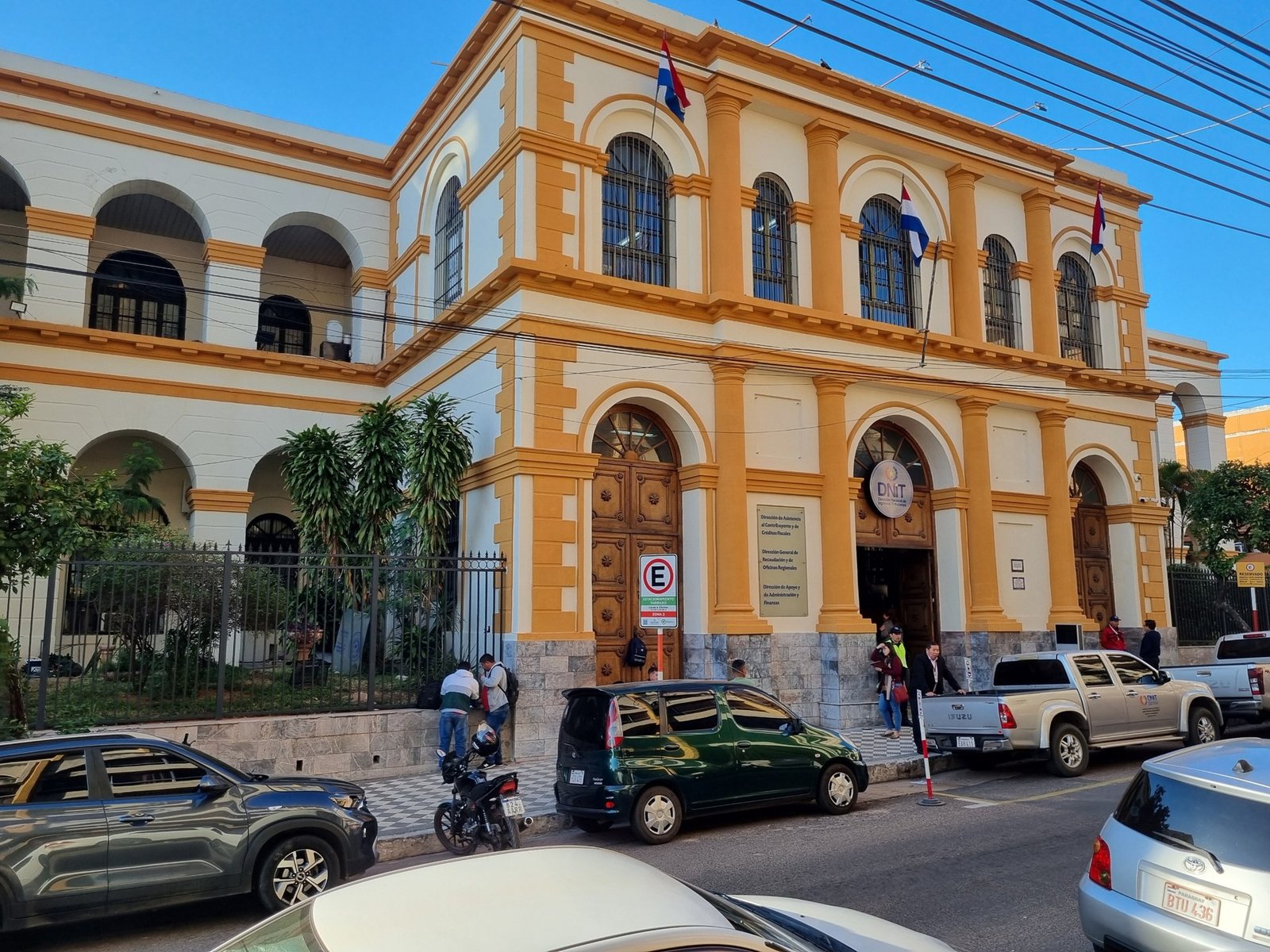
The RUC is issued by the DNIT. Prepare the registration application online in Marangatú and follow the case instructions if a verification or office visit is required.
Asunción contact point: Recaudación y Asistencia al Contribuyente, Yegros between Eligio Ayala and Mariscal López. Check the official DNIT contacts to confirm which office handles your application before travelling.
Prepare the registration information and supporting documents
- Your valid Paraguayan Cédula and clear scans of the required sides.
- The foreign identity and migration documents required for your registration category.
- The colour identity photograph requested in the procedure, showing your face with the identity document.
- Your actual Paraguayan tax address and the applicable supporting information.
- A working email address and telephone number.
- A truthful description of your activity and the data needed to select the appropriate tax obligations.
- Any authorisation or representation documents needed for your particular application.
These are the practical preparation points used in our guide. The exact upload list must follow the current DNIT registration category and amended rules, rather than an old checklist copied without checking its version.
Follow the RUC application through to approval
- Review the activity and registration category with the person handling your tax affairs.
- Access the DNIT’s RUC registration procedure and enter the requested information.
- Upload readable documents in the required format.
- Monitor the registered email address for observations and requests.
- Correct the file within the applicable time limit and follow any attendance or verification instruction.
- After approval, obtain the registration evidence and check your Marangatú access and recorded obligations.
Our guide describes an administrative appointment as part of the process. Follow the instructions issued for your actual application rather than assuming every file follows an identical sequence.
DNIT registration itself is free; professional fees cover assistance. Destination Paraguay also offers RUC assistance for clients who already hold a valid Paraguayan Cédula, including support organised remotely where applicable. Any required verification or attendance must still be addressed.
Explore our RUC service · DNIT registration-document reference.
Step 5: apply for your Paraguay tax residency certificate
Time to obtain the document: 2–4 weeks for the DNIT to issue your tax residency certificate.
Certificado de Residencia Fiscal
Once your file is ready, prepare the certificate request. This is the document used to evidence the tax situation certified by the DNIT for the period specified.
The certificate is distinct from the RUC registration. A tax number alone does not replace the supporting file or prove that another country has ceased treating you as tax resident.
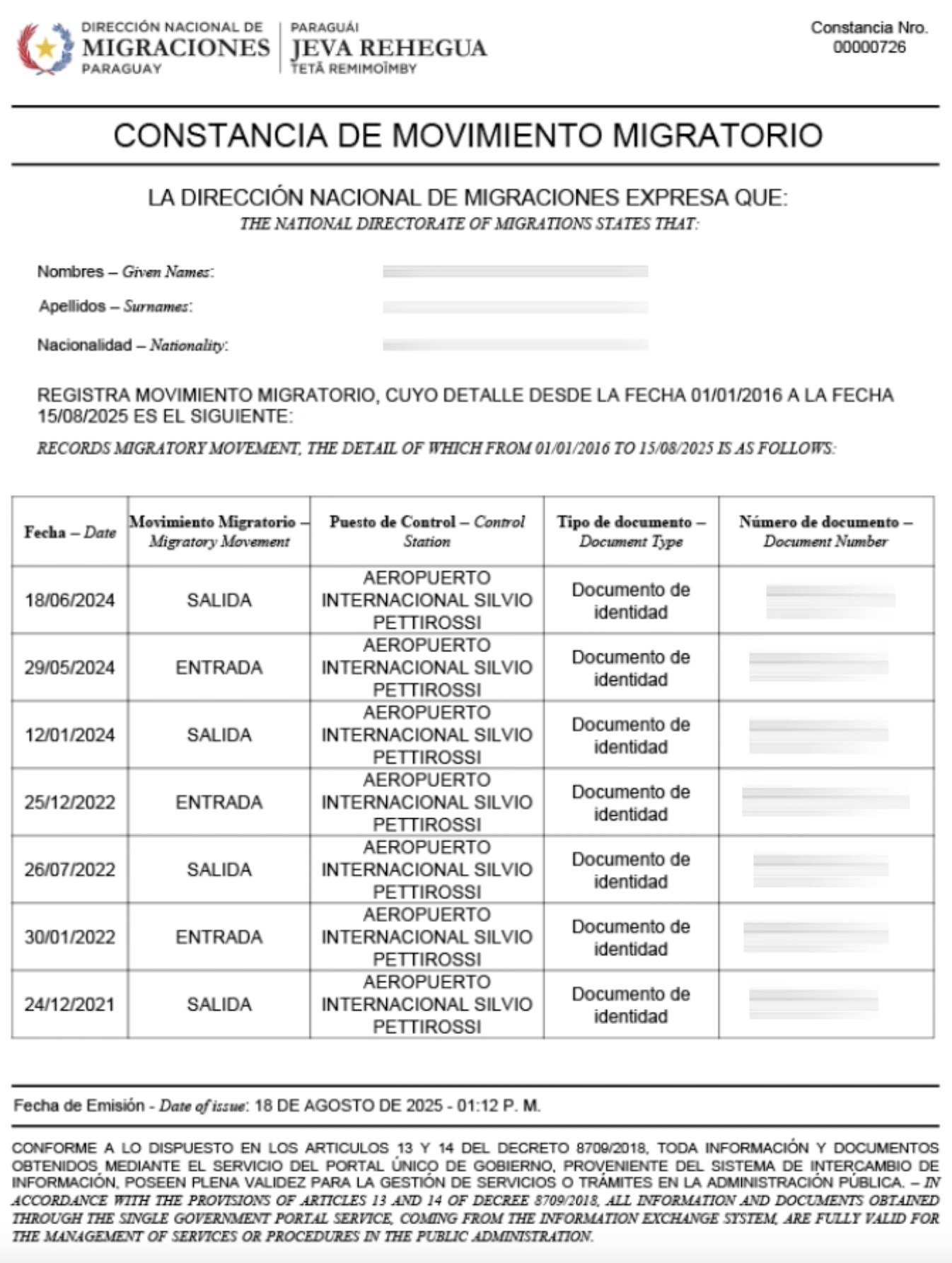
- Obtain your migration movement certificate from Migraciones.
- Once you receive it, prepare the file and apply to the DNIT for your tax residency certificate.
1. First obtain your migration movement certificate from Migraciones
Time to obtain the document: instant online according to the published procedure; 1–3 working days in person.
Constancia de Movimiento Migratorio
Request this document from Migraciones, not the DNIT. It records your registered entries into and exits from Paraguay. Select the period needed for your tax residency certificate.
Migraciones central office, Secretaría General, Caballero No. 201 at the corner of Eligio Ayala.
Official requirements and contact details
For an in-person application, prepare the signed request and your travel document, with authenticated copies of the identity pages and entry/exit stamps. If you used more than one travel document, prepare copies of all of them. Additional documents apply when using a representative.
Migraciones also offers an online application. Check the dates and movements when you receive the record. It is separate from the Certificado de Radicación used for your Cédula.
2. Once the record arrives, apply to the DNIT for your tax certificate
Time to obtain the document: 2–4 weeks.
Once you have obtained your migration movement certificate, you can submit your tax residency certificate application to the DNIT. Present the form and supporting documents at the authorised counter, following the submission arrangements currently in force.
Asunción contact point: Recaudación y Asistencia al Contribuyente, Yegros between Eligio Ayala and Mariscal López. Check the official DNIT contacts to confirm which office handles your application before travelling.
Official tax-certificate form and procedure.
Conditions and documents to prepare
For the taxpayer pathway described in this guide:
- Have an active RUC and up-to-date registration details.
- Be up to date with applicable tax obligations. Have your accountant check your position before submission.
- Provide a copy of your valid Cédula, or the legal representative’s valid identity document where applicable.
- Attach the Constancia de Movimiento Migratorio issued by Migraciones for the period or tax year to be certified.
- Complete the tax residency certificate application form.
- Include the relevant authorisations and representation documents if someone applies on your behalf.
Article 3 of General Resolution 65/2020 includes “Tener RUC” and “Estar al día en el cumplimiento de sus obligaciones tributarias”. It also distinguishes non-taxpayers; this guide follows the route for someone registered in the RUC.
Submit the application and follow its progress
- Check that the migration record covers the requested period.
- Review your Cédula, RUC and tax compliance with your accountant.
- Submit the signed form and supporting documents to the DNIT through the indicated channel.
- Keep the application reference and monitor DNIT messages.
- Respond to any requests for additional information.
- When issued, check your identity details, the certified period and issue date.
Allow a practical indicative period of 2–4 weeks for the document to be issued. The certificate is valid for one year from issue under Resolution 65/2020.
After obtaining the documents: keep the file consistent
Your documents should tell the same story: identity, residency status, address, activity and tax registration. Keep originals, digital copies, receipts and correspondence organised by application.
Follow the obligations actually registered in Marangatú. If IVA reporting applies to your registration, organise the required monthly returns, including periods without activity where a return is due. Agree who handles submissions and messages so a missed email does not become an unresolved observation.
Changes of activity, address or contact information should also be handled through the appropriate procedure. A file prepared correctly on the first day still needs attention when your circumstances change.
What about the 183-day rule?
General Resolution 65/2020 does not insert an annual 183-day threshold into its certificate-application checklist. That specific point must be kept separate from the law determining your status, migration absence rules and the tax-residency rules of any other country involved.
Your migration status remains a separate matter, and any departure from your previous tax system needs its own analysis. The Paraguayan certificate does not automatically complete that foreign process.
Read our article on the Paraguay 183-day question · Arrange accounting support in Paraguay.
Paraguay tax residency: frequently asked questions
Do I need permanent residency before starting this process?
This article follows the temporary residency route presented in our guide: temporary resident card, first temporary Cédula, RUC and the certificate request. Permanent-residency applications are outside this walkthrough.
Can I start with my passport and apply for everything remotely?
The standard temporary residency application requires personal attendance. Some follow-up or representation can be organised separately. RUC assistance for a client who already has a Cédula is a different service from obtaining residency and identity documents from scratch.
Do I need both the Interpol certificate and the foreign criminal record?
They are distinct documents in the preparation described here. The foreign criminal record concerns the relevant origin or residence country, while the Paraguayan Interpol certificate is obtained locally. The foreigners’ background certificate is a further separate item.
Can the same certified copies be reused for every application?
Prepare the number of originals and certified copies required by each office. Some documents are retained or must be submitted in their original form. Keep a separate checklist for residency, Cédula, RUC and the certificate.
How long does the whole process take?
Our guide gives practical ranges for the individual stages, but they are not guaranteed government deadlines. Your total depends on document preparation, issuance, observations and the ability to progress to the next stage. Obtain a current estimate for your file before planning around a completion date.
Does the certificate automatically make all my income tax-free?
No. Income must be classified under the applicable tax rules. Your income source, activity and obligations need to be considered independently of the certificate application.
Prepare your Paraguay tax residency file with our local team
Tell us where you have lived during the last three years, your nationality, your civil status and which Paraguayan documents you already hold. Our team in Asunción can help organise the required documents and explain the next steps for your circumstances.
Explore our residency assistanceSources and preparation notes
Prepared from the Destination Paraguay residence guide supplied for this article, especially its document explanations and application sequence. Official references were checked on 25 October 2026. Operational advice from the guide is distinguished from the wording of administrative requirements.
- Migraciones: temporary residency requirements and observations.
- Ministry of Foreign Affairs: apostille and legalisation.
- National Police: first Cédula applications under Resolution 717/2026.
- DNIT: RUC registration-document reference.
- Tax administration: amended foreign-registration rules, Resolution 133/2023.
- DNIT: tax residency certificate procedure.